Kauai Museum spotlights rare Hawaiian feathered capes and royal heritage
A Kaumuali‘i feathered cape at the Kaua‘i Museum lets families see royal Hawaiian history, craftsmanship, and alii power without leaving the island.
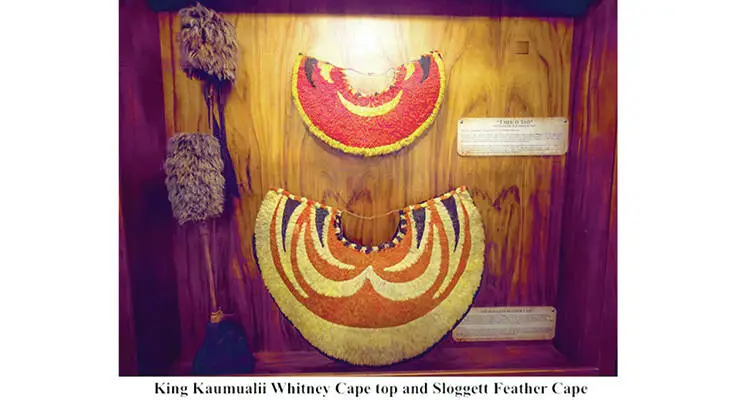
A feathered cloak worn by Kaumuali‘i now gives Kaua‘i residents a rare way to see Hawaiian royal history up close at the Kaua‘i Museum. The display connects the island to a garment class once reserved for alii, and it does so on Kaua‘i itself. For families, students, and anyone tracing the island’s past, the cloak turns kingdom-era history into something visible and immediate.
Why the cloak matters on Kauai
The Kaua‘i Museum unveiled the cloak and helmet display in 2018, placing a named piece of royal regalia in front of local viewers rather than leaving it buried in an archive or distant collection. Executive Director Chucky Boy Chock has described the replica as one of his favorite items in the museum’s collection, which fits the role it plays for the island: it is both an artwork and a direct link to Kaumuali‘i, the last ruling chief of Kaua‘i and Ni‘ihau.
That matters in a county where museums are part of everyday civic life, not just tourism. The display gives residents a concrete way to connect with Hawaiian heritage through an object tied to sovereignty, genealogy, and leadership on Kaua‘i. It also makes the island’s royal past legible to younger viewers who may know the name Kaumuali‘i but have never seen how his authority was represented in material form.
What an ahuula meant in old Hawaii
Ahuula were ceremonial capes and cloaks worn by high-ranking Hawaiian chiefs. They were symbols of rank and sacred status, not fashion items in the modern sense, and their presence marked the wearer as someone with authority. In old Hawaii, these garments helped communicate leadership and sovereignty in the Hawaiian Kingdom and earlier eras.
The rarity of surviving examples says as much about Hawaiian history as the objects themselves. These capes were made for the highest ranks in society and were often handled as treasured ceremonial items rather than everyday clothing. Their survival makes them unusually powerful teaching tools because one object can reveal status, governance, ritual, and the social order that shaped the islands.
How the featherwork was made
The craftsmanship behind an ahuula was exacting. Hawaiian feather cloaks were made by sewing feathers onto an olona fiber netting base, a process that demanded careful material selection, enormous labor, and technical knowledge passed down through generations. Each finished cloak represents both artistry and the resources needed to gather and organize thousands of feathers.
Rick San Nicolas has replicated several ahuula, including Kaumuali‘i’s feather cape on display at the Kauai Museum. That work helps local visitors see how the objects were assembled and why they carried such authority. A British Museum object description notes feathers of iiwi, ōo, and mamo in a Hawaiian cloak, a reminder that the visual richness of these pieces came from native birds whose feathers were woven into dense, ceremonial designs.
From Kealakekua Bay to global museums
The history of Hawaiian feather cloaks reaches beyond Kauai and even beyond Hawai‘i. In January 1778, King Kalani‘opu‘u gave Captain James Cook a feather cape at Kealakekua Bay. The Australian Museum describes that cloak as a ceremonial garment of a prominent chief and says it is about a meter and a half wide and almost a meter long.
That international record shows why Hawaiian feather cloaks continue to attract museum attention far from the islands. The Pitt Rivers Museum in Oxford, England, is presenting a 2024 to 2026 exhibition titled “Stories around a Feather Cloak,” which reflects ongoing interpretation of these objects in global collections. The same material that once marked chiefly authority in Hawai‘i now serves as a focal point for conversations about contact history, museum practice, and the movement of cultural objects across oceans.
What Kauai families and students can learn in person
Seeing Kaumuali‘i’s cloak at the Kaua‘i Museum gives families and students an entry point into Hawaiian history that does not depend on a textbook alone. The object makes the relationship between ali‘i power and craftsmanship concrete: feathers, netting, rank, ceremony, and identity all come together in one display. For young learners especially, that kind of direct viewing can be more memorable than a lecture about the Hawaiian Kingdom.
The display also reinforces the museum’s role as a place where history, identity, and language are kept alive. In a county where cultural tourism and community identity overlap, the cloak gives residents a reason to revisit the museum and learn more about Kaua‘i’s royal past. Scholarly research also frames ahuula as biocultural artifacts, meaning they can be read as records of ecological loss and changing relationships with native birds as well as symbols of sovereignty. That makes the Kaua‘i Museum’s display more than a look at fine work: it is a local window into power, preservation, and the living meaning of Hawaiian heritage.
This article was produced by Prism’s automated news system from verified source data, official records, and press releases, then run through automated quality and moderation checks before publishing. The system is built and supervised by the people who set the standards it runs under. Read our full AI policy.
Did this article answer your question?