Kauai's Menehune Fishpond stands as ancient Hawaiian aquaculture landmark
Alekoko Fishpond is still a living Kauai landmark, where wall repairs, mangrove removal, and land stewardship shape food resilience near Līhue.
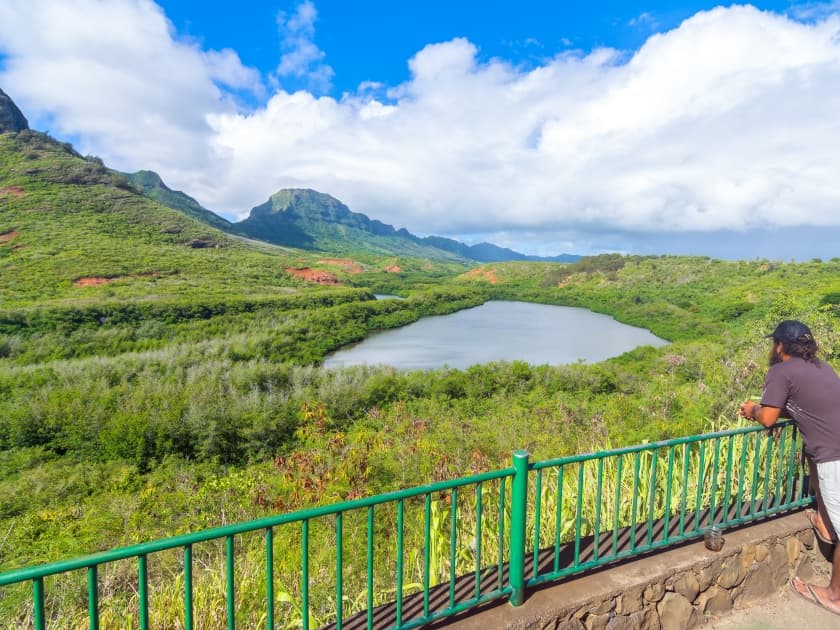
Alekoko Fishpond, better known as the Menehune Fishpond, is one of the clearest places on Kauai where ancient Hawaiian aquaculture still meets present-day responsibility. Minutes from Līhue and visible from an overlook on Hulemalu Road, the site is not just a scenic relic in Nāwiliwili. It is a historic food system, a cultural landscape, and a test of whether the island treats its landmarks as living infrastructure or as a backdrop.
A landmark that still carries a working purpose
The fishpond sits on the Hulēia River about 3,280 feet upstream from Nāwiliwili Small Boat Harbor, on private land owned and managed by the nonprofit Mālama Hulēia. The Department of Land and Natural Resources identifies it as the largest fishpond on Kauai, and the same setting gives the place its modern relevance: it is part of a watershed where land use, habitat health, and cultural stewardship all overlap. Historic Hawaii Foundation calls it the best example of an inland fishpond in Hawaii, a distinction that underlines how unusual and important the site remains.
This is why the fishpond matters beyond heritage tourism. It is part of a functioning local conversation about how Kauai feeds itself, who cares for the land, and how much of the island’s indigenous knowledge survives in practice rather than in display cases. When the wall is maintained and the basin is cleared, the fishpond remains legible as a working system, not just a memory.
What the wall tells you about Hawaiian engineering
The pond’s defining feature is its kuapā, the stone-faced dirt wall that cuts off a large bend in the Hulēia River. Different records describe that wall as about 900 feet long, while Historic Hawaii Foundation materials describe it as about 900 yards long; either way, it is a major construction, not a modest embankment. Sources also describe the fishpond itself as a 40-acre site, while broader cultural-landscape references put it at 102 acres, reflecting the different ways the surrounding area is measured and understood.
That engineering is the reason the site still draws attention from historians and conservationists. Hawaiian fishponds used seawalls, channels, and tidal flow to manage fish stocks, and the National Park Service’s account of Kaloko Fishpond places that tradition in a wider system of sophisticated food production. Alekoko belongs to that same tradition, which is why it is usually described not as a curiosity, but as evidence of a highly developed Native Hawaiian aquaculture system.
Legend lives here, but history still matters more
The Menehune story remains tied to the site, and tourism material still presents the pond as nearly 1,000 years old. Historic Hawaii Foundation and other historic records are more cautious, placing its age at roughly 580 to 600 years and describing it as likely built in the earliest period of Hawaiian settlement. That difference matters because it shows two truths at once: oral tradition gives the place its power, while archaeology and preservation work keep the record grounded.
The legend of the Menehune building the fishpond overnight has long helped make the site memorable. But the more important fact for Kauai today is that the fishpond’s age, however it is counted, makes it one of the island’s oldest surviving pieces of built landscape. It has been listed on the National Register of Historic Places since 1973, which gives the site formal recognition without turning it into a frozen exhibit.
Stewardship is what keeps it visible
Mālama Hulēia did not emerge as a ceremonial caretaker. The nonprofit grew out of canoe paddlers’ concerns about mangrove overgrowth along the river, and its work has been practical from the start. The group’s stated mission is to restore the Hulēia Watershed, remove mangrove along the river, re-establish native wetland ecosystems, manage Alakoko Fishpond, and build environmental stewardship programs rooted in Hawaiian values.
That work is already visible in the numbers. The nonprofit removed 26 acres of invasive mangrove from Alakoko, a major step in making the pond and surrounding wetland accessible again. In 2023, a community workday to rebuild part of the wall drew more than 2,000 volunteers, a sign that preservation here depends on public labor as much as on formal protection.
Why the restoration rules matter
Restoring a fishpond in Hawaii has never been simple, and state officials have tried to make the process less forbidding. The Department of Land and Natural Resources launched Hoāla Loko Ia, a streamlined fishpond-permitting program meant to cut through the tangle of multi-agency approvals that often slows restoration work. The department says the program has issued 20 fishpond restoration permits.

That matters because the Alakoko project is not finished. Reports on the 2023 wall work said several breaches in the 2,700-foot length of the wall still needed to be filled before the fishpond could perform its intended purpose. That is the clearest reason the site should be treated as living infrastructure: without the wall, the pond cannot function as a fishpond. Without steady stewardship, the cultural knowledge embodied in the site becomes harder to read, harder to pass on, and easier to lose.
A land question as much as a cultural one
The future of the fishpond has also depended on land strategy. In February 2021, Mālama Hulēia announced it was working with Trust for Public Land to purchase the 600-year-old Alakoko Fishpond for $3 million after originally negotiating a 20-year lease. The deal showed how preservation in Hawaii often hinges on access, ownership, and the ability to commit to long-term care rather than short-term use.
That acquisition effort also framed the fishpond as more than a preserved object. It positioned Alakoko as a place where education, restoration, and public access could continue together. Historic Hawaii Foundation has tied the site to place-based education and years of volunteer restoration, reinforcing the point that the fishpond’s value grows when people can still work on it, study it, and learn from it.
The setting around it still shapes the story
The fishpond sits beside the Hulēia National Wildlife Refuge, which gives the site a wider ecological context. It is not only a historical feature near Nāwiliwili; it is part of a larger wetland and river system where habitat, water flow, and cultural landscape are inseparable. That proximity makes the case for preservation even stronger, because any decline in the fishpond’s condition affects how the surrounding watershed is understood and cared for.
For Kauai residents, the issue is not whether Alekoko deserves admiration. It already has that. The question is whether it will continue to be maintained as a functioning sign of Hawaiian food production and land stewardship, or whether the island lets one of its most important aquaculture landmarks slide into the role of scenery alone.
This article was produced by Prism’s automated news system from verified source data, official records, and press releases, then run through automated quality and moderation checks before publishing. The system is built and supervised by the people who set the standards it runs under. Read our full AI policy.
Did this article answer your question?