PMRF honors ancestral remains at Nohili crypt on summer solstice
PMRF leaders and Na Ohana Papa O Mānā descendants gathered at the Nohili crypt as the Navy tied the observance to ancestral care, not just base protocol.
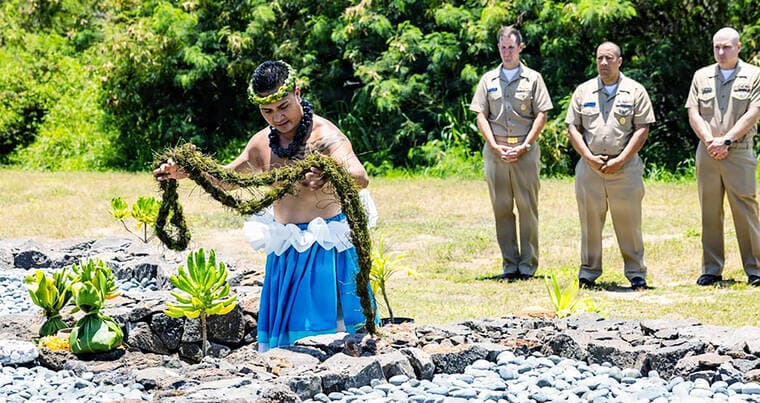
PMRF leadership and lineal descendants of Na Ohana Papa O Mānā gathered at Lua Kupapau O Nohili on June 20 for a summer solstice observance that placed ancestral remains and military responsibility in the same frame. The ceremony at the Nohili crypt on the Pacific Missile Range Facility drew on hula and traditional protocol.
The Nohili dunes are a wahi pana, a sacred and legendary place, and the area is also treated as a leina, a spiritual ascent point for ancestors. Burial sites have long surfaced over time as shifting sands, wind, storm surge and climate change expose iwi kūpuna along PMRF’s seven miles of coastline.

The crypt itself was completed in June 2019 after decades of collaboration among the Navy, PMRF personnel, cultural practitioners and Na Ohana Papa O Mānā. The weatherproof structure was built to preserve and honor remains exposed by coastal erosion, and the site includes native ti and royal ilima plantings. The Navy rededicated an expansion of the crypt on Oct. 10, 2024, through an Aha Awa ceremony to accept additional iwi kūpuna.
A Native American Graves Protection and Repatriation Act comprehensive agreement with Na Ohana Papa O Mānā was established on June 17, 2011, and the annual summer solstice rite continues the practice of placing newly discovered remains into eternal rest. In 2023, the ceremony included song, hula, prayers, blessings, leis and flowers, with descendants gathering the evening before for a sunset interment ritual.
PMRF Commanding Officer Capt. Robert Prince said maintaining the crypt and facilitating the ceremony is an honor tied to the base’s national defense mission. Tara del Fierro, the PMRF cultural resources manager and archaeologist, called the annual observance a sacred duty. PMRF is the world’s largest instrumented multi-domain range, with more than 1,100 square miles of instrumented underwater range and more than 42,000 square miles of controlled airspace, and brings about $150 million a year to the county.
This article was produced by Prism’s automated news system from verified source data, official records, and press releases, then run through automated quality and moderation checks before publishing. The system is built and supervised by the people who set the standards it runs under. Read our full AI policy.
Did this article answer your question?