Avista coordinates regional crews to restore power after March windstorm
A single downed pole can restore power to 300 people, but Avista’s March windstorm response shows why restoration is really a regional logistics race.
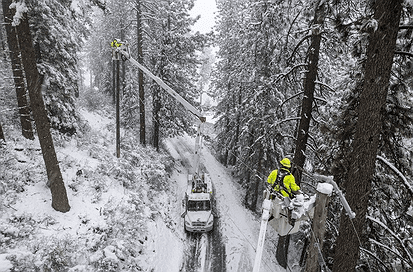
A single pole, a regional outage
One broken telephone pole in Coeur d’Alene helped bring service back for about 300 people, but it sat inside a repair effort that had already spread across North Idaho and beyond. At the height of the March 12 windstorm, Avista said 60,988 electric customers were without power, a scale that turns one damaged line into a regionwide operations problem.
That is why the utility treats severe weather as a staged response, not a simple repair call. Avista spokesman David Vowels described the work as a major logistical lift, and operations director Paul Good said the company starts preparing days in advance, before the first pole falls. In the March storm, more than 50 Avista line crews, 17 contract crews and 16 vegetation management crews were pulled into the effort, with additional staff handling the less visible but essential work of lodging, materials movement and meals.
Why the lights do not come back instantly
The public usually sees the last step, when a crew replaces a pole or clears a line and the power returns. What happens first is slower and less visible: assessment, routing, and triage. Avista said assessment and restoration work began the night of March 11, after its preparedness notice warned that strong winds were forecast across its Washington and Idaho service area.
That early warning matters because storm damage is often scattered. Crews have to find where the outages are concentrated, see which roads are passable, identify whether the damage is one broken pole or a larger chain of failures, and decide where outside help is needed. Even when a fix looks small from the street, the utility may still have to move trucks, set safety zones, and coordinate material deliveries across several districts before a single repair can be completed.
Scott Dahl, one of the linemen quoted in the feature, underscored the point that safety comes first. That may sound like a delay to customers staring at dark houses, but it is also what keeps a damaged grid from becoming more dangerous. In a windstorm, a rushed repair can create more outages, more risk for crews, and a longer recovery for everyone else.
How Avista decides what gets fixed first
Avista’s restoration order is shaped by three practical questions: where the damage is worst, how quickly crews can reach it, and what outside help is needed. That is the core of storm accountability. It means the company is not just counting outages, it is deciding which break points will return the most people to service fastest, which roads are safe enough for heavy equipment, and where support crews need to stage.
The staffing behind the scenes matters as much as the visible repair work. When more than 80 crews are spread across multiple districts, someone has to make sure they are housed, fed and supplied. That logistical layer can determine whether line crews keep moving overnight or lose hours waiting for materials, fuel or access. In a storm of this size, restoration speed depends as much on organization as on technical skill.
The March numbers show why. A single local outage can feel isolated, but Avista said the March 12 event left nearly 61,000 customers without power at its peak. The company also pointed back to the December 17 storm, which affected about 80,000 people, as another reminder that major wind events are not rare one-off emergencies. They are recurring tests of how well a utility can mobilize under pressure.
The mutual-aid system behind the response
Avista does not handle these events alone. Before major weather hits, the company alerts other utilities and contractors through the Western Region Mutual Assistance Group so resources can be shifted quickly if the damage is severe. That regional web is formalized in the Western Region Mutual Assistance Agreement, which was identified in Reno, Nevada, on October 23, 2002, developed with a task force that included Avista Corporation, and formally executed on November 14, 2003.
The agreement is meant to serve gas and electric utilities across the Western United States and Canada, which gives Avista’s storm response a much wider frame than Kootenai County alone. That wider network matters when a single utility serves nearly 418,000 electric customers across 30,000 square miles in four northwestern states. A storm that hammers one part of the service area can quickly require help from crews and contractors hundreds of miles away.
For readers trying to understand why restoration can take so long, the mutual-aid system is the answer. It is not just a phone tree. It is a standing regional mechanism for moving people, trucks, parts, meals and lodging to the hardest-hit places as fast as conditions allow.
What Kootenai County learned from the December storm
The human cost of wind damage in Kootenai County sharpened the stakes. During the Dec. 17, 2025 windstorm, a tree fell onto a home in the Village of Fernan and killed a 55-year-old man. Other occupants were trapped inside before rescuers pulled them out. That incident is a reminder that the danger in a major wind event is not limited to downed lines or darkened houses.
It also explains why neighborhoods with heavy tree cover, older overhead lines and fast-moving storms can be especially exposed. In places like Fernan and other wooded pockets around Coeur d’Alene, fallen branches and trees can damage homes, block access, and complicate the very repairs customers are waiting on. When roads are obstructed or houses are at risk, line crews cannot simply drive in and get to work.
For businesses and households, the outage problem is not only inconvenience. It is a chain reaction that affects everything from daily routines to local commerce, and the longer restoration takes, the more those costs spread across the community. That is why storm readiness in North Idaho is as much about logistics and mutual aid as it is about wires and poles. In a region that has already seen 60,988 customers lose power in one March storm and 80,000 affected in December, the pace of recovery is part of the public safety story.
This article was produced by Prism’s automated news system from verified source data, official records, and press releases, then run through automated quality and moderation checks before publishing. The system is built and supervised by the people who set the standards it runs under. Read our full AI policy.
Did this article answer your question?