Coeur d'Alene's politics swing sharply right after 2016 and COVID turmoil
Coeur d'Alene's rightward shift now shapes elections, public meetings, and the county's image far beyond city hall. The fallout reaches employers, tourism, and civic trust across Kootenai County.
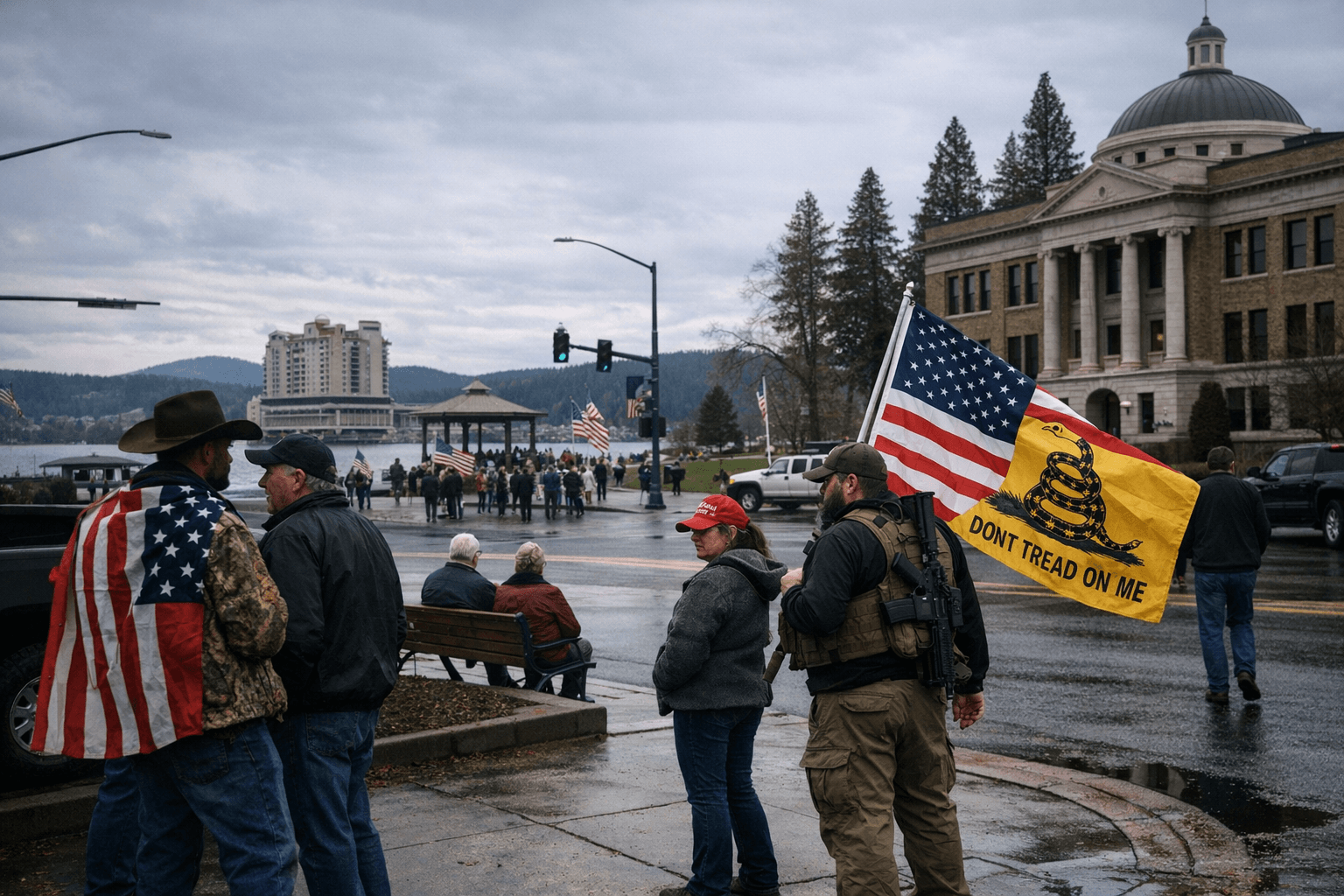
From timber county to political flashpoint
Kootenai County’s current political image did not appear overnight. The county was established on December 22, 1864, named for the Kootenai Native American Tribe, and its earliest history is tied to the Schitsu'umsh people, followed by fur trading, rail expansion, mining, logging, tourism, and later rapid population growth. That older story matters because the county that once sold itself on movement, extraction, and outdoor beauty now finds itself defined just as much by political conflict as by Lake Coeur d’Alene or the Coeur d’Alene River.
The population change has been steep enough to reshape daily life. U.S. Census Bureau estimates put Kootenai County at 188,323 residents in 2024 and 191,864 in 2025, a scale that puts more pressure on roads, schools, public meetings, and the local job market. In places like Coeur d’Alene, Post Falls, and Rathdrum, growth has not just filled subdivisions. It has also widened the gap between people who want a quieter, more conventional North Idaho and those who see the county’s politics as the new defining feature.
2016 marked the hard turn
The clearest electoral break came in 2016. Kootenai County had 77,885 registered voters that year, with 67,952 ballots cast in the general election. Donald Trump won the county with 44,449 votes, or 66.07 percent, compared with 16,264 votes, or 24.17 percent, for Hillary Clinton. That margin was not just a presidential result. It set the tone for a county in which national conservative politics increasingly became local identity politics.
Since then, Coeur d’Alene’s public reputation has shifted with unusual speed. The county’s political brand now travels well beyond Idaho because it is visible in school board fights, county party battles, and public meetings that spill into police involvement and criminal charges. For employers trying to recruit workers, and for businesses that depend on a calm civic atmosphere, that visibility can become part of the calculation. For tourism, the issue is different but related: visitors do not come to North Idaho for partisan warfare, yet the county’s headlines increasingly carry that imprint.
COVID hardened the divide and pulled local factions apart
The pandemic did more than intensify argument. It reorganized local politics. By 2021, rival conservative factions were openly competing for control inside Kootenai County. The Kootenai County Republican Central Committee said it endorsed 17 winning candidates that year, while a breakaway group, Citizens to Elect Qualified & Experienced Candidates, backed 11 winners. That split showed that the county’s rightward movement was not a simple story of one unified bloc gaining strength. It was also a fight over who would define conservatism in public life.
The issues that carried candidates to victory in 2021 reflected the post-pandemic mood. Opposition to mask mandates, COVID-19 vaccine mandates, and critical race theory became rallying points, not side issues. In practical terms, that meant local elections were increasingly shaped by anger over schools, public-health authority, and cultural change. It also meant the county’s political identity became more confrontational, with public meetings and campaign events serving as proxy battles for a much larger cultural split.
A town hall became a national symbol
That tension reached a public peak on Feb. 22, 2025, when a KCRCC-hosted legislative town hall at Coeur d’Alene High School ended with Teresa Borrenpohl being forcibly removed after heckling speakers. The event quickly moved from local controversy to national symbol because it put free speech, law enforcement, and political intimidation on the same stage. Coeur d’Alene police later asked prosecutors to review possible criminal charges, and six men were charged in April 2025 in connection with the removal.
The Idaho Attorney General’s Office then deepened the significance of the incident in November 2025, saying Sheriff Bob Norris would not face battery charges because investigators found no evidence he acted in bad faith. The attorney general also said Borrenpohl’s repeated heckling was enough under KCRCC rules for Norris to ask her to leave. That conclusion did not erase the political damage. Instead, it underscored how closely party rules, law-enforcement action, and public order now intersect in Kootenai County politics.
For residents, the lesson was immediate: a school auditorium in Coeur d’Alene can become a test case for how far political confrontation will go in North Idaho. For employers and public institutions, the signal was harder to ignore. A county that repeatedly lands in the national conversation for conflict has to manage not just governance, but reputation. That matters when recruiting teachers, public servants, health workers, and private-sector employees who weigh community climate as part of where they choose to live and work.
Race and human relations remain part of the story
The county’s political shift has also collided with race and civic trust. On March 26, 2024, the Kootenai County Task Force on Human Relations and local officials held a press conference after a reported racial incident in Coeur d’Alene. That moment mattered because it showed the county’s hard-right turn is not only about party labels or campaign strategy. It also affects how people experience safety, belonging, and public accountability in day-to-day life.
When those tensions surface in a county already known for fast growth and strong conservative organizing, they shape how outsiders see Coeur d’Alene and how insiders talk about their own community. Civic leaders now have to answer questions that go beyond who won the last election. They have to address whether public spaces feel open, whether institutions can manage conflict without escalation, and whether the county’s image helps or hurts the local economy.
What changed after 2016
The shift since 2016 is measurable in more than rhetoric. The county’s voting base has been pulled deeper into partisan conflict, conservative factions have split over control, and public gatherings have become more combustible. A county that once leaned on scenery, history, and steady growth now finds its political reputation affecting how people think about schools, law enforcement, recruitment, tourism, and community life.
Kootenai County is still growing, and its older identity has not disappeared. But the county’s political story now travels as fast as its lakeside scenery. In North Idaho, that means the reputation of Coeur d’Alene is no longer a side effect of politics. It is part of the governing environment itself.
This article was produced by Prism’s automated news system from verified source data, official records, and press releases, then run through automated quality and moderation checks before publishing. The system is built and supervised by the people who set the standards it runs under. Read our full AI policy.
Did this article answer your question?