Camp Bouse marker recalls Patton’s top-secret desert tank training site
A marker in Bouse points to Patton’s secret tank camp in Butler Valley, where plaques, a restored tank and annual ceremonies keep the site visible.
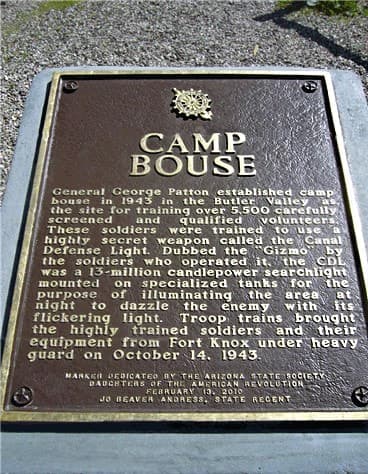
At the northeast corner of Arizona State Route 72 and Main Street in Bouse, a memorial park turns a once-secret war project into something you can still see, walk around, and read. The place is tied not only to George S. Patton Jr., but also to veterans like Henry “Hank” Leintz, who trained with the 748th Tank Battalion and later returned for a dedication in Bouse.
What remains visible in Bouse
La Paz County still points visitors to the Camp Bouse Memorial, Museum and access to the Arizona Peace Trail, which makes Bouse the practical starting point for anyone trying to understand the site. The memorial park has plaques, military vehicles, artifacts and a restored tank, and local volunteers keep it up and open it without charge.
The camp Patton built for secrecy
Camp Bouse was established in 1943 in Butler Valley, about 20 miles from Bouse, as a top-secret training site for more than 5,500 carefully screened volunteers. The camp was home to the 9th Tank Group, which included six tank battalions, one armored infantry battalion, an ordnance company and a station hospital; the 10th Tank Group was also there during the classified work.
The weapon being tested was the Canal Defense Light, or “Gizmo,” a 13-million-candlepower carbon-arc searchlight mounted in the turret of an M3 tank. The system used shutters that opened and closed six times a second, creating a strobing beam meant to confuse and briefly blind enemy troops during night attacks. Army history later described the CDL project as the second-most secret Army program of its era, after the Manhattan Project.
Construction began in August 1943 under the 369th Engineer Battalion. The engineers dug a well, laid water lines, poured concrete pads and sidewalks for the hospital and headquarters, graded roads and tent areas, and built a 500,000-gallon reservoir before the camp was closed in April 1944, when the CDL concept was judged too vulnerable to enemy fire.
Why the desert still matters now
Camp Bouse was only one part of a much larger wartime system. The Desert Training Center, also called the California-Arizona Maneuver Area, was created in 1942 to train U.S. troops for desert warfare, and Patton called it the largest and best training ground in the United States. Camp Bouse sat inside that broader effort to harden soldiers and equipment for North Africa.
That institutional lineage still runs through Yuma Proving Ground and Yuma Test Center. Camp Bouse sits within the last active Army installation lineage in the World War II-era Arizona Desert Maneuver Area, and YPG and YTC commanders have kept showing up for the annual Bouse ceremonies, with Patrick McFall speaking in 2023, Shane Dering in 2024, Kevin Hicks in 2025, and Hicks again in 2026.

In 2025, the 748th Tank Battalion was the only one of the six or seven tank battalions tied to the classified project without its own monument in Bouse. Annual commemoration ceremonies have continued, reaching the 27th in 2022, the 28th in 2023, the 29th on Feb. 8, 2025, and the 30th on Feb. 14, 2026.
What you can physically read today is a layered record: the roadside marker in Bouse, the memorial park with plaques and a restored tank, the annual ceremonies, and the surviving traces in Butler Valley where roads and concrete remnants still mark the old camp.
This article was produced by Prism’s automated news system from verified source data, official records, and press releases, then run through automated quality and moderation checks before publishing. The system is built and supervised by the people who set the standards it runs under. Read our full AI policy.
Did this article answer your question?