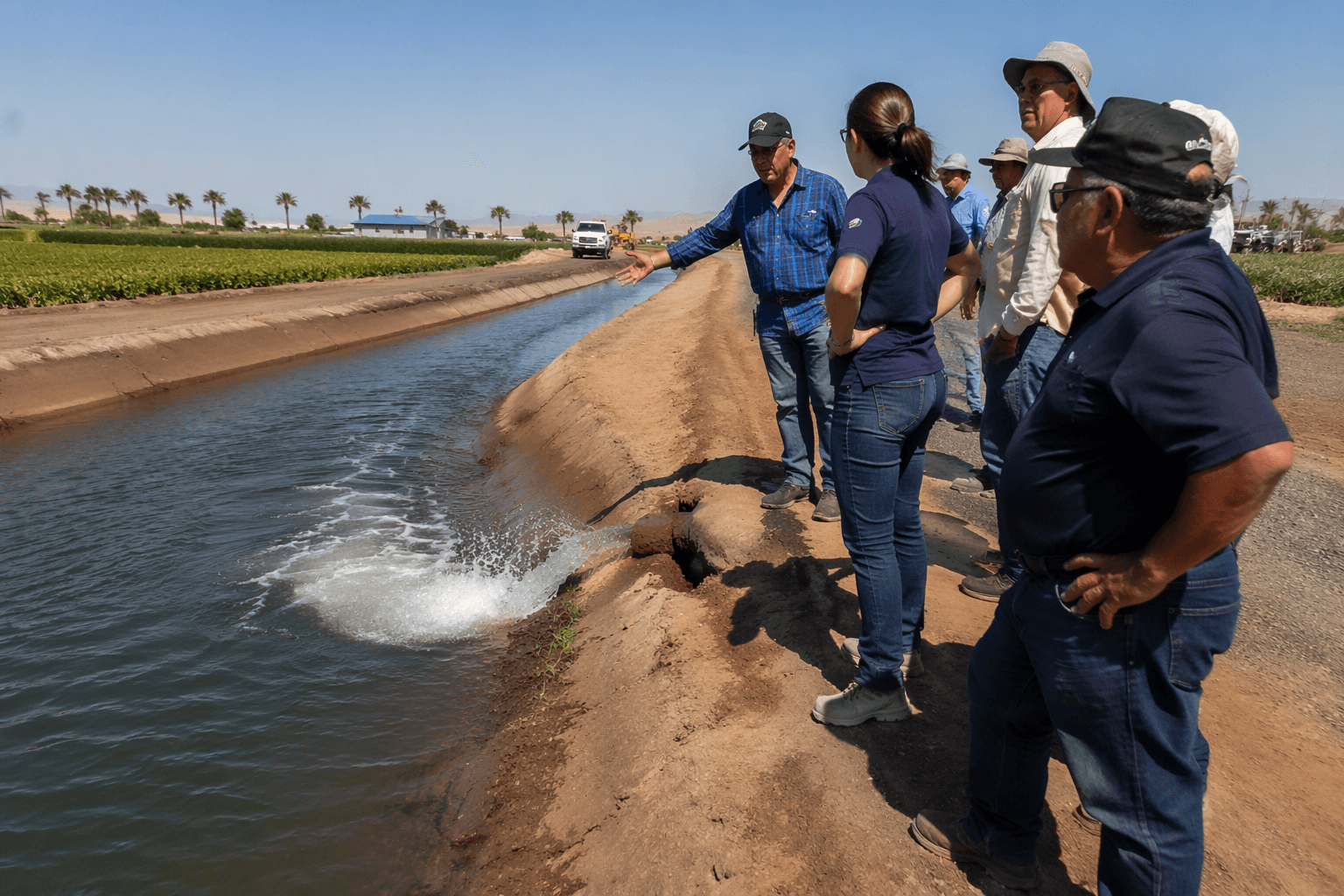
Colorado River leaders explore new water solutions as drought worsens
Leaders are testing interstate water deals, desalination and reuse as Lake Mead stays in shortage. Parker and CRIT could feel the next water rules in rates, supply and farm decisions.

Colorado River managers are widening their search beyond emergency cuts alone, and the newest signal came from a memorandum signed at the Claude “Bud” Lewis Carlsbad Desalination Plant. Reclamation and water agencies in Arizona, California and Nevada are now exploring interstate water exchanges, desalination, advanced water purification and recycled water as Lake Mead remains in shortage and basin operations stay tied to existing guidelines. For La Paz County, that matters most in Parker, Quartzsite, Bouse and Ehrenberg, where tribal water rights, farm deliveries and household bills all depend on how these new tools are written.
What the new basin agreement is trying to do
The June 3 memorandum brings together the Bureau of Reclamation, the San Diego County Water Authority, the Metropolitan Water District of Southern California, the Southern Nevada Water Authority, the Arizona Department of Water Resources, the Central Arizona Water Conservation District and Salt River Project Agricultural Improvement and Power District. Its purpose is not to solve the drought in one stroke. Instead, the agencies want to see whether future interstate water transactions, desalination partnerships and advanced purification projects can be built into a broader reliability strategy for the Colorado River Basin.
That distinction matters. Basin leaders are signaling that the region is moving past a narrow focus on emergency cuts and toward a more complicated mix of demand reduction, supply creation and legal exchange. San Diego County Water Authority said the memorandum still needs to be ratified by the other agencies, which means the agreement is a framework, not an immediate transfer of water or a finished policy. Even so, it marks a clear shift in how major water agencies are planning for the next round of scarcity.
Reclamation said the goal is to strengthen long-term water reliability across the basin. In practical terms, that means the region is no longer only asking how much water can be saved. It is also asking where new water can come from, how it can move legally across state lines, and which communities will bear the cost if those new systems become part of the next operating plan.
Why La Paz County is directly in the line of impact
La Paz County is not a distant observer in this fight. Parker and Quartzsite are the county’s main population centers, and more than 56% of the county’s residents live in rural areas. About 10% of county land is Tribal land, the sovereign lands of the Colorado River Indian Tribes. That makes the county especially vulnerable to policy shifts that are designed in basin-wide negotiations but felt in very local ways.
In places like Parker, the real questions are concrete: Will there be enough water for farms, homes and public agencies? Will new supply projects lower pressure on shortages or raise costs through new infrastructure and exchange arrangements? Will rural systems have the bargaining power to benefit from new interstate deals, or will they simply absorb the price increases that come with more complicated water management?
The basin conversation now under way suggests those are not abstract questions. If water agencies rely more heavily on exchanges, storage agreements or desalination-linked partnerships, the financial and political burden may not be spread evenly. Larger urban districts usually have more lawyers, more infrastructure and more leverage. Rural places like La Paz County often experience the result later, but more sharply.
CRIT is becoming one of the county’s most important water actors
The Colorado River Indian Tribes sit at the center of this local story. Multiple reports say CRIT has a diversion right of 662,402 acre-feet of Colorado River water each year for use on its Arizona lands, making the tribe one of the state’s most significant water holders. That alone gives Parker and the Colorado River Indian Reservation unusual weight in basin politics.
In 2024, Arizona, the Interior Department and CRIT signed documents implementing an agreement that allows the tribes to lease, exchange or store part of their Colorado River allocation off-reservation. That settlement changed the county’s water map by giving CRIT more flexibility and by making tribal water a more active part of regional planning. It also helped explain why Parker has become such a crucial location for Colorado River policy.
That role expanded again in April 2026, when state, federal and tribal leaders signed water-resiliency agreements in Parker that gave CRIT a new legal tool for its Colorado River water. The exact local effect will depend on how the tool is used, but the direction is clear: CRIT is no longer only a water-rights holder. It is now a more active shaper of how water can be counted, conserved and potentially moved.
For La Paz County, that means future water decisions will not simply arrive from outside the area. Some of the most important negotiations will happen inside the county itself, with Parker serving as a place where tribal sovereignty, state policy and basin-wide shortage management meet.
What residents, farmers and agencies may see next
The clearest near-term change is not a new river of water flowing into the county. It is a policy shift toward more complex management, with more attention to exchanges, storage, reuse and desalination. If the Carlsbad memorandum moves forward, it could create a pathway to move water from Carlsbad to areas in the Colorado River Basin, but only if the agencies ratify it and build the legal and financial structure to support it.
At the same time, the basin’s emergency footing has not gone away. Reclamation’s June 2026 24-Month Study says Lake Powell and Lake Mead remain governed by the 2007 Interim Guidelines, the 2024 Interim Guidelines SEIS ROD and the 2026 Annual Operating Plan. Lake Mead remained in shortage conditions through 2026, and one report put it at about 1,056 feet at the end of April 2026. That level of stress keeps pressure on every local system that depends on Colorado River deliveries.
- More attention to water exchanges and storage deals that could affect Parker-area users.
- Greater pressure on rural systems if new supply projects come with higher costs.
- A larger role for CRIT in regional water decisions, especially around leasing, exchange and storage.
- Continued uncertainty for farmers and public agencies as basin rules are tested against falling reservoir levels.
For La Paz County, the likely next changes are straightforward:
The Colorado River crisis is still being managed from across the Southwest, but its consequences are becoming more local, more legal and more immediate in La Paz County. Parker is where the next stage of that fight is taking shape, and the decisions made there will help determine how scarce water is priced, shared and protected in the years ahead.
This article was produced by Prism’s automated news system from verified source data, official records, and press releases, then run through automated quality and moderation checks before publishing. The system is built and supervised by the people who set the standards it runs under. Read our full AI policy.
Did this article answer your question?