La Paz County aquifer guide explains deepening groundwater crisis
La Paz County’s water fight is underground, where pumping has outpaced recharge and some wells have fallen more than 200 feet since the 1980s.
The hidden supply beneath La Paz County
The fight over La Paz County’s future is really a fight over water buried underground. Most usable supply here sits in aquifers, the layers of rock, sand, and sediment that store water and allow wells to pull it up for homes, farms, and businesses.
That distinction matters because not all groundwater behaves the same way. Unconfined aquifers tend to respond more quickly to rainfall and river infiltration, while confined aquifers sit deeper and can hold water that accumulated thousands of years ago. In practical terms, that means one basin may refill slowly enough to feel stable for years, while another can fall into depletion even when the surface still looks dry and unchanged.
Why the crisis feels local in Parker, Quartzsite, Bouse and Ehrenberg
La Paz County’s water challenge is not abstract because it is spread across a huge rural area. The county covers 4,496.6 square miles, according to the Census Bureau, and its farms, homes, and businesses are scattered across long distances rather than clustered around one urban water system.
That geography is one reason groundwater policy hits so hard in places like Parker, Quartzsite, Bouse, and Ehrenberg. The same hidden supply supports household wells, irrigation, and local business activity, while also shaping property values and whether new development can happen without driving existing wells deeper and more expensive to maintain. USDA’s county profile shows La Paz County has a substantial agricultural base with farms of many sizes, which makes groundwater stability a direct economic issue, not just an environmental one.
What the Ranegras Plain decision changed
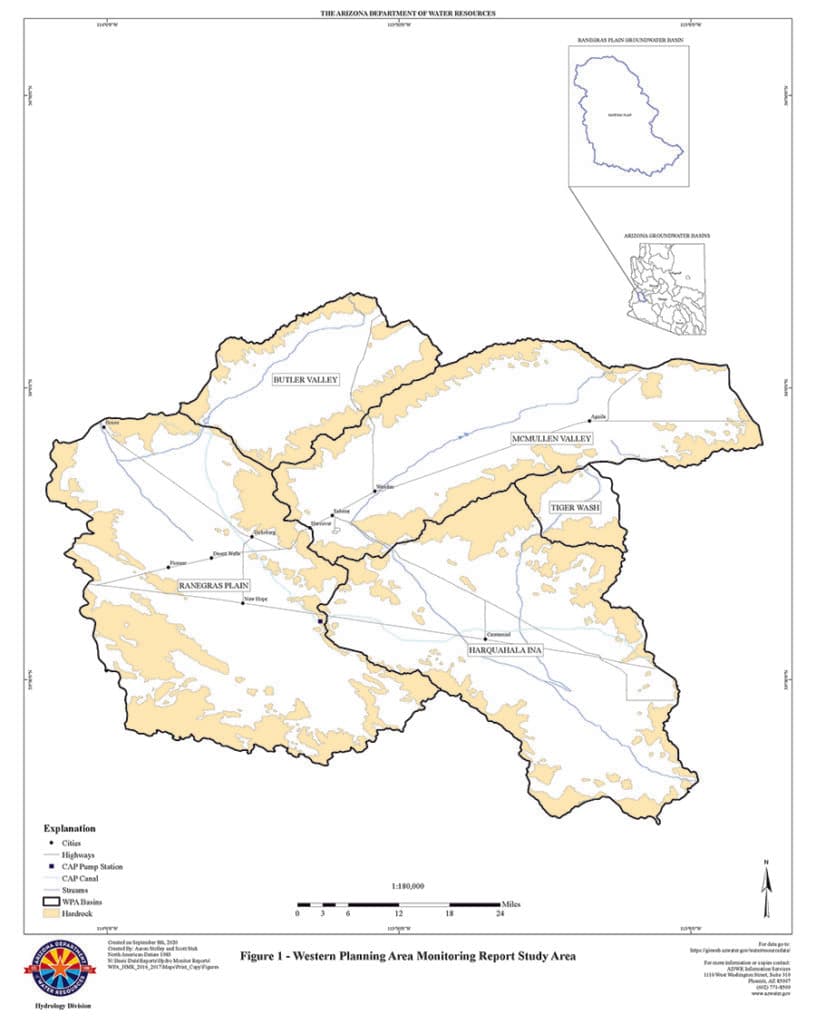
The most important policy shift now centers on the Ranegras Plain Groundwater Basin, which spans La Paz and Yuma counties. Arizona’s Department of Water Resources designated it a subsequent Active Management Area on January 9, 2026, after an informational meeting on October 15, 2025 and an informal-comment period that closed October 17, 2025.
That designation matters because Active Management Areas were created under Arizona’s 1980 Groundwater Code to manage finite groundwater resources. In plain language, the state is moving from warning signs to direct management: measurement, reporting, and conservation planning are intended to slow depletion and make the basin last longer. ADWR’s proposed management goal, posted March 5, 2026, is to reduce groundwater overdraft by half over 50 years so the aquifer can keep supporting the basin’s long-term economy and welfare.
The trigger is stark. Local reporting said extraction in the Ranegras Plain basin is nearly 10 times greater than recharge. The Water Alliance of La Paz County also says some wells in the region have dropped more than 200 feet since the 1980s. Those numbers explain why what looks like a technical designation in Phoenix or Tucson lands in La Paz County as a daily reality for people who depend on wells.
How to understand groundwater in everyday terms
The best way to read the aquifer debate is to think about it the way a well owner or farmer does. If water levels keep falling, a well may need to be deepened, pumps may have to work harder, and the cost of simply keeping water flowing can climb quickly. That can affect everything from a family’s monthly budget to whether a farm can stay productive at all.
Recharge is the other half of the story. The U.S. Geological Survey says natural recharge happens when precipitation soaks into soil or when water leaks from rivers, streams, lakes, and wetlands. It also notes that artificial recharge can be done through injection wells, especially where spreading water on the land does not work well for deep aquifers. In other words, every gallon that leaves the basin is not automatically replaced, and some aquifers are far harder to refill than people assume.
This is why the words pumping limits and water reliability matter in local land-use fights. If a subdivision, farm expansion, or industrial project depends on groundwater in a basin that is already falling, the long-term cost may show up later as deeper wells, stricter rules, or simply less water available for the next round of growth.
The data tools shaping the debate
Arizona now has more tools to measure the problem than it once did. The U.S. Geological Survey says groundwater makes up about 41% of water use in Arizona, which helps explain why aquifer conditions remain central in a mostly arid state. ADWR’s Groundwater Site Inventory holds current and historic depth data for more than 44,000 wells and hydrologic sites across Arizona, giving policymakers and residents a statewide record of how groundwater has changed over time.
ADWR also maintains a depth-to-water dashboard that summarizes measurements, well data, and trends by basin and sub-basin. That matters in La Paz County because the county is not dealing with one uniform water table. It is dealing with multiple groundwater systems, including the Ranegras Plain and McMullen Valley, where USGS has also published hydrogeologic work showing the basin has its own distinct structure and behavior.
For residents, those tools turn a hidden resource into something visible enough to judge. They help answer basic questions: Is the basin falling? How fast? Which wells are most vulnerable? And what will the next decade of pumping do to the people already living here?
What this knowledge should help you judge
The aquifer guide is more than background reading. It gives La Paz County residents a way to evaluate the decisions that will shape the next generation of water access, from state management rules to county-level growth choices. It also clarifies why land-use and water disputes keep escalating: each new pumping decision is stacked on top of a finite supply, and the basin does not refill on a political timetable.
That is the lens to bring to ADWR’s Ranegras Plain management plan, to any future reporting or conservation requirements, and to local debates over where growth should go next. In a county where groundwater supports farms, homes, and businesses across 4,496.6 square miles, the real question is no longer whether water policy matters. It is whether leaders act before the drops in the aquifer become permanent losses on the ground.
This article was produced by Prism’s automated news system from verified source data, official records, and press releases, then run through automated quality and moderation checks before publishing. The system is built and supervised by the people who set the standards it runs under. Read our full AI policy.
Did this article answer your question?