President Signs H.R. 1043 Conveying 3,400 Acres for Solar
On Dec. 29, 2025 the President signed H.R. 1043, the La Paz County Solar Energy and Job Creation Act, authorizing the conveyance of roughly 3,400 acres of federally managed land to La Paz County at fair market value. The law gives local officials control of those parcels for potential solar energy development and job-creation efforts, while preserving project-level environmental review and permitting requirements that will shape any future projects.
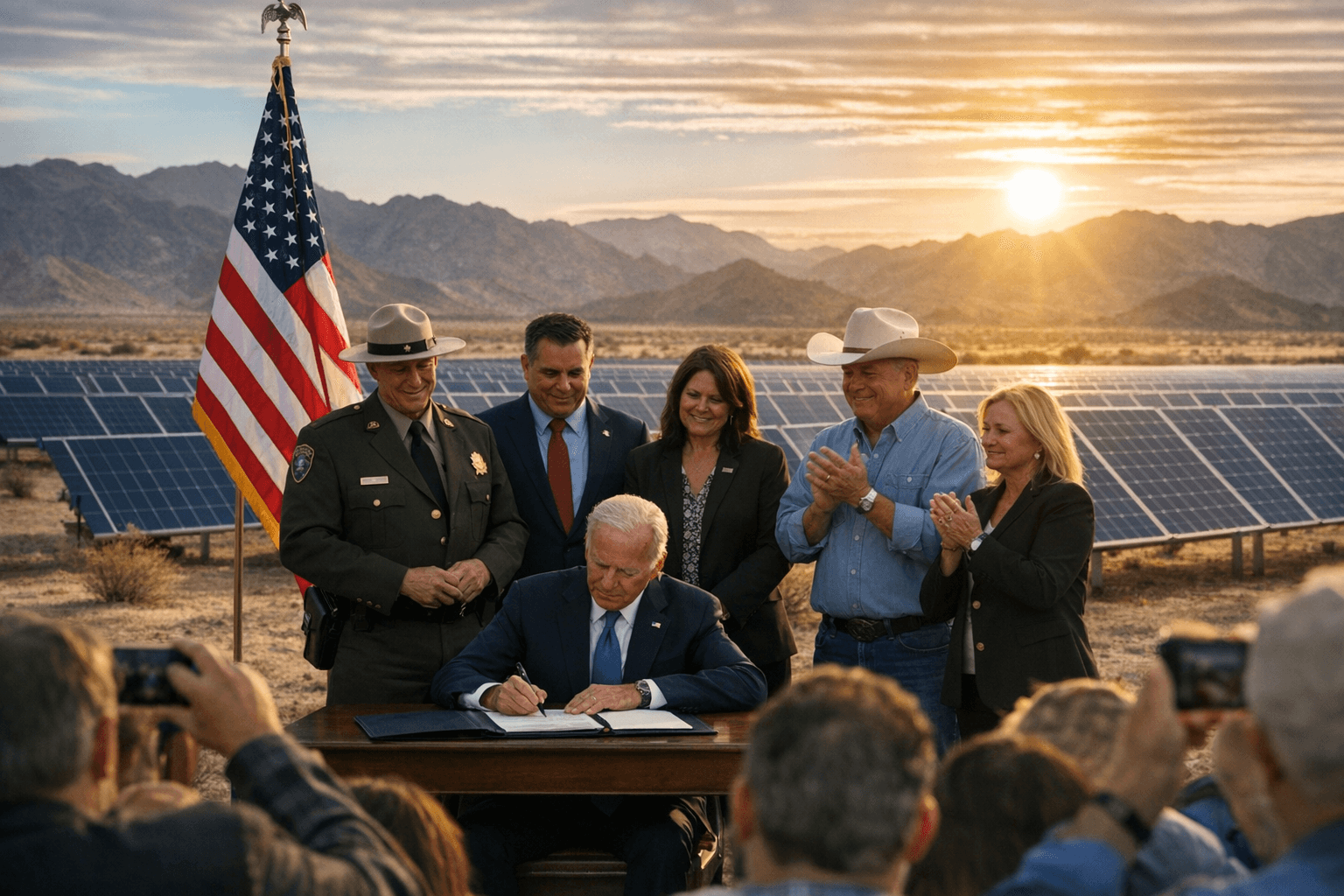
The new law transfers statutory authority over approximately 3,400 acres of federally managed land in La Paz County to the county, with the conveyance to occur at fair market value. The legislation is framed as a tool to enable local control of public lands for potential energy development and associated economic activity, including job creation tied to solar projects.
Although the signing establishes county ownership as a legal outcome, it does not authorize immediate construction or bypass regulatory safeguards. Project-level environmental review, state and federal permitting and other approvals will still be required before any development proceeds. Those procedural steps will determine where projects can be sited, identify mitigation measures, and provide formal opportunities for public comment and input.
For La Paz County residents, the law could translate into new local planning decisions, altered land-use maps and potential economic benefits if solar projects advance. County officials will face a sequence of practical tasks: coordinating the formal transfer with federal land managers, establishing the sale price through appraisal and valuation processes associated with fair market value transactions, and integrating the parcels into county zoning and permitting frameworks. The pace of development will depend on those administrative steps and on the outcome of environmental reviews and permit applications.
The conveyance shifts a key decision point from federal land management to county control, but federal and state regulatory reviews retain substantial influence over project approvals. Environmental assessments will evaluate potential impacts on wildlife, cultural resources, water use and other local resources, and permits from state agencies as well as federal agencies may be required depending on project scope. Those processes will create multiple public touchpoints where residents can weigh in and local leaders must balance economic goals with environmental and community concerns.
Economically, proponents of the transfer point to job-creation opportunities in construction, operations and supply chains for utility-scale solar, and the potential for expanded tax revenue and local contracting. Skeptics may press county officials and regulators to scrutinize site selection, community impacts and long-term land stewardship commitments.
Next steps for La Paz County include completing transactional requirements to accept the parcels, updating local plans and ordinances as needed, and preparing to manage the environmental review and permitting processes that will determine if and how solar development proceeds. Residents and stakeholders should monitor county commission agendas and public notices to engage in those decision-making stages.
This article was produced by Prism’s automated news system from verified source data, official records, and press releases, then run through automated quality and moderation checks before publishing. The system is built and supervised by the people who set the standards it runs under. Read our full AI policy.
Did this article answer your question?