Ripley Intaglios stands as La Paz County’s rare historic landmark
Ripley Intaglios is a rare National Register historic district near Ehrenberg, tied to Yuman heritage and protected desert geoglyphs in La Paz County.

Ripley Intaglios is one of La Paz County’s strangest and most important historic places because it is not a building, monument, or roadside marker. It is a protected desert landscape near Ehrenberg that the National Register recognizes as nationally significant, and it sits in a county with only nine National Register listings total and just two historic districts. That rarity alone makes it worth knowing, but the site’s Yuman cultural affiliation and its prehistoric and historic Aboriginal significance make it more than a curiosity in the sand.
Where Ripley Intaglios fits in La Paz County
The site belongs to the lower Colorado River public-lands landscape, not to a neighborhood street grid or a developed park. The Bureau of Land Management’s Lake Havasu Field Office visitor map labels the Ripley Intaglios Site, placing it within a region that spans portions of La Paz and Mohave counties. That same field office oversees nearly 1.3 million acres of public land, more than 140 miles of the lower Colorado River, and about 10 million annual visitors, which helps explain why preservation rules matter so much in this corridor.
For local readers, that context is important. Ripley Intaglios is tied to Ehrenberg, but the exact location is intentionally not presented as a tourist stop with a street address, because geoglyph sites are sensitive cultural resources. The practical way to think about the site is as part of a managed public landscape, where access is shaped by protection rather than by open, casual foot traffic.
Why the National Register listing matters
Ripley Intaglios was added to the National Register of Historic Places in 1975 under reference number 75000368. The listing identifies the site’s areas of significance as prehistoric and historic Aboriginal themes, and its cultural affiliation as Yuman. It also places the period of significance across multiple subperiods from 1500 to 1874, which gives the site a long historical arc rather than a single moment in time.
The register also classifies the site’s historic function and current function as recreation and culture, with a historic sub-function of work of art, sculpture, carving, rock art. That description fits what a visitor is actually looking at: an engineered image on the desert surface, not a ruin with walls or an artifact behind glass. Arizona State Parks describes the National Register as the nation’s official listing of prehistoric and historic properties worthy of preservation, and Ripley Intaglios is one of the clearest examples of why that label carries real weight.
La Paz County’s numbers sharpen the point. With only two historic districts on the National Register and only nine total listings, Ripley Intaglios sits in a very short list of recognized places. Four of those county listings are nationally significant, so the site is not merely locally interesting. It is one of the county’s most formally recognized historic resources.
What an intaglio is, and what a visit can realistically look like
An intaglio is a design made by removing the dark desert surface so a figure appears against the lighter earth below. In the Colorado River region, that means geoglyphs that are best understood as both archaeological evidence and cultural expression. They are not the kind of landmarks you walk up to, touch, or study at close range, and that limitation is part of their protection.
A realistic visit, for most people, means approaching the site with restraint and expecting a broad landscape view rather than a museum-style experience. The BLM visitor map marks the site, but it does not function as a detailed turn-by-turn guide, and that is by design. Use official public-lands information, stay on designated routes where they exist, and treat the site as something to be observed without disturbance.
A few practical points matter in this part of La Paz County:
- Bring far more water than you think you need.
- Plan for severe heat and open, exposed terrain.
- Wear sturdy shoes that handle uneven desert ground.
- Do not cross or scrape on geoglyph lines or other desert surfaces.
- Leave rocks, soil, and artifacts exactly where they are.
The lower Colorado River desert is unforgiving in warm weather, and the terrain around geoglyph sites can be fragile even when it looks hard-packed. Preservation is not a slogan here; one careless step can damage a feature that has survived for centuries.
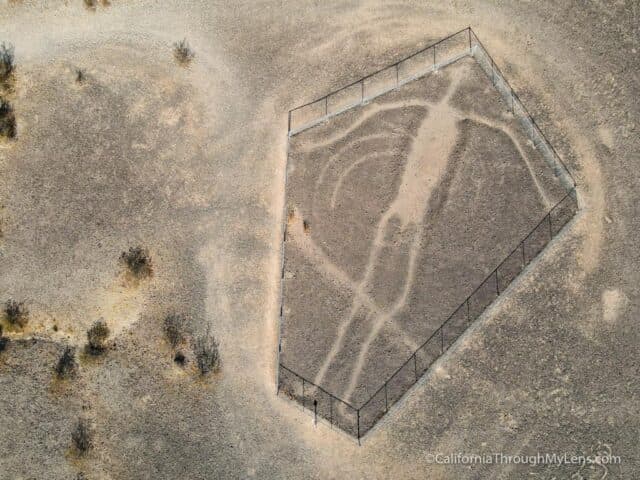
Ripley Intaglios in the wider Colorado River geoglyph landscape
Ripley Intaglios does not stand alone. A 1974 Bureau of Land Management study documented known intaglios along the Colorado River between Ripley and Old Fort Mohave, which shows that the site belongs to a broader archaeological corridor rather than an isolated oddity. That larger pattern matters because it links La Paz County to a long-running record of Indigenous land use and artistic expression along the river.
The nearby Blythe Intaglios in California help give readers a sense of the cultural landscape. The Bureau of Land Management says those figures are between 450 and 2,000 years old, are best viewed from the air, and are understood by the Mohave and Quechan as sacred figures tied to creation stories. The agency also says the animal figures there represent Hatakulya and that sacred ceremonial dances were held on the site in ancient times. Together, those details show that the Ripley area is part of a living cultural geography, not just an archaeological map.
Why preservation matters to the county now
Ripley Intaglios helps define La Paz County’s identity in a way that few landmarks can. It brings together archaeology, Indigenous heritage, public-lands management, and local tourism potential in one protected place near Ehrenberg. Because the county has so few National Register districts and so few nationally significant listings, losing or damaging a site like this would mean losing one of the strongest visible links between the modern county and the deeper history of the Colorado River corridor.
That is why the county’s heritage appeal depends on restraint as much as access. Visitors who treat the site carefully help preserve a landmark that still carries historical, cultural, and civic value. In a county where most places on the National Register are rare exceptions, Ripley Intaglios remains one of the clearest reminders that the desert is part of the record.
This article was produced by Prism’s automated news system from verified source data, official records, and press releases, then run through automated quality and moderation checks before publishing. The system is built and supervised by the people who set the standards it runs under. Read our full AI policy.
Did this article answer your question?