Ole Miss chemist wins NSF CAREER Award for clean energy research
Ole Miss researcher Vignesh Sundaresan won a prestigious NSF CAREER Award to study nanoscale chemistry that could one day improve hydrogen fuel and carbon dioxide conversion.

A University of Mississippi chemistry lab in Oxford just got federal backing for work that could make clean-fuel chemistry more efficient, especially by squeezing more output from expensive materials such as platinum. Vignesh Sundaresan, an assistant professor of chemistry and biochemistry, won a National Science Foundation CAREER Award to study electrochemical reactions at tiny scales, research that remains experimental now but could eventually influence fuel efficiency, industrial emissions and energy-related business opportunities in North Mississippi.
The project centers on nanopores, microscopic holes carved into material surfaces to create more places for reactions to happen. Sundaresan’s team compares the structure to the cups in a muffin tin, a simple way to show how confined spaces can host and separate reactions. Doctoral student Shubhendra Shukla said the arrays will let the researchers watch individual nanoparticles one by one instead of averaging the response of thousands together, a difference that could make catalyst testing far more precise.
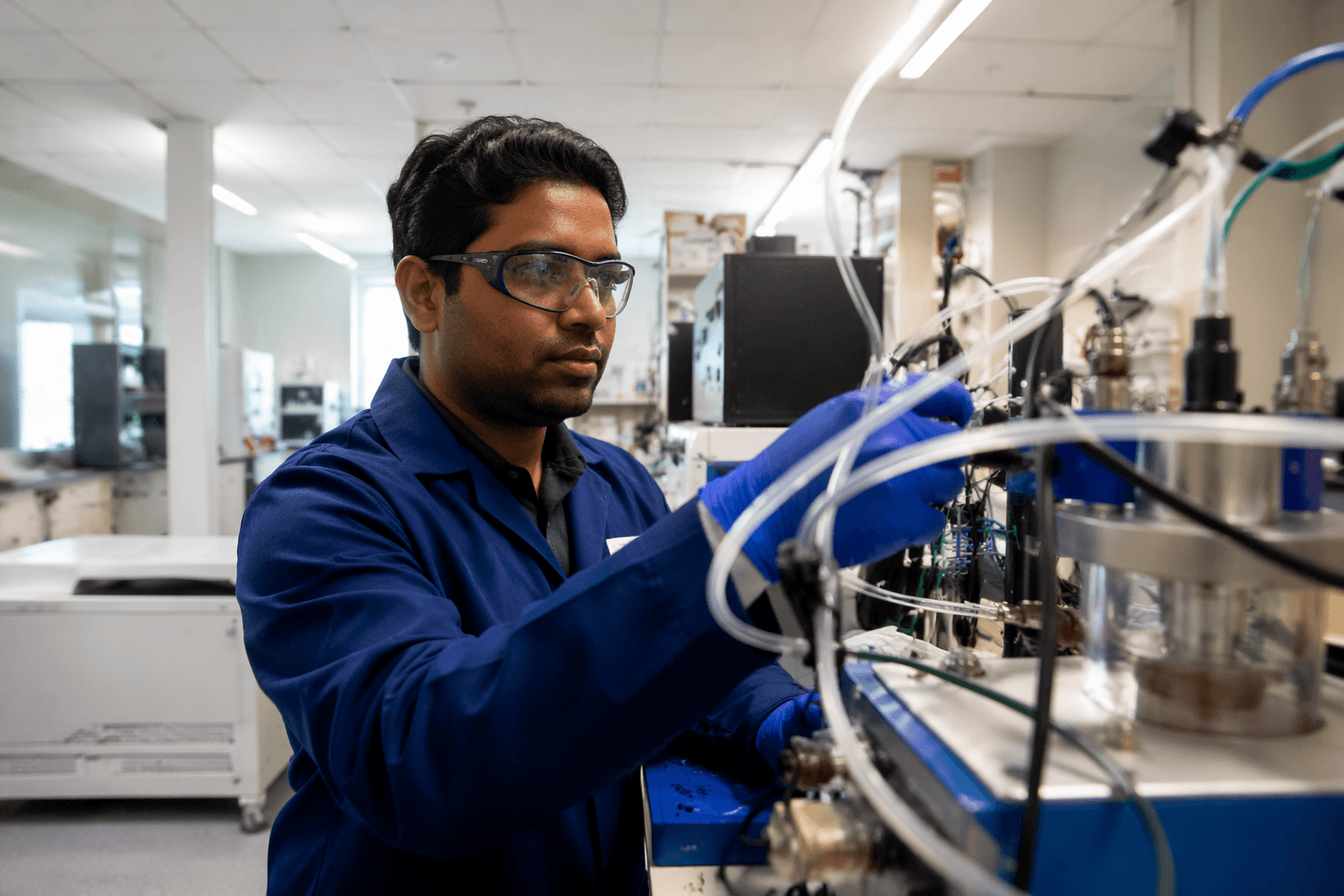
That precision matters because some of the best catalyst materials are also the most costly. Platinum is especially effective for producing hydrogen, but Sundaresan said its price makes efficiency essential if hydrogen-based technologies are ever going to scale. The lab also hopes the approach could help convert carbon dioxide into fuel, another long-term clean-energy goal that depends on better control of reactions at the nanoscale. The work will use a NanoFrazor Explore tool that can write nanoscale and microscale patterns, letting the team test multiple reaction setups and physical configurations.
The CAREER award is part of the National Science Foundation’s Faculty Early Career Development Program, which NSF describes as one of its most prestigious awards for early-career faculty. The program also includes an education component, and NSF says CAREER awardees can be considered for presidential early-career nominations. For Oxford and Lafayette County, the practical significance is less about the honor itself than the research capacity it reinforces at Ole Miss, where NSF support has already helped fund a $673,000 NanoFrazor Explore acquisition that was said to be the first tool of its kind in Mississippi and to support 18 ongoing research groups.

Sundaresan earned his Ph.D. from Temple University in 2018 and worked as a postdoctoral associate at the University of Notre Dame from 2019 to 2021. He also previously received an NSF EPSCoR Research Fellows Award, and Ole Miss reported a separate 2024 NSF EPSCoR grant of $244,000 to improve electrocatalyst testing methods for cleaner hydrogen production. That line of research arrives at a moment when the nation’s hydrogen fueling network remains thin and heavily concentrated in California, underscoring how much progress is still needed before cleaner fuel chemistry can move from the lab to everyday transportation and industry.
This article was produced by Prism’s automated news system from verified source data, official records, and press releases, then run through automated quality and moderation checks before publishing. The system is built and supervised by the people who set the standards it runs under. Read our full AI policy.
Know something we missed? Have a correction or additional information?
Submit a Tip