Big Wheels brings Lake County families together for 34th year
Big Wheels keeps turning Lake County’s biggest vehicles into a family ritual, and the crowd at William Kelley School shows how much civic glue it still creates.
Big Wheels keeps families coming back
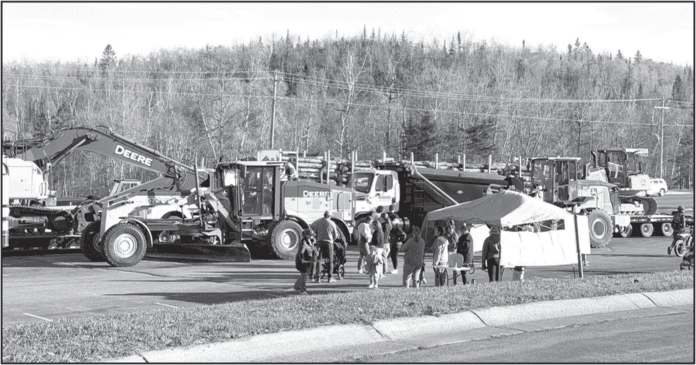
Big Wheels has become one of those Lake County traditions that feels less like a one-night event and more like a community habit. At William Kelley School in Silver Bay, the parking lot fills with children eager to climb toward logging trucks, ambulances, construction equipment and law-enforcement vehicles, while parents see something else: a rare local gathering that pulls together schools, public safety crews, mining operators and volunteers in one place.
That combination is why the event still matters after 34 years. What began as a small Transportation Night at Mary MacDonald School has grown into a well-attended family outing that now regularly draws more than 300 people, a scale that says as much about community loyalty as it does about the vehicles on display. In a place where weather can change the mood in minutes, Big Wheels has kept its place through sunshine, rain, wind, snow and even years when it had to be canceled because of Covid or lightning.
From a small transportation night to a countywide ritual
The roots of Big Wheels go back to 1991, when ECFE Coordinator Kathy Trumbell started Transportation Night at Mary MacDonald School with a focus mostly on emergency vehicles. About 27 people came that first year, a modest turnout that hardly hinted at what the event would become. Yet the basic idea was strong from the start: give young children a close-up look at the machines they see around town, and let families experience the community in a hands-on way.
The event’s evolution mirrors the growth of its audience. In 1996, a Life Flight helicopter took part, showing that special vehicles have been part of the draw for decades. By 2024, the display had expanded well beyond its original emergency-vehicle focus, with logging trucks, an ambulance, construction equipment and law-enforcement vehicles all part of the lineup. That broader mix reflects the workaday reality of Lake County, where industry, public safety and schools are all highly visible parts of daily life.
Why the crowd keeps returning
The turnout is only part of the story. Big Wheels works because it gives children a safe, low-pressure way to meet the tools and people that shape their town. For preschool and elementary-age children, it is a chance to climb, look, ask questions and connect what they see on the road with the jobs adults do around them. For parents, it is a family night that does not ask them to leave their own community behind to find something meaningful to do.
Kim Lenski, the longtime coordinator behind the event’s growth, has watched that cycle repeat. Some of the people now bringing their own children once came as kids themselves, a detail that shows how deeply the event has settled into local memory. That kind of return visit is not accidental. It suggests Big Wheels is doing more than entertaining families for an evening; it is building familiarity with schools and local institutions, which is often where long-term trust begins.
The partners behind the parking lot
Big Wheels also survives because a wide network of local partners keeps showing up year after year. The mix includes the City of Silver Bay, local emergency services, Northshore Mining, towing companies, the U.S. Forest Service, Cooperative Light & Power, local logging companies, VanHouse Construction and D&D Services. Longtime participants such as the City of Silver Bay Street and Recreation Departments, the Silver Bay Fire Department, Silver Bay Police Department, Silver Bay Ambulance and the Lake County Sheriff’s Department give the event its civic backbone.
A newcomer this year, Life Link Fire Protection Services, stood out as a hit, which is a reminder that the event can still refresh itself without losing its identity. That matters because the display works best when children can see both familiar community faces and something new. Big Wheels stays lively by balancing consistency with surprise, which is one reason families keep making the trip back.
ECFE is the bigger mission behind the fun
Big Wheels makes the most sense when it is viewed as part of Early Childhood Family Education, not as a standalone attraction. ECFE was founded in Minnesota in 1974 as an early childhood learning and parenting education program, and the Lake Superior School District says it serves children from birth to kindergarten entrance. In the district, ECFE operates at William Kelley School in Silver Bay and Minnehaha Elementary School in Two Harbors, and it is offered on a sliding-fee basis with the option to waive the fee.
That wider mission helps explain why the event endures. ECFE is built around families with young children, and Big Wheels functions as an invitation into school-community life at the earliest stages. It is also one of the clearest examples of what community education can look like when a district treats public service as more than classroom instruction. The event shows families that schools are not just places for drop-off and pickup; they can also be places where the community gathers, learns and recognizes itself.
Why Big Wheels still matters in Lake County
In Lake County, where the school district, fire departments, public works crews and mining operations are all part of the same civic landscape, Big Wheels offers something practical and something emotional at the same time. Children get a friendly introduction to the machinery that keeps the county moving. Adults get a reminder that local institutions can still work together in ways that feel personal, visible and useful.
That is the real reason Big Wheels has lasted. It is not just nostalgia, and it is not just a vehicle show. It is a repeated civic ritual that helps families understand who does what in their community, and it keeps schools at the center of that relationship. After more than three decades, that remains a rare kind of local glue.
This article was produced by Prism’s automated news system from verified source data, official records, and press releases, then run through automated quality and moderation checks before publishing. The system is built and supervised by the people who set the standards it runs under. Read our full AI policy.
Know something we missed? Have a correction or additional information?
Submit a Tip