Iona’s Beach offers a rare glimpse into Lake County’s volcanic past
Pink rhyolite, dark basalt, and a rare cobble beach make Iona’s Beach a window into the North Shore’s volcanic past, with strict rules protecting it.
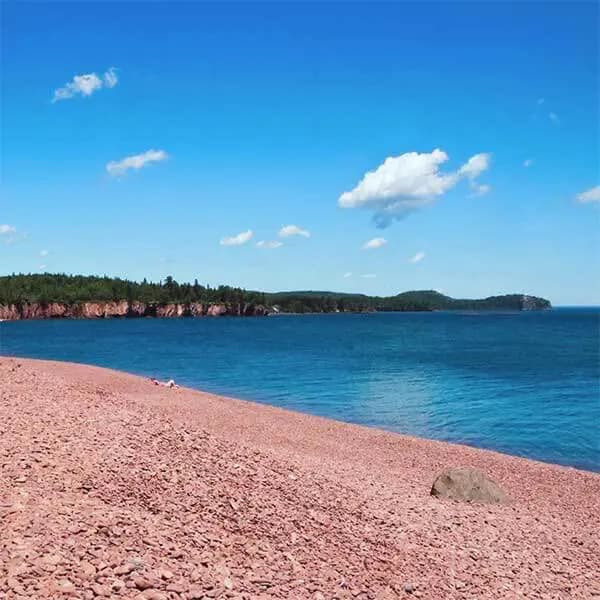
Iona’s Beach is not just another Lake Superior stop. In an 11-acre Scientific and Natural Area in Lake County, the shoreline lays out the North Shore’s volcanic history in plain view, with pink rhyolite and felsitic bedrock cliffs meeting dark gray basalt and a beach built from the rock that breaks away from them. That unusual geology, paired with public access from Highway 61 and the Gitchi Gami State Trail, is exactly why the site draws attention and why it is protected so tightly.
A shoreline built from lava and time
The Minnesota Department of Natural Resources describes Iona’s Beach as a place where cliffs of pink rhyolite and felsitic bedrock meet dark gray basalt with rhyolite beach rocks. Explore Minnesota describes the shoreline as a salmon-colored crescent that runs for more than 300 yards, bounded on one side by roughly a 30-foot cliff and on the other by a headland of gray basalt. The result is a narrow strip of cobble and rock that works like a field guide to the Lake Superior North Shore, where the bedrock belongs to the larger North Shore Volcanic Group documented by the U.S. Geological Survey.
That geology is what separates Iona’s Beach from the better-known waterfalls and overlooks farther up the county. The site is a visible lesson in how volcanic flows, uplift, and wave action shaped the coast, and the DNR specifically uses it as one of the state’s showcase geologic features. The beach itself is the product of erosion, as waves and storm winds continue to chip pink rhyolite from the cliff, smooth it into pebbles and shingles, and spread it along the shore.
Why it feels different from a typical beach
The setting is as distinctive as the rock. Explore Minnesota says visitors can walk the beach in any season, pass through a stand of pines, and step into open sky where the lake keeps remaking the land. The same listing notes orange crustose lichen on the bare rock, 13 species of warblers, and dragonflies tracing patterns over the water as late as November. That mix of stone, water, and living habitat gives Iona’s Beach a stronger ecological story than a simple scenic overlook.
The DNR’s bird checklist reinforces that point. The site is used by Bald Eagle, Osprey, Merlin, Barred Owl, Yellow-bellied Sapsucker, Double-crested Cormorant, American White Pelican, Trumpeter Swan, Red-breasted Merganser, and a range of other waterfowl and warblers. Beyond the cobble beach itself, the DNR map shows aspen-birch forest, alder swamp, and rock shore outcrops, which helps explain why the area matters to birders as much as to geology-minded visitors.
One of the most memorable parts of the site is the sound. Iona’s is often called a “singing” beach because waves recede across the smooth shingles and leave a tinkling chime behind them. It is a small detail, but it is central to the experience. The sound, like the pink stone, is part of the shoreline’s geology in motion.
How to visit without wearing it down
Iona’s Beach sits in a location that is easy to reach and easy to misuse if visitors treat it like a souvenir stop. The beach is along Highway 61, beside the Gitchi Gami State Trail, and next to Twin Points Protected Access. A path from the parking area leads down to the shoreline, and a trail-and-travel source places the site about 16 miles northeast of Two Harbors. Twin Points itself is located approximately midway between Two Harbors and Silver Bay, which makes the area a natural day-trip stop for people moving up and down the North Shore corridor.

The access is practical, but the rules are strict. The DNR says rock collecting is not allowed in state parks and state Scientific and Natural Areas, and the SNA rules also prohibit collecting plants, animals, rocks, or fossils. That matters here because the beach is literally made of the material visitors may be tempted to take home. The protection is part of the site’s purpose, not an afterthought.
There is also room for winter use. The DNR notes that many SNAs are recommended for snowshoeing and cross-country skiing in winter, which fits a place like Iona’s Beach where the shoreline and adjacent habitat stay visually striking even when the tourist traffic thins. The site’s draw is not limited to summer beachgoers, and its rules reflect that year-round use has to coexist with preservation.
The resort history behind public access
The public shoreline at Iona’s Beach exists because the land changed hands with preservation in mind. A 1995 Sugarloaf Interpreter article says the Lind family had owned the property since 1938, when Iona and John Lind, immigrants from Finland, opened Twin Points Resort. The same article says Iona wanted the land to come into public use when she retired in 1994.
That property was not small. The article says it included more than 3,000 feet of shoreline and 58 acres, with an appraised value of $845,000. The family sold it for $750,000, a contribution of $95,000 in value. The sale to the Sugarloaf Interpretive Center Association took place in September 1995, and the association later sold 5.4 acres to the state for a public boat launch.
That transition continued years later. The DNR says the Twin Points boat launch was constructed in 2002 on an old resort site after cleanup and site preparation. It is paved, with parking for 20 car-trailers and overflow space in the adjacent lot. The result is a public access point that sits immediately beside a state scientific and natural area, a rare arrangement that shows how shoreline protection and shoreline use can be balanced on the same piece of land.
Why Lake County should treat it as more than a pretty stop
Iona’s Beach matters because it holds several kinds of value at once. It is a geologic record of the North Shore’s volcanic past, a habitat that supports birds, forest edge, and shore species, and a public place that still asks visitors to behave like stewards rather than collectors. The DNR’s purpose for SNAs is to preserve natural features and rare resources of exceptional scientific and educational value, and Iona’s Beach fits that definition cleanly.
For Lake County, that makes the beach more than a photo opportunity. It is a local asset shaped by a private family’s decision to pass the shoreline into public use, a state protection framework that limits what visitors can take, and a landscape that keeps revealing its history every time waves pull back across the stones.
This article was produced by Prism’s automated news system from verified source data, official records, and press releases, then run through automated quality and moderation checks before publishing. The system is built and supervised by the people who set the standards it runs under. Read our full AI policy.
Did this article answer your question?