Lake County museum traces 3M's failed mining start in Two Harbors
A failed mineral venture near the Baptism River became 3M's unlikely start, and Two Harbors still tells it from the Dwan Law Office building.
The 3M story in Lake County begins with a bad bet on the North Shore, a patch of ground near the Baptism River, and five Two Harbors businessmen who thought they had found the raw material for a new industrial future. Instead, the venture collapsed into a lesson in geology, shipping, and business risk that still gives the city one of its most durable hometown stories.
A North Shore gamble that did not pan out
The Lake County Historical Society traces the beginning to 1901, when Duluth prospector Ed Lewis identified a possible corundum deposit. Corundum was valuable because it could be turned into abrasive material, and that prospect drew local investors into an enterprise they thought could mine, crush, analyze, and market the mineral.
In 1902, five Two Harbors businessmen organized the Minnesota Mining and Manufacturing Company: Henry S. Bryan, Dr. J. Danley Budd, Herman Cable, William A. McGonagle, and John Dwan. They bought mineral rights and 300 acres at Crystal Bay and built a processing plant near what is now Ilgen City. The geography mattered, because the company's first plan depended on getting the right ore out of a remote stretch of shoreline and into a market that could make use of it.
The problem was that the deposit was not what they hoped. The holdings turned out to be anthracite, not corundum, and the business failed before it could become the mineral strike its founders imagined. That collapse is the piece of the story that gives Two Harbors its edge: the company that would eventually become a global manufacturing giant began as a local attempt to solve a very specific North Shore problem and got the rock formation wrong.
How the company survived the failure
The failure did not end the company. In 1905, new investors Edgar Ober and Lucius Ordway stepped in and rescued the business, which then moved to Duluth and shifted into sandpaper production. That pivot mattered far beyond one product line. It turned a failed mining speculation into a manufacturing company with a practical market, built on abrasives rather than a mine that could not deliver the mineral it promised.
The next phase of the company’s growth also remained tied to identifiable people and dates. William L. McKnight joined in 1907, followed by A.G. Bush in 1909. By 1916, the company had become financially stable enough to begin paying dividends. Those milestones show how quickly the enterprise moved from a speculative North Shore venture to a business with the structure and cash flow of a durable industrial firm.
For Lake County, that evolution is the heart of the story. The company did not emerge fully formed from a distant boardroom. It grew out of local names, local capital, and a failed attempt to make sense of the region's mineral landscape. The early setback near the Baptism River became part of a much larger industrial trajectory, but the origin still belongs to Two Harbors and the men who launched it there.
Why the Dwan Law Office building matters
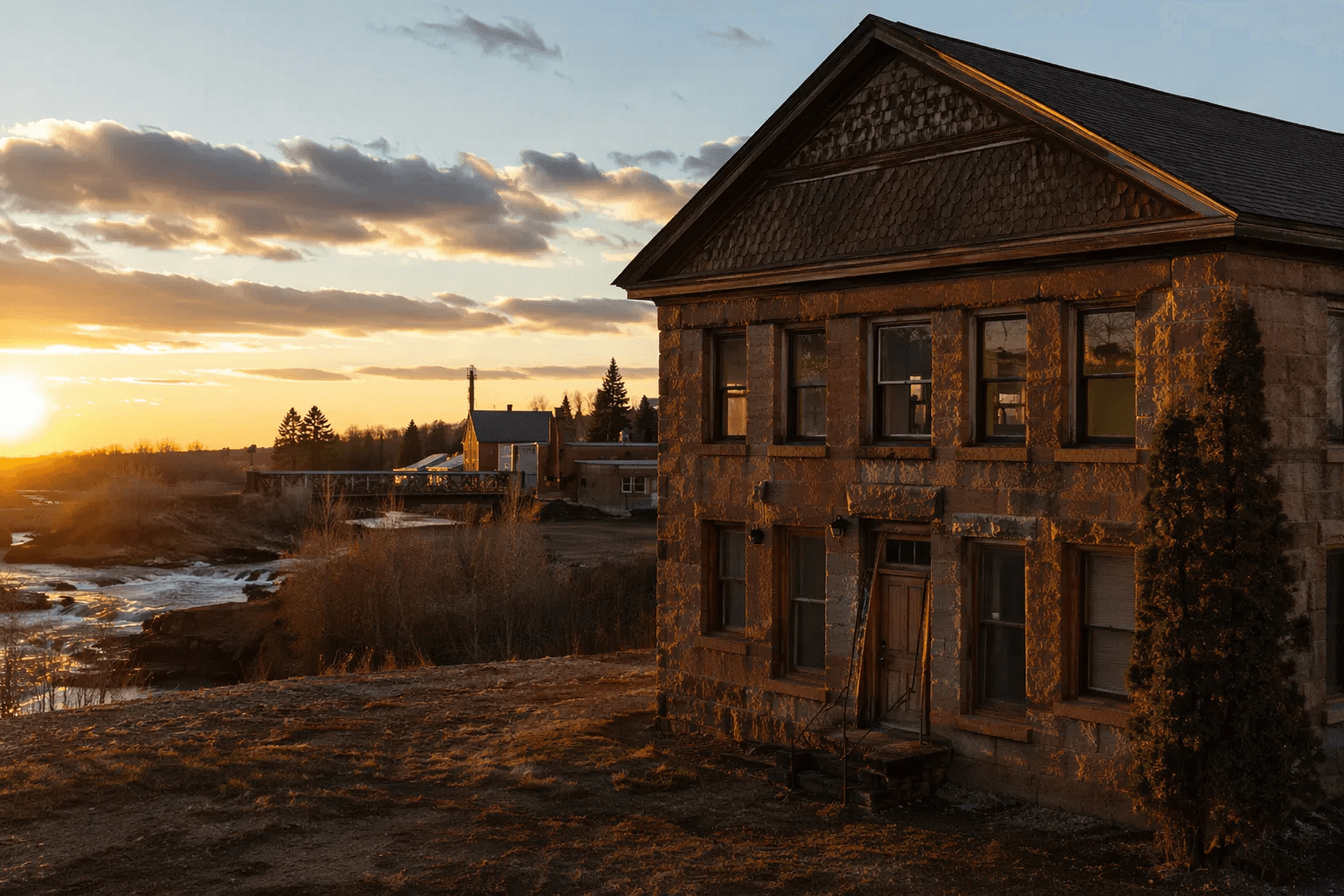
The strongest reason the story still resonates in Two Harbors is the place where it is preserved. The 3M Birthplace Museum sits in the original Dwan Law Office Building, which the Lake County Historical Society purchased in 1991. The following year, the building was listed on the National Register of Historic Places and opened as a museum devoted to 3M's early years.
That sequence gives the museum unusual authority as a civic object. It is not a generic corporate display, but a building tied directly to John Dwan, one of the five men who organized the company in 1902. The structure itself connects business formation to downtown Two Harbors, where legal work, mineral speculation, and local entrepreneurship intersected at the start of the 20th century.
The museum also preserves a version of the company's first chapter that is easy to miss when 3M is discussed only as a major multinational manufacturer. Here, the emphasis is on the Lake County beginning: the corundum hope at Crystal Bay, the 300 acres near present-day Ilgen City, the failed geology, and the turnaround that followed. Those details matter because they locate the company's origin in a specific landscape rather than in a distant corporate narrative.
Why the story still belongs to Lake County
Two Harbors keeps retelling this story because it is one of the rare local histories that connects a familiar downtown building to a company with global reach. The facts are plain enough to stand on their own: a 1901 mineral lead, a 1902 incorporation, a failed North Shore mine, a 1905 rescue, and a museum opened in a preserved law office building in 1992. Put together, they explain why residents still treat the company’s origin as part of the county’s own memory.
That memory has practical value. It gives the Lake County Historical Society a concrete way to link the region’s business history to civic pride, and it gives Two Harbors a story that is both humble and improbable. The city can point to a failed mining venture near the Baptism River and say that one of America’s most recognizable companies began here, not because the first idea worked, but because local people kept adapting after it did not.
This article was produced by Prism’s automated news system from verified source data, official records, and press releases, then run through automated quality and moderation checks before publishing. The system is built and supervised by the people who set the standards it runs under. Read our full AI policy.
Did this article answer your question?


