Silver Bay was built for taconite, not tourism
Silver Bay was mapped around a taconite plant, not a shoreline resort, and that design still shapes its streets, jobs, and county role today.
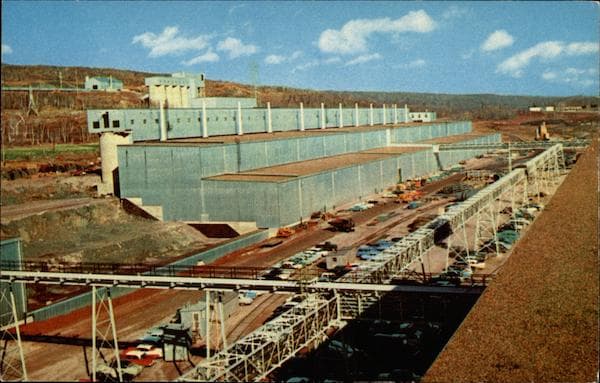
On September 13, 1956, Reserve Mining dedicated the E. W. Davis Works plant in Silver Bay. The town was engineered to serve a single industrial purpose. Unlike the looser harbor communities that grew along Lake County’s shore, this place was laid out around Reserve Mining Company’s taconite complex, and that origin still explains its housing pattern, street grid, and civic life.
A town built to fit a mine
Reserve Mining’s plans became visible in 1946, when surveyors started setting stakes for the plant and the town that would support it. The first version of the project was even known as the Beaver Bay housing project, a reminder that Silver Bay began as a company solution to an industrial problem, not as a tourist destination or a spontaneous settlement.
By 1955, Reserve had built the complex needed to extract iron from taconite, the lower-grade iron-bearing rock that only became valuable once processing methods could crush it, separate the iron with magnets, and ship the concentrate to steel mills. The plant’s name tied the town’s identity to the engineer whose work helped make commercial taconite processing possible.
Minnesota’s taconite era produced other purpose-built mining towns, including Babbitt and Hoyt Lakes. Silver Bay sits inside that wider regional redesign, when Minnesota mining shifted from richer ore deposits to a more technical and capital-intensive industry that could keep the Iron Range economy alive.
The scale of the plan versus the town that emerged
Silver Bay was designed for up to 10,000 people. It never came close to that figure. The town reached its peak population in the early 1960s at about 3,900, and its current population is about 1,950.

Maps, roads, and housing stock were built for growth that never fully arrived. The town’s physical shape still feels different from older Lake County harbor settlements, where development followed the shoreline more gradually and less centrally.
The built environment still reflects the original industrial logic. Homes, civic services, and transportation routes were arranged to support the plant and the workforce it needed.
Why taconite changed the North Shore
Taconite was economically important because it kept iron production viable after higher-grade natural ore became harder to rely on. The processing system was a technological shift: crush the hard rock, use magnets to separate the iron, and move the finished product to steel mills. Silver Bay became one of the most visible places where that shift was built into the landscape.
That industrial transition also explains Silver Bay’s place in Lake County’s economy. The town became part of the county’s labor, transportation, and public-service network. Its roads and homes were part of the factory’s operating design.
The environmental conflict that reshaped the story
By the late 1960s, the same industrial system that made Silver Bay possible had become a source of major conflict. Local environmental groups, commercial fishermen, and sport-fishing groups objected to Reserve Mining’s taconite sediment in Lake Superior. Their complaints were concrete: the tailings were killing fish, clouding the water, and threatening Lake Superior as a freshwater source for Duluth and nearby communities.
The dispute deepened when environmental organizations, scientists, and lawyers argued that the tailings contained cummingtonite-grunerite, a mineral found in asbestos and associated with cancer risk. That transformed the argument from a local nuisance dispute into a broader fight over public health, water quality, and industrial accountability.
The federal case United States v. Reserve Mining Company grew out of that conflict and became one of the defining environmental disputes on the North Shore. Minnesota Conservation Commissioner Chester S. Wilson had warned Reserve about the business risk at a public hearing on June 17, 1947, years before the fight became a national case.
Silver Bay now: a county town, not just a company town
Silver Bay is still more than a memory of Reserve Mining. Lake County maintains a Health and Human Services office at 99 Edison Blvd. in Silver Bay, and the same address is listed as the Silver Bay Public Health Clinic.
University of Minnesota archival finding aids list Silver Bay and Babbitt histories and Reserve Mining photographs from 1952 to 1962 in collections associated with E. Judson Bentley and Reserve Mining records.
This article was produced by Prism’s automated news system from verified source data, official records, and press releases, then run through automated quality and moderation checks before publishing. The system is built and supervised by the people who set the standards it runs under. Read our full AI policy.
Did this article answer your question?


