How Lane County government works, from charter to commissioners
Lane County’s charter puts five district commissioners, plus the sheriff, assessor and district attorney, at the center of local decisions from roads to public safety.
A pothole on a rural Lane County road, a property tax dispute in Springfield, or a public safety complaint in West Lane all start with the same question: which local office actually has the power to act? In Lane County, the answer runs through a home rule charter, a five-member board of commissioners, and a set of separately elected countywide officials that shape daily life in Eugene, Springfield, Florence, Oakridge and the county’s unincorporated communities.
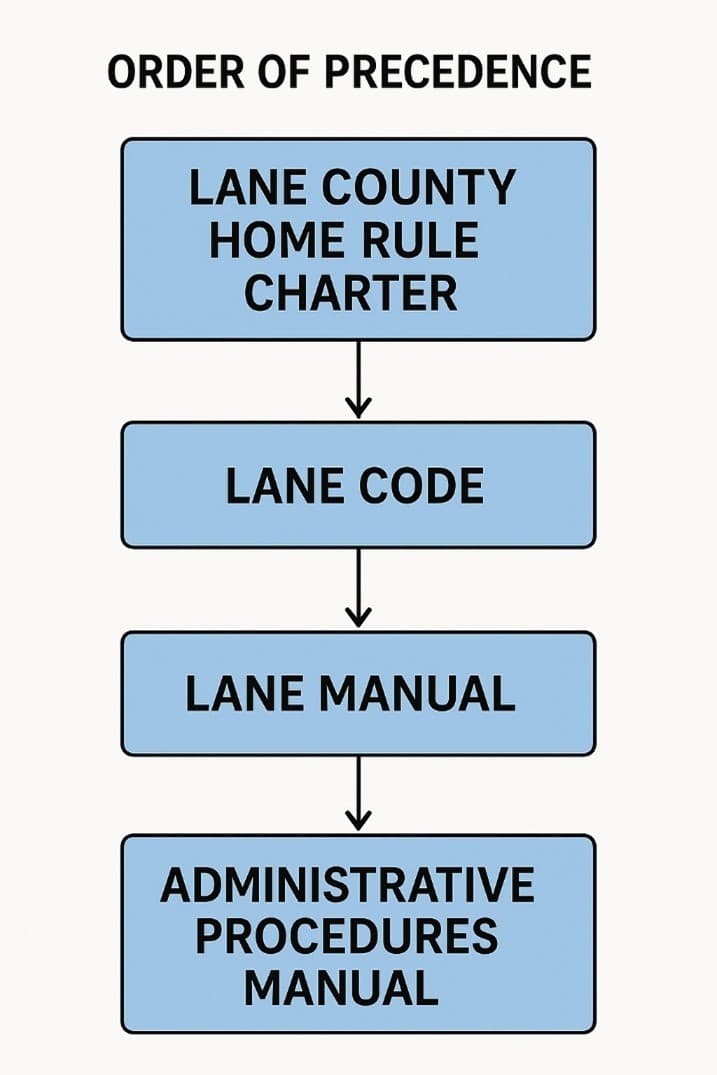
The charter is the county’s rulebook
Lane County government operates under a home rule charter approved by voters in 1962, and the charter itself was adopted at the November 6, 1962, General Election. Home rule gives Lane County its own local framework for governing within state and federal limits, instead of relying only on a generic county structure.
The charter’s preamble says residents adopted it “in order to avail ourselves of self determination in county affairs to the full extent permissible under the constitution and laws of the state.” Lane County’s charter also sits inside Oregon’s broader home rule system: all 36 Oregon counties have home rule power, nine counties adopted charters under the 1958 constitutional home rule amendment, and the remaining 27 exercise home rule power through a 1973 statute. State law still prevails, but the charter gives Lane County room to decide matters of county concern on its own terms.
The charter sets the county’s powers, boundaries and county-seat structure, and it also creates offices and boards that affect how the county is run.
Five commissioners, five districts
The most visible part of county government is the Lane County Board of County Commissioners. It is a five-person, full-time, compensated board, and commissioners are elected from specific geographic districts for four-year terms. Each commissioner represents a specific geographic district, so the person representing North Eugene does not represent Springfield, and the commissioner for East Lane does not speak for West Lane.
The districts are West Lane, Springfield, South Eugene, North Eugene and East Lane. In 2020, Jay Bozievich represented District 1, West Lane County; Joe Berney District 2, Springfield; Pete Sorenson District 3, South Eugene; Pat Farr District 4, North Eugene; and Heather Buch District 5, East Lane. On June 30, 2021, Joe Berney was chair and Pat Farr was vice chair.
The board legislates and administers county government within the limits of the authority granted in the charter. The commissioners are the elected decision-makers when county policy, county administration, parks, public works and other county functions need direction. If a problem sits in county territory rather than city hall, the district commissioner is usually the elected official residents need to know.
Where residents actually go with everyday problems
For people living in Eugene or Springfield, the first stop for a city street problem or a local ordinance issue is often the city government. But once an issue falls into county territory, especially in places such as Florence, Oakridge, Junction City, Veneta, Harrisburg, Blue River and other unincorporated communities, Lane County offices become much more important.
Public safety complaints belong with the Lane County Sheriff’s Office, because the sheriff is one of the countywide elected officials. Tax questions go to the Lane County Assessor’s Office, another elected countywide office. Criminal prosecution falls to the Lane County District Attorney’s Office, also elected countywide. Those offices are not appointed by the commissioners, even though they operate inside the same county system.
Land use and county services in unincorporated areas also run through county government. When residents outside city limits need action on county policy, county administration or a commissioner’s district office is where the chain of responsibility starts. The district map tells residents which commissioner represents their part of the county, and the charter tells them how much authority the county has to act.
Why the map matters as much as the charter
Lane County has kept redrawing its districts through public process. The Board of County Commissioners selected Map J on Dec. 1, and Map J took effect after the November 2022 general election. That kind of change can shift which neighborhoods fall into which district, and it is one reason residents should verify their commissioner when a local issue comes up.
A 2024 county flyer asked voters to consider four proposed amendments to the Lane County Home Rule Charter in the November 2024 general election. The proposed changes included removing outdated references and establishing a new charter section.
The quieter board that still affects public office
One less visible piece of county government is the Lane County Elected Officials Compensation Board. Created under the charter, it recommends compensation schedules for county elected officials.
This article was produced by Prism’s automated news system from verified source data, official records, and press releases, then run through automated quality and moderation checks before publishing. The system is built and supervised by the people who set the standards it runs under. Read our full AI policy.
Did this article answer your question?