UO opens Knight Campus Building 2 to expand bioengineering research
UO’s new 185,000-square-foot Knight Campus Building 2 opened at 1100 Riverfront Parkway, adding lab and startup space that Lane County will judge by jobs and biotech spinouts.
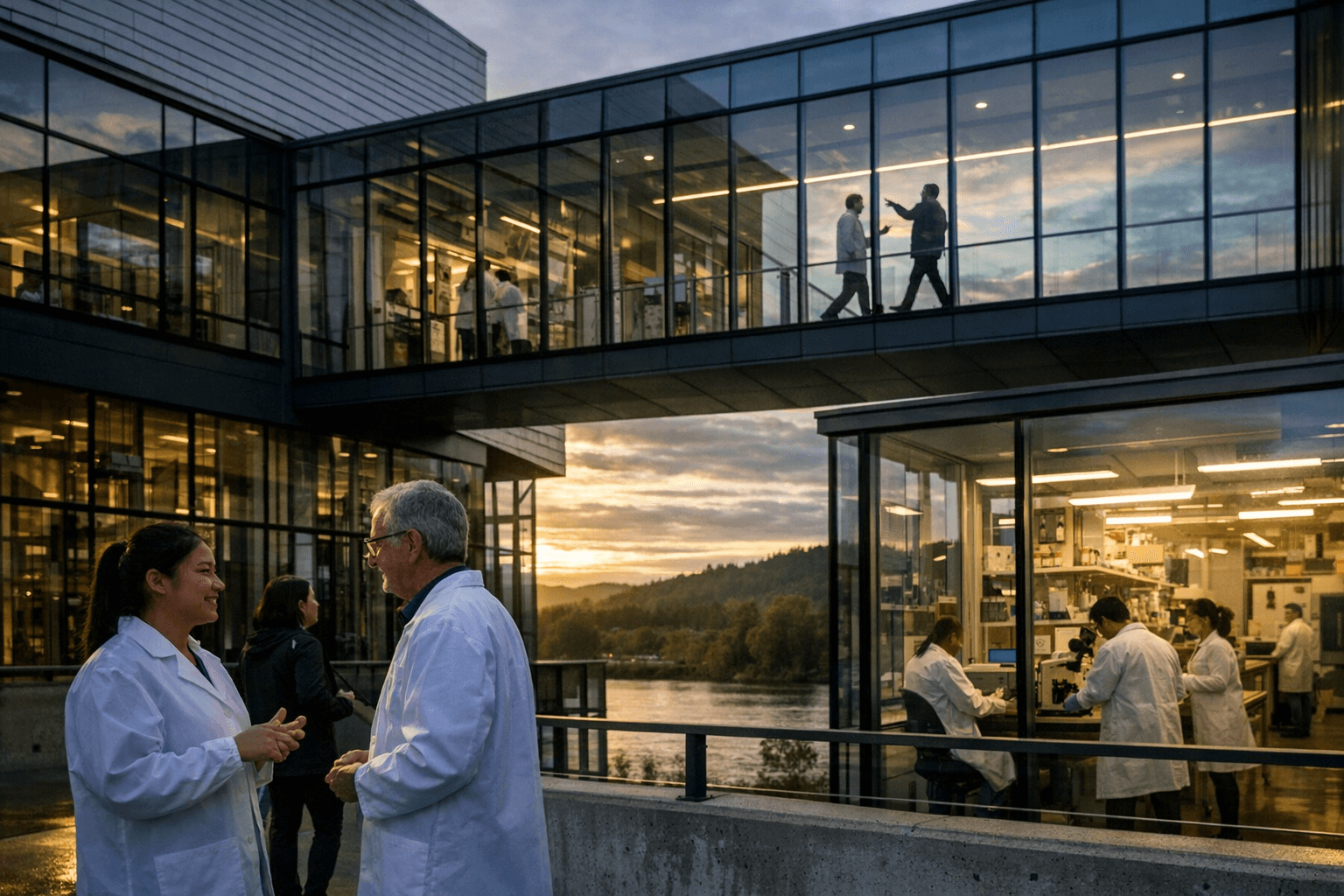
The University of Oregon opened Knight Campus Building 2 at 1100 Riverfront Parkway, adding 185,000 square feet of bioengineering space to Eugene’s riverfront and setting up a bigger question for Lane County: how much public and private money will turn into jobs, startup companies and medical technology that reaches patients.
The new multi-story building opened to the public on Monday, March 30, 2026. Its first two floors are open to the UO community and the public during business hours, Monday through Friday from 7 a.m. to 5 p.m., with the Riverfront Bistro operating weekdays as one of the few public-facing pieces in a facility built for research.
UO says the building doubles the Knight Campus’s capacity for research and development of new biomedical technologies and adds room for expanding academic programs, startup incubation spaces and a new BioFoundry. The second phase of the Phil and Penny Knight Campus for Accelerating Scientific Impact was made possible by a second $500 million gift from Penny and Phil Knight, and Oregon lawmakers approved $10 million to support cutting-edge technologies in Building 2. Construction moved forward after the Oregon Board of Trustees approved the budget on Dec. 6, 2022, and the university first revealed design details on May 23, 2023.
The campus’s bioengineering program now includes 15 independent faculty-led labs working on 3D printing, laser microfabrication, gene therapy, tissue regeneration and polymer chemistry. That mix is meant to push discoveries beyond the laboratory, from better ways to deliver medicines and vaccines to new materials and therapies that could help injuries heal faster. UO says many of its faculty members are entrepreneurs who help develop startups, a detail that matters for Eugene because the building is designed not just for research, but for commercialization.
Two new faculty hires in January 2026 underscore that push. Therapeutic ultrasound engineer Sara Keller joined the campus, along with nanomaterial immunoengineer David Peeler, whose work is aimed at targeted diagnosis and therapy, antimicrobials, immunotherapies and vaccines.
Many of the labs are only beginning to move in, so the building is still in a ramp-up phase. UO says a skybridge will eventually connect the new buildings, further enlarging a campus that now stands as one of Eugene’s most visible bets on medical innovation, but its real measure will come in the number of startups, research partnerships and technologies that leave the building and reach the market.
This article was produced by Prism’s automated news system from verified source data, official records, and press releases, then run through automated quality and moderation checks before publishing. The system is built and supervised by the people who set the standards it runs under. Read our full AI policy.
Did this article answer your question?