Aguilar water tank corrosion highlights rural infrastructure strain in Las Animas County
Aguilar’s corroding water tank shows how one small-town breakdown can become a countywide emergency, with Hartman’s collapse underscoring who may end up paying.
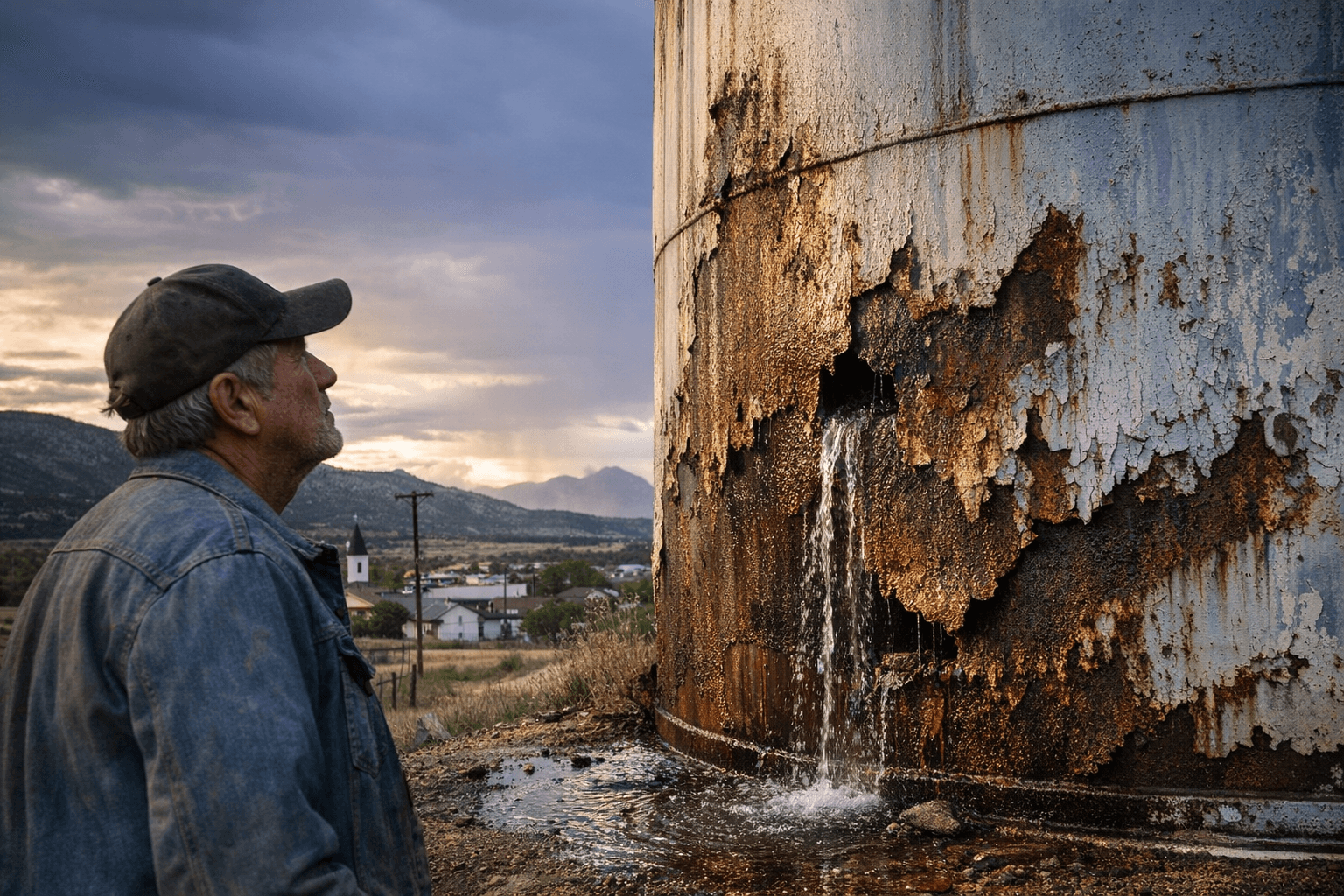
Aguilar’s aging 180,000-gallon water tank is still in service under a state enforcement order, and that alone shows how quickly a small-town utility problem can spill into a countywide risk. In a town of about 450 people in southern Las Animas County, inspectors have documented corrosion and structural concerns over multiple visits, turning a basic maintenance problem into a question of public safety, fire protection and whether local government can still keep a system running.
The Colorado Department of Public Health and Environment issued the enforcement order in May 2023 after a sanitary survey found structural and operational deficiencies in Aguilar’s primary water system, including deterioration in the storage tank. A comprehensive inspection in September 2025 found the problems had deepened: extensive interior coating failure and corrosion, with pitting on the tank floor, walls and support column. State drinking-water rules allow escalated enforcement when systems pose threats to public health or rack up multiple or severe violations, and CDPHE’s Water Quality Control Division is responsible for inspecting systems, issuing permits, ensuring compliance and taking action against violators.
The town’s water troubles have been compounded by governance turmoil. Recent reporting said Aguilar town administrator Tyra Avila was arrested on suspicion of embezzling money tied to a legally mandated water project, adding a criminal case to a utility crisis that already threatened day-to-day service. When a town loses control of both the infrastructure and the money meant to support it, the burden can quickly move beyond the municipal line.
A similar warning played out farther east in Hartman, where state and local officials met with residents in Holly on Feb. 28, 2026, to discuss the town’s governance crisis and the future of its water system. Hartman had no Board of Trustees as of January 2026, after the mayor resigned in November 2025. The town’s water system was under a boil order and had no certified operator, leaving a municipality with no functioning local government to oversee one of its most basic services.
That collapse has pushed lawmakers to consider a bill that would make it easier to declare towns abandoned so a county could transfer a failing water system to another entity, a move meant to limit Prowers County’s liability tied to Hartman’s water supply. In Las Animas County, the emergency-management office describes itself as the county’s center for all-hazard emergency preparation, prevention, response and recovery, a reminder that counties often become the only institution left with enough structure to help when a small town’s water system starts to fail.
That shift matters in Aguilar and beyond. A corroded tank is no longer just an engineering issue when it threatens taps, fire protection and compliance with state orders. In rural southern Colorado, the first breakdown in a small municipal system can become the point where county government starts serving as the safety net.
This article was produced by Prism’s automated news system from verified source data, official records, and press releases, then run through automated quality and moderation checks before publishing. The system is built and supervised by the people who set the standards it runs under. Read our full AI policy.
Did this article answer your question?