Mt. San Rafael Mural Celebrates Trinidad Heritage, Sister Augusta Zimmer's Artistic Legacy
A 28-foot ceramic masterpiece in Mt. San Rafael Hospital's lobby tells Trinidad's full story, shaped by a Cincinnati nun's four years of dedicated work.
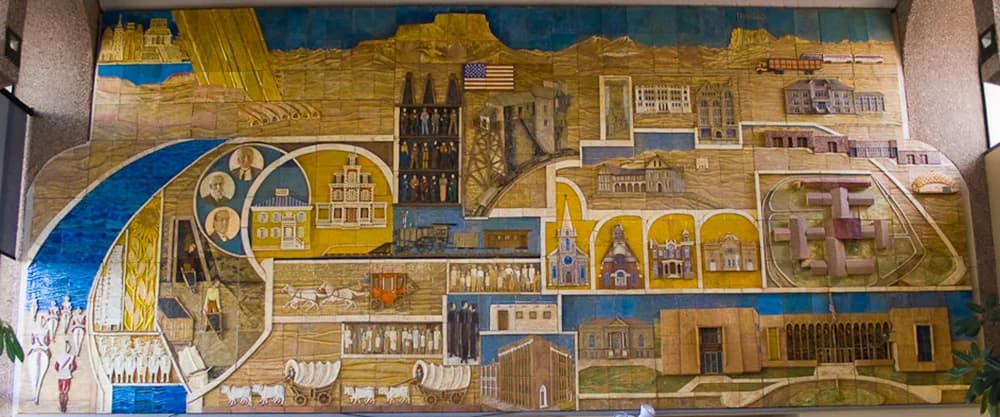
Tucked among newspaper clippings and carefully preserved booklets in the history room of the Carnegie Public Library of Trinidad is the documented story of one of the most ambitious works of public art ever created for this city. The ceramic mural titled "Trinidad — Our Proud Heritage" stretches 28 feet long and 12 feet high across the lobby of Mount San Rafael Hospital, a permanent testament to the community's layered past. Its creator, Sister Augusta Zimmer, S.C., shaped that history in clay from a studio hundreds of miles away in Cincinnati, and her work has endured for more than four decades as both art and archive.
A Commission Born from Community Memory
The Trinidad Area Health Association commissioned the mural in 1976, funding it entirely through memorial contributions rather than hospital operating budgets. That funding model matters: every dollar came from families and neighbors honoring the dead, which gives the piece a collective weight beyond its physical dimensions. Sources describe that physical weight with some variation. The World Journal describes the mural as weighing "nearly a ton and a half," while the Sisters of Charity of Cincinnati archives refer explicitly to the "2,000-pound ceramic mural." The two figures do not reconcile easily, since a ton and a half would be closer to 3,000 pounds. Both descriptions appear in the historical record, and the Carnegie Public Library's archives may hold installation records that could resolve the discrepancy definitively.
The timeline of the project also carries some complexity. The World Journal places the commission in 1976. A January 4, 1981 feature in Empire Magazine described the undertaking as "four years of dedicated work" by Sister Augusta, which would place the start of active work around 1976 or 1977, consistent with that commission date. The Sisters of Charity of Cincinnati archival timeline, however, states that installation occurred in 1980 and references "five years into the execution," a phrasing that could push the start date back to 1975 or suggest a different counting of the project's phases. What all sources agree on is the installation year of 1980 and the result: a mural that Empire Magazine called "a story forever preserved."
The Artist Behind the Clay
Sister Augusta Zimmer was not a regional artist taking on a local commission. By the time she accepted the Trinidad project, she had built a career grounded in serious formal training and international experience. She studied at the Chicago Art Institute and at the Pius XII Institute in Florence, Italy, and traveled extensively through Europe and the Middle East. That breadth of exposure shaped an artist capable of working at monumental scale with historical precision.
Her professional home was Mount St. Joseph in Cincinnati, where she served as a faculty member and taught art for 33 years, from 1938 to 1971. Her studio in Regina Hall became the operational headquarters for the Trinidad mural. The World Journal notes that much of Trinidad's history literally "took shape in clay" in that Cincinnati studio, hundreds of miles from southern Colorado. The logistics of conceiving, producing, and ultimately transporting a ceramic work of this scale from Ohio to Colorado adds another dimension to the achievement.
Before the ceramic mural, Sister Augusta had already left her mark on Mount San Rafael Hospital. The Sisters of Charity of Cincinnati archives record that she completed a fused glass window depicting the Burning Bush for the new hospital building, and that commission preceded or coincided with the mural project. The Burning Bush window and the lobby mural together represent a sustained artistic relationship between Sister Augusta and the Trinidad institution she helped define visually.
What the Mural Depicts
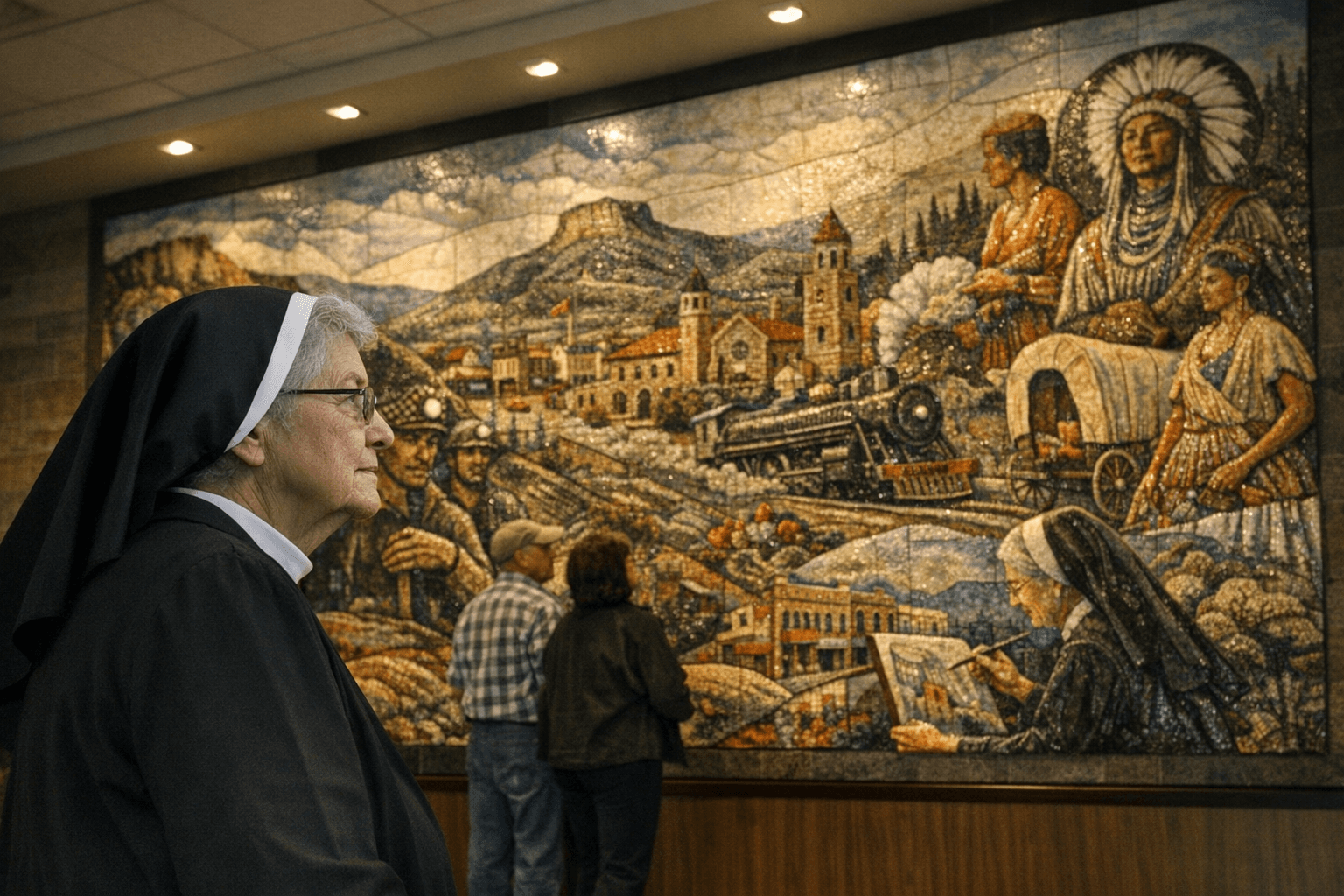
The title "Trinidad — Our Proud Heritage" signals the mural's documentary intent. An article headline preserved in the Carnegie Library archives captures the ambition plainly: "History of Western City Comes Alive in Nun's Ceramic." The mural was designed to narrate Trinidad's history in visual form, making the hospital lobby a civic gallery as much as a medical waiting space. Empire Magazine recognized this in its 1981 feature, describing the result of Sister Augusta's four years of work as something permanently preserving the city's story for anyone who passes through those doors.
The Deeper History the Mural Inhabits
Mount San Rafael Hospital itself carries a history that gives the mural additional resonance. In 1889, five Sisters of Charity, under the leadership of Sister Catherine Mallon, opened the hospital with support from Rev. Charles Pinto, S.J., Dr. Michael Beshoar, and citizens of Trinidad. That founding act was the beginning of a presence that would eventually span 138 years, during which a total of 444 Sisters of Charity lived and worked in Trinidad.
The Sisters' footprint extended well beyond the hospital walls. In 1873, a new building opened to accommodate St. Joseph Academy. In 1892, the Sisters withdrew from the public school system after a requirement prohibited them from wearing religious habits while teaching, and Holy Trinity parish school opened in response, with the Sisters teaching there alongside St. Joseph Academy. In 1908, after a statue of the Virgin Mary was discovered on a hillside near the hospital, the Sisters built a small grotto that eventually grew into the Ave Maria Shrine.
That institutional longevity is part of what Sister Augusta was preserving in ceramic. By 1976, when the Trinidad Area Health Association commissioned "Trinidad — Our Proud Heritage," the Sisters of Charity had already shaped nearly a century of the city's educational, medical, and spiritual life. The mural was, in some sense, a record of what they and the broader community had built together.
Finding the Full Story
For anyone wanting to go deeper, the Carnegie Public Library of Trinidad's history room holds the physical record: newspaper clippings, preserved booklets, and archival materials that trace the mural from commission through installation and into its reception by the press. The Sisters of Charity of Cincinnati archives provide the institutional context, including the timeline of Sister Augusta's other work at the hospital and the broader history of the congregation's 138 years in Trinidad.
The World Journal's "Mt. San Rafael Legacy" series, written by Lisa Glorioso, has been working to surface this material for a contemporary readership. This third installment on the mural and Sister Augusta follows earlier parts of the series covering the hospital's broader century-long legacy. Together, they offer Las Animas County residents a documented account of an institution that has sat at the center of community life since the late nineteenth century.
The mural in the lobby of Mount San Rafael Hospital is not decorative background. It is a 28-foot record of a city's identity, fired in clay by a woman who spent four years ensuring that Trinidad's history would outlast the people who lived it.
This article was produced by Prism’s automated news system from verified source data, official records, and press releases, then run through automated quality and moderation checks before publishing. The system is built and supervised by the people who set the standards it runs under. Read our full AI policy.
Did this article answer your question?