Helena Volunteers Restore Eroded Riverbanks With Native Plantings, Bioengineering
Volunteers stabilized 200 feet of eroded Little Prickly Pear Creek bank Tuesday using a "brushy toe" technique, replacing riprap with native willows that will root and filter sediment downstream.
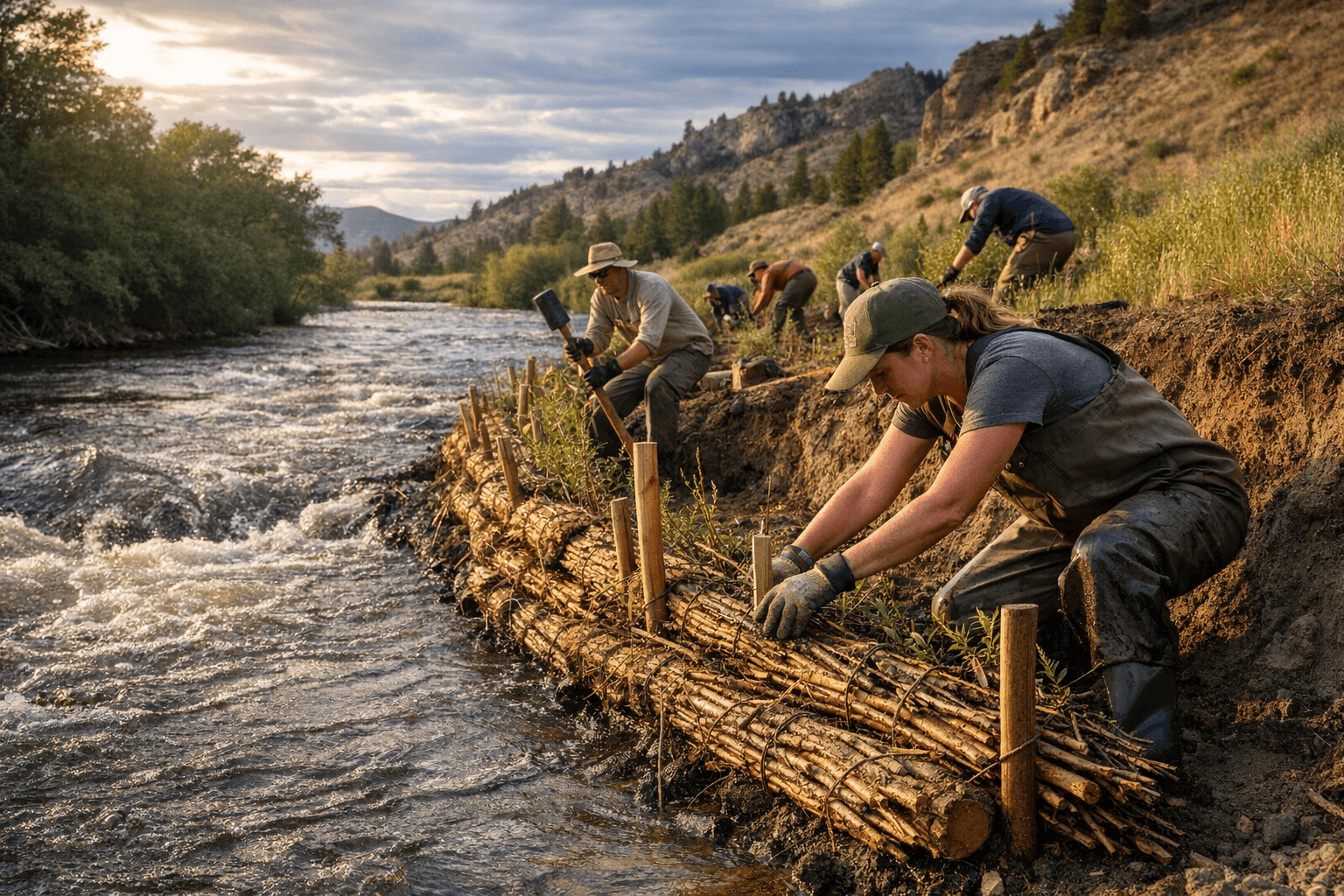
Landowner John Baucus stood on the banks of Little Prickly Pear Creek Tuesday as Lewis and Clark Conservation District volunteers packed wet soil over willow cuttings and forest fire debris, rebuilding 200 feet of stripped streambank without a piece of heavy machinery in sight.
The technique is called "brushy toe." Volunteers cut willows growing naturally along the creek, laid them at the base of the eroded bank, stacked branches salvaged from nearby forest fire clearing operations on top, then tamped the entire structure down with wet soil. Over the next year, thousands of roots will thread through that packed material, bonding soil that high flows had stripped away.
"It's a learning process," said Baucus, whose property borders the affected stretch. "I'm kind of learning just along with everybody else, but it's all positive. It's good to know different processes or different options for different stream banks."
The approach directly replaces traditional riprap, the stacked rock walls that have been the default fix for eroding Montana banks but provide little benefit for fish habitat or water quality. Lewis and Clark Conservation District chairman Jeff Ryan said the difference is a bank that fights back.
"How it works is those branches, that roughness breaks up those water currents that tend to erode the banks," Ryan said. "We'll break up these currents, and then all of those live willow cuttings that are in the brush will root."
The stakes extend well beyond the property line. Little Prickly Pear Creek drains into the Missouri River system, and unanchored banks carry sediment and nutrients downstream, degrading water quality and smothering fish habitat with each high-flow event. The Tuesday site was selected because past bank disturbance and vegetation loss had left it especially exposed to erosion. The Lake Helena Watershed Group partnered alongside the Lewis and Clark Conservation District on the broader restoration push, with volunteers relying entirely on hand tools to avoid disturbing the fragile, rebuilt bank soil.
Unlike riprap, the brushy toe structure is designed to improve with age. Willow canopy will shade the creek, cooling water temperatures for fish; root networks will filter stormwater runoff before it reaches the channel; and the bank itself becomes progressively harder to erode as vegetation matures.
Organizers said monitoring and follow-up plantings will continue through the growing season as the district works to confirm that root establishment is taking hold. Landowners, municipal staff, and students interested in joining future restoration sessions can contact the Lewis and Clark Conservation District directly for schedules and training details.
Know something we missed? Have a correction or additional information?
Submit a Tip