Lewis and Clark County History Center Preserves Local Heritage, Hosts Community Programs
Territorial maps and 150 years of digitized Helena newspapers housed at 618 Helena Avenue can resolve active title disputes; the same archive where vigilante-era justice left its paper trail.
Records That Can Protect You Right Now
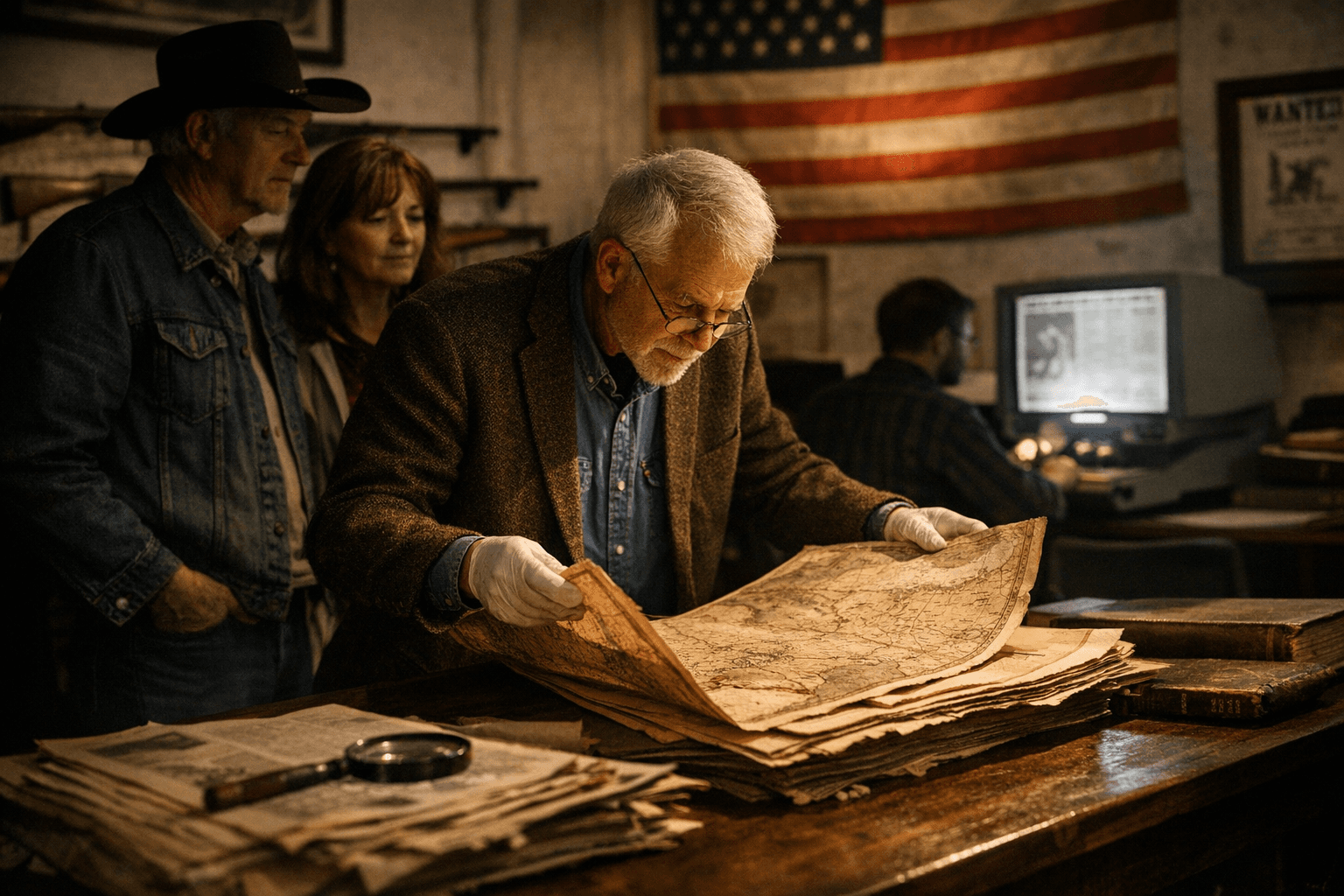
Before a boundary dispute becomes a lawsuit, before a family searches court filings for an ancestor's land claim, and before a developer discovers an unrecorded easement the hard way, there is a resource on Helena Avenue that most Lewis and Clark County residents have never fully used. The Lewis and Clark County History Center, operating out of the historic Steamboat Block at 618 Helena Avenue, is more than a museum with rotating exhibits. Its research archive holds maps, photographs, property-linked documents, and 150 years of digitized local newspapers, all of them accessible free of charge to anyone who walks through the door.
The Historical Society behind the center was established in 1989 by a founding group that included Jerry Metcalf, Harriett Meloy, Jean Weeks, Lynn Moon, Kathy Macefield, Dennis McCahon, and Dick Wall, among others. A permanent downtown History Center followed in 2007 and has operated continuously since. What began as a preservation effort has become one of the most useful primary-source repositories in the region, specifically because so much of what it holds cannot be found anywhere else in one place.
What the Collections Actually Contain
The History Center curates artifacts, photographs, maps, and documents spanning territorial-era settlement through 20th-century industrial and civic development. Exhibits rotate seasonally and have covered clothing and domestic artifacts, transportation and communications history, and thematic installations on mining heritage. Beyond the exhibit floor, the archival holdings support research into family histories, property records, and community organization records, with volunteers and staff available to guide patrons through the materials.
The center also carries books and publications on Helena's development, including works by local historian and author Jon Axline, whose writing on Montana transportation history offers context that maps and documents alone cannot provide. For anyone tracing the growth of a specific neighborhood, a water right, a mining claim corridor, or a family homestead, these secondary sources often become the interpretive bridge between raw archival evidence and a legible story.
Using the Archives to Resolve Land and Legal Questions
The research center inside the History Center features free computer workstations, printer access, and full internet connectivity for on-site researchers. Its most distinctive offering is digital access to the historic newspapers that served Lewis and Clark County's communities across the past 150 years, making it possible to trace how specific properties, businesses, legal disputes, and public figures were reported on in real time.
If you are dealing with a property boundary question, an unresolved easement, or a title issue that predates modern digital records, here is how to approach a research visit:
1. Call or check the website before you go. Hours and program schedules vary seasonally.
Staff can also tell you in advance whether the specific record type you need is likely to be in the History Center's holdings or whether you should also plan a visit to the Lewis and Clark County Clerk and Recorder's office at 316 N Park Avenue, which holds deeds, mortgages, surveys, mining work filings, military discharges, and birth and death records.
2. Ask specifically for historical maps of your area of interest. The center holds cartographic records that predate subdivision-era surveys and can show original plat lines, drainage features, and road corridors that formal deeds may not describe clearly.
These maps are particularly useful for identifying historical access routes that later became disputed easements.
3. Request the newspaper archive for the relevant time period. Digitized papers can surface notices of sale, probate filings, court judgments, and property transfer announcements that never made it into formal deed books.
A contested mining claim from the 1890s or a boundary ruling from the 1910s may appear in a Helena paper long before it was indexed elsewhere.
4. Ask staff about community organization records. Homeowners' associations, irrigation districts, and neighborhood groups often deposited records with the Historical Society.
These documents can establish longstanding use agreements that have legal bearing on current property questions.
5. For certified legal copies, follow up at the county. The History Center's holdings are invaluable for research and establishing historical context, but certified copies of recorded instruments must come from the Lewis and Clark County Records Department.
Use the History Center to identify what exists and when it was filed; use the county office to obtain the official copy.
Computer and printer use at the research center is free. Staff assist patrons without charge. Membership and donations support the ongoing work of acquiring and preserving collections.
The Vigilante Files: Justice Before the Courts Existed
The most gripping chapter in the History Center's archive is also among the most legally instructive. On July 14, 1864, four prospectors, John S. Cowan, John Crab, Bob Staley, and Daniel Jackson, struck gold in a creek they named Last Chance Gulch. Within months, a mining camp had become a town. Within years, that town became Helena, the seat of what is now Lewis and Clark County. But formal legal infrastructure was nearly nonexistent in those first years. Territorial law enforcement carried little practical authority in remote mining settlements, and citizens organized their own response.
The Montana Vigilantes, drawing on the model established at Alder Gulch and Bannack in December 1863, had already hanged at least 22 men, including Sheriff Henry Plummer himself, before Helena's gold rush was underway. As fortune seekers flooded Last Chance Gulch from Alder Gulch and Bannack, they brought this extralegal tradition with them. The territorial newspapers that the History Center has digitized covered these events in real time, with original reporting on hangings, mining camp disputes, and improvised land claims that were later challenged when formal courts arrived.
Those newspapers and the territorial-era records in the History Center's collections document what the county looked like before deeds were reliable, before courts had enforcement power, and before the boundary lines on modern maps were drawn. For anyone researching a family connection to early Helena, a property claim that traces back to a mining-era patent, or simply the legal history that preceded Montana's statehood in 1889, these are the original documents. No other institution in Helena has assembled them in this form.
Monthly Programs and Second-Tuesday Talks
Beyond the archive, the History Center functions as a civic forum for ongoing historical education. Monthly programming includes the recurring Second Tuesday talks, which have brought speakers on subjects ranging from transportation history and mining heritage to local biographies and preservation policy. Special events complement the regular calendar, often featuring visiting historians, extended Q&A sessions, and refreshments that make these evenings accessible as community gatherings rather than purely academic events.
School groups visit regularly, and the programming is intentionally designed to show how historical decisions inform present-day choices. Whether Helena pursues a particular downtown development, routes a trail through a historically significant corridor, or applies for a National Register nomination, the History Center's programming keeps public awareness of those connections alive.
Planning Your Visit
The History Center is located in downtown Helena's Steamboat Block at 618 Helena Avenue, within walking distance of Last Chance Gulch and the broader core that the county's earliest settlers built. Because hours and special-event schedules shift seasonally, checking the Lewis and Clark County Historical Society's website at l-cchs.org or calling ahead before a research-focused visit is strongly advised. On-site staff can provide exhibition overviews, direct patrons to specific archival materials, and answer questions about membership, which is one of the primary ways the organization sustains its preservation and programming work. Typical visits combine a walk through the current exhibit with a session at the research workstations, and researchers with specific questions often find that staff familiarity with the collections significantly shortens the search.
Why the Archive Is a Practical Tool, Not Just a Cultural One
Local history institutions carry obvious cultural value, but the Lewis and Clark County History Center's collections do something more concrete: they supply documentary evidence for decisions that carry legal and financial weight. National Register nominations require historical documentation. Oral histories preserve community knowledge that no deed book captures. Interpretive signage, infrastructure decisions, and tourism initiatives all draw on the kind of primary-source grounding that the History Center provides to residents, planners, and decision-makers who need more than current records to understand what they are working with.
For a county whose entire legal and civic foundation was laid in the chaotic decade after four prospectors named a gold strike after their own diminishing odds, the archive at 618 Helena Avenue is where that foundation is still legible.
This article was produced by Prism’s automated news system from verified source data, official records, and press releases, then run through automated quality and moderation checks before publishing. The system is built and supervised by the people who set the standards it runs under. Read our full AI policy.
Did this article answer your question?