Montana Teacher Shortages Persist, Rural Districts Facing Acute Strain
Montana has more than 300 teaching vacancies statewide, and 75% of northeastern districts rely on emergency-licensed teachers as a stopgap for a shortage experts call among the worst in the nation.
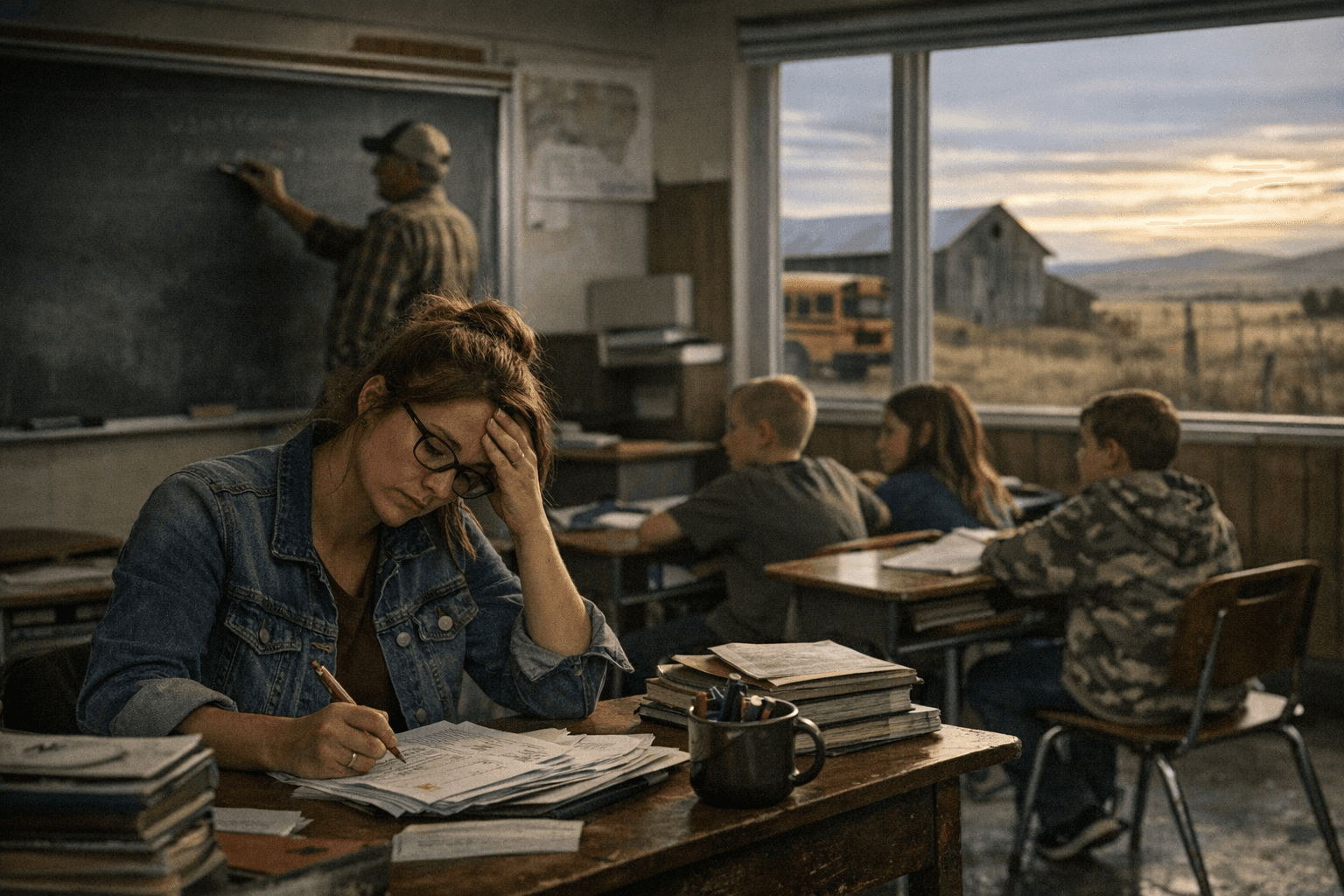
The Montana Office of Public Instruction reported more than 300 teaching vacancies statewide at the start of this school year, and the pressure landing on rural classrooms has grown severe enough that educators, administrators, and state officials are calling Montana's situation one of the most acute in the country.
Over half of Montana's school districts reported difficulty filling positions last year, with rural communities bearing the heaviest burden. According to the Montana Department of Labor & Industry, new teachers in the state typically start in the mid $30,000 range, among the lowest starting salaries nationwide. That combination of scarce applicants and thin compensation has left districts from Cascade to Centerville posting openings they struggle to close.
Michael Wilson, principal of Cascade Schools, said the applicant pipeline has thinned dramatically compared with a decade or two ago. "Ten, 15 years ago, you know, pre-COVID, districts really were receiving probably a larger — we were definitely seeing a larger applicant pool than we are today," Wilson said. "So, we're just seeing fewer applicants for single positions." Though Cascade is currently fully staffed, most districts struggle as teachers retire or leave the workforce.
In northeastern Montana, the shortage has pushed the Wolf Point School District into a staffing model that state officials acknowledge was never meant to be permanent. Wolf Point High School is one of many Montana schools using Emergency Authorized teachers, a temporary license that fills critical gaps in staffing but has become a crutch when teacher shortages are high. Seventy-five percent of districts in northeastern Montana have emergency-licensed teachers, according to the School Administrators of Montana.
Will Larsen began his career in education when he took a job at Glasgow Middle School as a teacher's assistant in the special-education department; before that, he worked in the oil fields. Last spring, he got an offer to work at the school as more than an assistant when the science teacher left and the school needed help fast. Larsen began teaching the middle school's science course under an Emergency Authorized license, a temporary credential developed by Montana's Office of Public Instruction for situations where a school needs a teacher and no fully licensed instructor will take the job. Larsen is now one of 17 Emergency Authorized teachers in the Wolf Point School District, according to January data from Montana's education department.
Superintendent David Perkins said the district's remote location in northeastern Montana and pay limits make it hard to recruit from outside the community. "It's hard to find staff," Perkins said. "They aren't coming out of the colleges the way they used to. The pandemic really hurt some of that as well."
Perkins is working to reduce the district's reliance on emergency licenses by supporting teachers like Larsen who are pursuing full credentials. He developed an agreement with the teachers' union requiring Emergency Authorized teachers to make measurable progress toward certification each year, and he hopes to grow teachers from within the community. Larsen plans to finish his degree by 2026.
Teachers under an emergency license may bring other life experience into the classroom, but they often lack formal training in skills vital to teaching, like creating lesson plans.
The strain extends beyond empty desks. Dean Jardee, president of the Montana Parent Teachers Association, described a system being pulled in every direction at once. "They're looking at all sorts of things, everything from how much does it cost to repair a building and deferred maintenance to mental health, to teacher pay, to teacher burnout," Jardee said. "I think we have a big teacher burnout issue in our schools." Teacher burnout has become a growing concern across the state, with educators absorbing responsibilities far outside the classroom as vacancies persist and the remaining workforce shoulders heavier loads.
Wolf Point's internal pipeline strategy offers one local answer to a statewide problem that state salary schedules and college enrollment numbers have yet to solve. Whether that model scales beyond a single northeastern Montana district remains the open question.
Know something we missed? Have a correction or additional information?
Submit a Tip