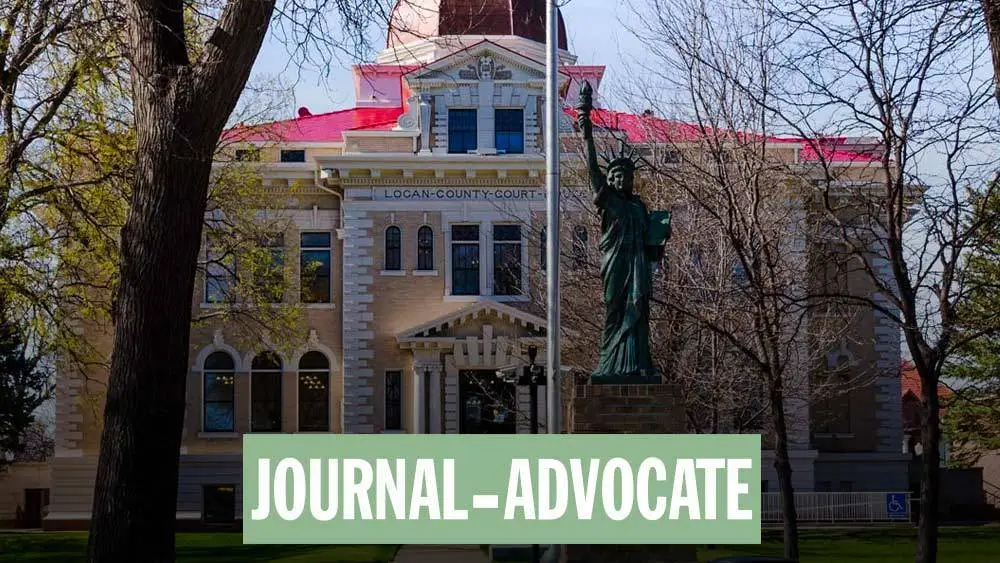
Logan County Courthouse anchors Sterling’s historic town square
The Logan County Courthouse is more than a landmark: its rotunda, blueprints and Carara paintings make Sterling’s town square the best place to start downtown.
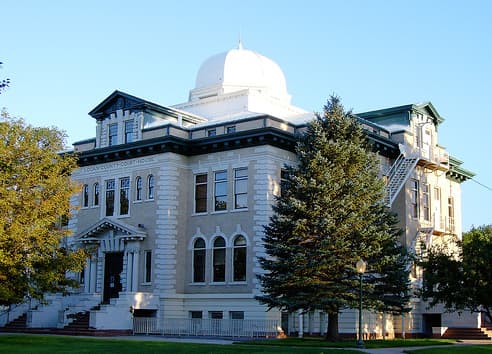
The Logan County Courthouse sits at the center of Sterling and gives the town square its clearest point of focus. Built in 1909 and still serving as the county seat, it is both a working government building and one of the easiest ways to read Logan County’s history in a single stop.
Start at the square
The courthouse stands at 315 Main St. in Sterling, right in the middle of the town square that Colorado.com describes as the heart of the city’s historic downtown. That location matters because Sterling’s downtown is not just a backdrop for the courthouse, it is part of the experience: old buildings, shops and eateries cluster nearby, giving a short walk real civic and commercial texture.
Sterling’s official city website calls the community the “Queen City of the Plains” and places it in the northeastern corner of Colorado on Interstate 76. It also identifies Sterling as the regional shopping hub for Northeast Colorado and Southwest Nebraska, with an estimated population of about 14,777. Those details help explain why the square still carries weight. In a city of that size, the courthouse is not a symbolic leftover, it is a daily reference point for residents, county business and downtown movement.
What to notice on the building
History Colorado describes the courthouse as architecturally significant, with many classical elements and elaborate ornamentation. That means the building rewards a slower look. The exterior is not plain government architecture, but a deliberately formal design that signals permanence, order and public authority, the kind of visual language counties used when they wanted a courthouse to stand for more than file rooms and hearings.
Inside, the building is dominated by a central rotunda. That detail gives the courthouse a sense of vertical openness that changes the mood from the street-level square outside. It also makes the interior easier to read as a civic space, with circulation and light gathered around a central core rather than dispersed through a series of narrow corridors.
The courthouse was listed on the National Register of Historic Places on Feb. 22, 1979. That listing marks it as a preserved part of Colorado’s built heritage, not just an old building that happens to survive. For a downtown walk, that designation gives the visit a practical layer of meaning: you are not only looking at county government in action, you are standing inside a documented historic site.
The art and the architecture tell the same story
One of the strongest reasons to stop here is the collection on the courthouse walls. Colorado.com highlights paintings of early life by local artist Eugene Carara, along with framed original linen blueprints by architect John J. Huddart. Those two elements make the courthouse feel personal in a way many civic buildings do not.
Carara’s paintings tie the building to Logan County memory through a local artist’s eye. Huddart’s blueprints do something different: they expose the courthouse as an object of design, not just administration. Seeing the original linen drawings alongside the finished structure lets visitors connect plan and place, which is rare in a courthouse that still functions as a government building.
Huddart’s work in Logan County was not isolated. History Colorado’s profile of the architect says his courthouse commissions also included Cheyenne County, Washington County, Summit County, Saguache County, Lincoln County and Custer County, with projects spanning 1908 to 1910. That places the Sterling courthouse within a broader early 20th-century wave of county building across Colorado, when courthouse architecture was being used to express permanence, local pride and public ambition.
Pair the courthouse with a short downtown walk
Colorado.com points visitors to other downtown must-sees, including the Sterling Creatives Artist Co-Op, part of the Sterling Creative District. That makes the courthouse an easy anchor for a compact self-guided loop rather than a one-stop photo stop. Start at the square, spend time with the courthouse’s exterior and interior details, then continue into the surrounding blocks for galleries, shops and places to eat.
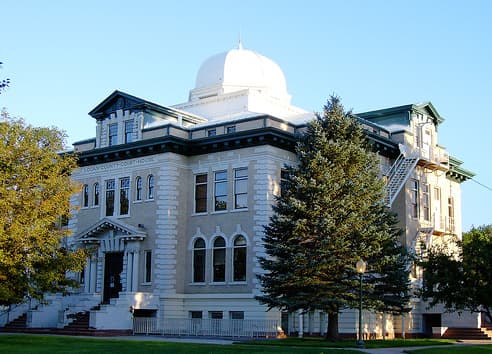
The walk works because the courthouse sits in the middle of Sterling’s historic core, where the city’s older building stock still frames the public square. That setting is what turns the stop into an afternoon instead of a quick errand. The courthouse provides the institutional center, while the nearby storefronts fill in the daily life of the town.
- the courthouse square itself, for the rotunda, ornamentation and wall displays
- nearby shops and eateries that reflect Sterling’s downtown mix
- the Sterling Creatives Artist Co-Op, for a look at the city’s creative district
A simple route through downtown can include:
That combination gives families, visitors and longtime residents a way to see how the county seat still functions as both a civic center and a commercial crossroads.
A building that still marks the season
Logan County also says its Buildings and Grounds Department decorates Courthouse Square with lights for the holidays. That detail matters because it shows the square is not frozen in one era. The courthouse remains part of the county’s seasonal life, with the square used and maintained as a shared public place rather than treated as a museum piece.
That ongoing care reinforces the building’s role in local identity. The courthouse still carries out government business, still marks the center of Sterling, and still anchors a downtown that residents use for shopping, walking and community events. For anyone trying to understand Logan County quickly and clearly, this is the place where the county’s public past and present meet in one square.
This article was produced by Prism’s automated news system from verified source data, official records, and press releases, then run through automated quality and moderation checks before publishing. The system is built and supervised by the people who set the standards it runs under. Read our full AI policy.
Did this article answer your question?