Logan County Courthouse in Sterling marks 1909 civic landmark
Sterling’s 1909 courthouse shows how Logan County concentrated power, records, and public life downtown. Its rotunda, marble, and blueprints turn a working government building into the county’s civic core.
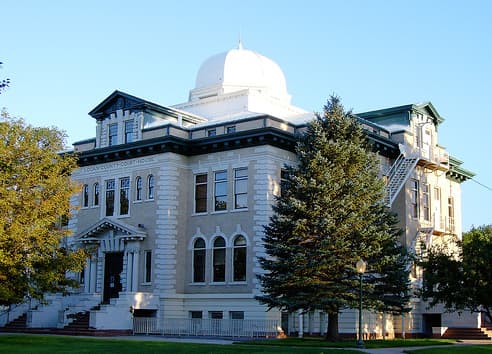
The Logan County Courthouse at 315 Main St. is the building that explains Sterling’s rise as the county’s political center. Its 1909 construction sits at the meeting point of county formation, South Platte settlement, and the town’s move from homestead cluster to regional seat of power.
Why the courthouse belongs at the center of the Logan County story
Logan County was established in 1887, named for Civil War General John A. Logan, and stretched across 1,845 square miles of the Great Plains and South Platte River valley. Even now, the county’s population of 22,036 is heavily concentrated in Sterling, where 18,211 residents live along the South Platte. That concentration matters because the courthouse was built for a county whose civic life, land use, and everyday administration were already tied to one town and one river corridor.
Agriculture has been the dominant industry since the county was created, and the county had nearly 900 farms as of 2012. The courthouse therefore sits in a place where the practical work of county government has always been tied to farm records, land transactions, taxes, and local administration. Its significance is structural, not decorative: this is where Logan County made permanence visible.
How Sterling became the county seat
Sterling began in 1881, when homesteaders settled along the South Platte River. The town was platted later that year in September, incorporated in December 1884, and then elevated again in 1887 when Logan County was formed and Sterling became the county seat. The first county courthouse stood at Third and Main Streets, a detail that shows how quickly the town’s core became the county’s core.
That sequence tells the larger story behind the 1909 courthouse. Sterling did not become important because of a single landmark. The courthouse came after the town had already been chosen as the place where county government would gather, and after the South Platte corridor had become the county’s basic geographic and economic spine. In that sense, the building marks consolidation: county authority, commercial activity, and public identity all settling into one downtown block.

What makes the 1909 building a landmark
History Colorado identifies the courthouse as a 1909 building with many classical elements, elaborate ornamentation, and an interior dominated by a central rotunda. It was listed in the National Register of Historic Places on February 22, 1979, and its site number is 5LO.35. The courthouse was built by Kaepernik and Jenkins at a cost of $100,000, with the cornerstone laid on June 23, 1909 and the building dedicated on March 5, 1910.
Those dates help frame the courthouse as a statement of confidence. Logan County was still rooted in agriculture, but the county seat was investing in a substantial civic building that signaled stability and permanence. The courthouse’s address at 315 Main St. also places it firmly in Sterling’s commercial and civic center, not off to the side as a detached government compound. It is part of the Downtown Sterling Historic District, which reinforces its role as a piece of the town’s working urban fabric.
John J. Huddart and the county courthouse era
The courthouse was designed by John J. Huddart, a Denver architect who practiced from 1882 until 1930 and became especially well known for courthouse design. His courthouse work was concentrated mainly from 1905 to 1912, a period when he produced at least six Colorado courthouses, including projects in Adams, Cheyenne, Washington, Logan, Summit, and Saguache counties. In that context, Logan County Courthouse belongs to a broader regional pattern of counties using architecture to project authority and order.
Huddart’s presence matters because it ties Sterling to a statewide civic style rather than an isolated local effort. The courthouse reflects a moment when Colorado counties were building durable public institutions and choosing architects who could express that ambition in stone, trim, and formal interior space. The building’s classical details were not accidental flourishes. They reinforced the idea that law, records, and public business belonged in a setting built to last.

Inside the rotunda
The courthouse’s interior is what gives the building its strongest identity today. SAH Archipedia describes a four-story rotunda with stained-glass skylights, Colorado Yule marble, ornate tile floors, golden oak trim, a wrought-iron staircase, and brass railings. The central rotunda was restored in 1984, keeping the interior from becoming only a preserved relic.
The rotunda also holds cultural material that ties the courthouse back to Logan County itself. It contains paintings by local artist Eugene Carara showing early county life, along with framed original linen blueprints by Huddart. That combination gives the building more than architectural value. It preserves both the designer’s work and the county’s own visual memory in the same public room where government business still resonates.
How to understand the courthouse today
The courthouse works best as a lens on Logan County’s civic geography. Sterling is still where most of the county lives, where county identity is concentrated, and where the South Platte corridor remains the dominant axis of settlement and commerce. The courthouse stands at the point where that geography became administration, and where administration became civic identity.
Seen this way, the building is not just an old structure in downtown Sterling. It is the county’s most visible proof that settlement, agriculture, law, and local government were gathered into one center and made durable in 1909.
This article was produced by Prism’s automated news system from verified source data, official records, and press releases, then run through automated quality and moderation checks before publishing. The system is built and supervised by the people who set the standards it runs under. Read our full AI policy.
Did this article answer your question?