Logan County Courthouse showcases historic paintings and original blueprints
The Logan County Courthouse doubles as a history gallery, with Carara paintings, Huddart blueprints and Propst narratives. It turns a county visit into a lesson in local memory.
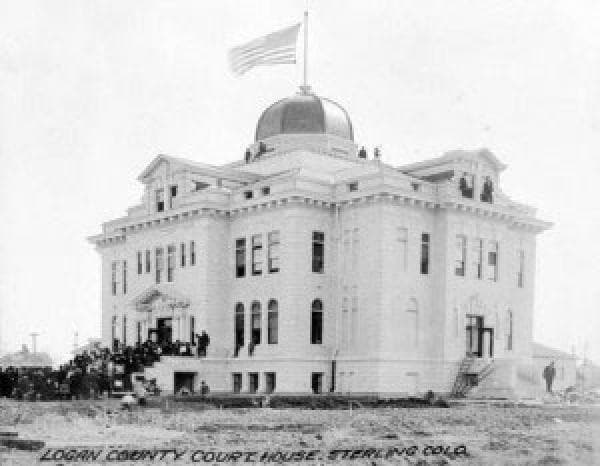
The Logan County Courthouse in Sterling is doing more than processing county business. Inside, the walls carry the "Eugene Carara Collection at Historic Logan County Courthouse," a display that pairs paintings of early life with framed original linen blueprints and written narratives that explain what visitors are seeing. If you only pass through for a filing, a hearing, or a public meeting, you miss a built-in visual civics lesson about how Logan County remembers itself.
How to read the courthouse walls
The easiest way to approach the courthouse is not as a hall of offices but as a sequence of local stories. Explore Sterling’s booklet, "Historical Logan County Courthouse," is designed around that idea: the printed narratives accompanying each painting were written by Logan County historian and author Nell Brown Propst and by artist Eugene Carara. That gives the display a clear interpretive voice rooted in the county itself, not imported from elsewhere.
One of the clearest examples is the work titled "Cattleman: Northeast Colorado," listed on Explore Sterling’s Logan County Courthouse art gallery page. A named painting matters because it signals that the collection is not a single decorative backdrop, but a group of specific works tied to particular subjects and scenes. For a courthouse visitor, that changes the experience from glancing at wall art to reading a curated county story one canvas at a time.
The booklet framing also matters because it turns the building into something closer to an exhibit than a waiting room. The walls are not simply hung with paintings and plaques, they are organized by text written to accompany the art, which means the courthouse can be read in layers. First comes the image, then the narrative, then the broader sense of how Logan County chose to represent early life in the region.
The local people behind the collection
The collection carries a strong local pedigree. Nell Brown Propst is identified in the booklet as Logan County’s historian and author, while Eugene Carara is described as an artist who taught in local schools for thirty years. That pairing links scholarship and education, giving the courthouse display the feel of a community project shaped by people who spent years explaining Logan County to its own residents.
Carara’s teaching career matters as much as his art. A longtime local instructor bringing his work into the courthouse ties public education to public memory, and it helps explain why the collection fits Sterling so naturally. In a county seat, the courthouse already stands for government authority and official record-keeping; Carara’s paintings and Propst’s narratives add another layer by showing how people, work and daily life looked in the county’s past.
The donor list in the booklet also shows that the collection was built with broad community support. Logan County recognizes Eugene and Wilma Carara, Dorothy Lutin Curlee, David and Genevieve Hamil, Alta S. Herbrick, the Propst Family, Effia Sherwin, Dr. Edwards and June Tennant, Donald and Sandra Wilson, former directors and staff of Colorado National Bank Sterling, and former Board of County Commissioners of Logan County. That mix of families, individuals, bank staff and county officials suggests the collection grew through many hands, not a single patron.
Why the blueprints belong on the walls too
The courthouse display is not limited to art about the past. Colorado.com identifies the attraction as the "Eugene Carara Collection at Historic Logan County Courthouse" and says the courthouse walls also include framed original linen blueprints by architect John J. Huddart. That detail gives the building a documentary dimension: visitors are not only seeing scenes of early life, they are also seeing material tied to the courthouse’s original design.
That matters because blueprints are not decoration, they are evidence. A framed original linen blueprint connects the building to the planning stage, to the architect’s decisions, and to the physical structure that still serves Logan County today. In other words, the courthouse tells two stories at once: what the county once looked like in Carara’s paintings, and how the building itself was conceived by Huddart.
Taken together, the paintings and the blueprints make the courthouse a rare kind of civic exhibit. One set of objects looks outward at county life, while the other looks inward at the making of the building itself. The result is a place where residents can understand not just what Logan County valued enough to paint, but also what it built to house its government.
A civic building that also works as a heritage stop
Explore Sterling and Colorado.com both promote the courthouse as a visitor attraction in Sterling, Colorado, which places it firmly in the town’s public-facing heritage landscape. That is important in a county seat, where the courthouse is often treated as a place to handle obligations and leave quickly. Here, the building is also presented as a reason to stay downtown a little longer and take in what the county has chosen to display on its walls.
That dual role matters for civic identity. Courthouses in rural counties often anchor records, legal proceedings and county administration, but they also become symbols of how a community sees itself. In Sterling, the Carara Collection and the Huddart blueprints make that symbolism visible in a way that is accessible to residents, students and visitors alike.
The booklet’s approach suggests a simple but powerful idea: a courthouse can teach as well as govern. The painted scenes, the handwritten narratives, the original blueprints and the donor network all point to a county that preserved its own visual record instead of hiding it in storage. For anyone who walks through the doors only to finish an errand, that is the detail worth not missing.
This article was produced by Prism’s automated news system from verified source data, official records, and press releases, then run through automated quality and moderation checks before publishing. The system is built and supervised by the people who set the standards it runs under. Read our full AI policy.
Did this article answer your question?