Sterling’s Union Pacific Depot reflects railroad history and downtown growth
Sterling’s depot shows how railroads built downtown and why preserving adaptive reuse still shapes Logan County’s identity.
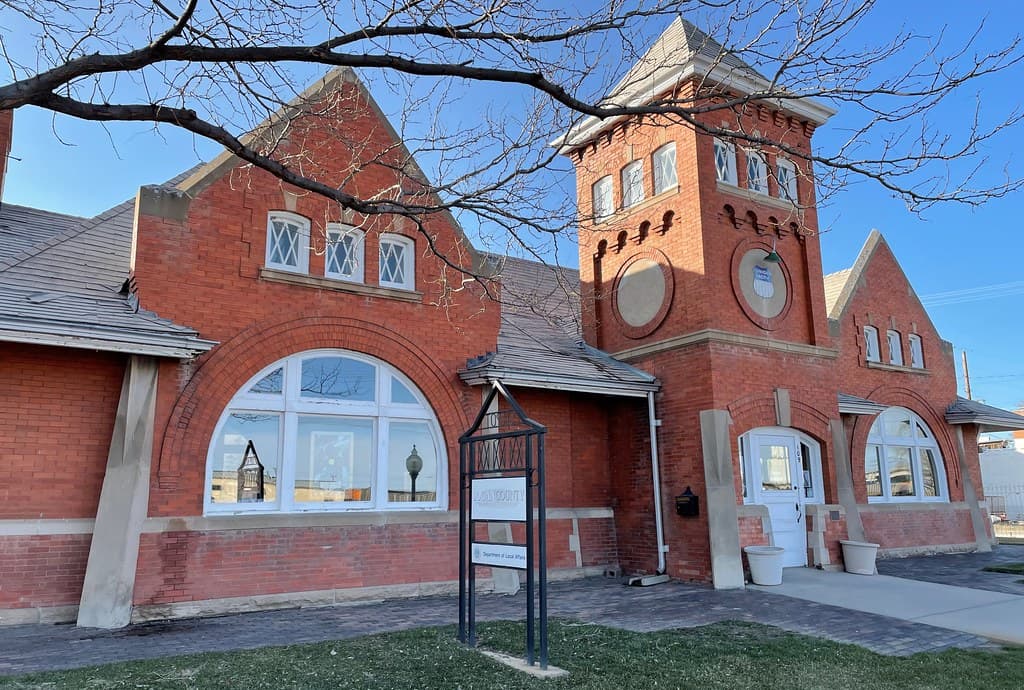
At 113 N. Front St., Sterling’s Union Pacific Depot still reads like a railroad town’s blueprint. Built in 1902 in Romanesque Revival style, moved to its current site in 1984, and now used as a museum and events center, the depot ties logistics, architecture, and downtown renewal into one building. Its story is a compact record of how Union Pacific investment helped turn Sterling into Logan County’s commercial core.
A railroad decision that fixed Sterling’s trajectory
Sterling’s rail era began to harden into place in 1887, when Union Pacific agreed to make the town its division point on the line to Denver. That decision did more than bring trains through town. It helped anchor Sterling’s growth and shaped the street grid that still organizes downtown today.
The depot followed that expansion. History Colorado dates the building to 1902 and describes it as a Romanesque Revival depot built to match Sterling’s importance on the Union Pacific system. The station also served the Chicago, Burlington & Quincy Railroad, a sign that Sterling was not just a stop but a transfer point in a wider freight network.
That wider network mattered because Sterling’s economy was built on moving goods, not simply hosting passengers. The depot linked the town to eastern markets and handled agricultural products such as sugar beets and livestock. A sugar beet factory opened in 1905, adding another layer of industrial activity and reinforcing Sterling’s role as a shipping and service center for northeastern Colorado.
How to read the building when you stand in front of it
The depot is worth a close look because its architecture tells the story as clearly as any plaque. SAH Archipedia describes a square entry tower, steep rooflines, and decorative stone-and-brick detailing that give the structure an unusual vertical profile for a railroad station. The same source identifies the building’s style as a blend of Victorian eclectic and Romanesque Revival, while History Colorado classifies it as Romanesque Revival.

Those details are not just decorative. The building was designed to project stability and importance at a time when a railroad depot functioned as both arrival point and civic symbol. The historical marker summary says the depot is significant architecturally because it combines styles into a unified whole, and that unity is still visible in the massing and masonry today.
The interior matters too. The central waiting rooms retain their elegant golden oak finishes, one of the clearest surviving signs that this was once a public building meant to impress travelers. The depot also gained wings in 1923, which shows how rail service and passenger needs changed while the structure remained in use.
Why the depot belongs in the downtown story, not just the rail story
The depot sits inside the Downtown Sterling Historic District, which History Colorado describes as important because it has served Sterling and surrounding communities with goods and services since 1896. The district has long functioned as a major agricultural center, a railroad junction, a commercial hub, and a regional center of government for northeastern Colorado and parts of western Nebraska.
That broader setting explains why the depot still matters to downtown identity. Sterling’s historic core was not built around nostalgia, but around trade, shipping, and the daily work of moving people and products. The depot is one of the most visible reminders of that economy, and its location near the center of town still makes it part of the downtown streetscape rather than a museum hidden on the edge of city limits.
It also helps frame how residents can use the building today. Explore Sterling’s historic-buildings tour says five of the city’s most important historic buildings have been carefully researched, documented, and made available for virtual viewing. That gives the depot a place in a larger local preservation story, one that connects public history to walking routes, school projects, and downtown foot traffic.
What Sterling chose to save, and what that choice preserved
The railroad closed the depot in 1983, but the building did not disappear with passenger service. The City of Sterling relocated it to its present site in 1984, and it was listed on the National Register of Historic Places on Feb. 6, 1986. That sequence turned the depot from a threatened railroad structure into a preserved civic asset.
The relocation is the key preservation choice. Instead of losing the building when rail operations declined, Sterling kept the physical fabric of the depot and gave it a second life. History Colorado’s railroad context notes that railroads were central to Colorado’s development, and the state historic context was created in part to support preservation planning and rails-to-trails conversions. The depot fits that larger pattern of communities deciding that transportation landmarks still have public value after the trains leave.
That decision has practical consequences for downtown today. A preserved depot keeps original materials, scale, and craftsmanship in view, while adaptive reuse keeps the building active as a museum and events center. If a structure like this is neglected, the cost is not abstract: the city loses a recognizable link to the division-point era, the oak interiors and masonry details deteriorate, and another piece of downtown becomes harder to read as part of Sterling’s history. If it is funded and maintained, the building continues to draw people, support civic events, and anchor the street where rail commerce once set the pace.
What Logan County gains by treating the depot as part of the present
For Logan County, the Union Pacific Depot is most useful when it is treated as an operating part of downtown identity, not a frozen relic. It shows how one railroad decision in 1887 shaped the town grid, how a 1902 station supported freight and passenger traffic, and how a 1984 relocation kept the structure in public view after the rails changed course.
That matters because downtowns compete on character as much as on commerce. Sterling’s depot gives the city a physical asset that cannot be replicated by new construction, and its survival keeps the connection visible between rail infrastructure, agricultural growth, and the commercial downtown that followed. The building still tells the story of how Sterling became what it is, and it still offers a place to decide what kind of downtown Logan County wants to protect next.
This article was produced by Prism’s automated news system from verified source data, official records, and press releases, then run through automated quality and moderation checks before publishing. The system is built and supervised by the people who set the standards it runs under. Read our full AI policy.
Did this article answer your question?