Ten 2026 Colorado Bills to Watch and How They Affect Logan County
Ten Colorado bills could reshape housing, utilities, public safety and local authority, here’s what Logan County officials should track, who to call, and what to expect.
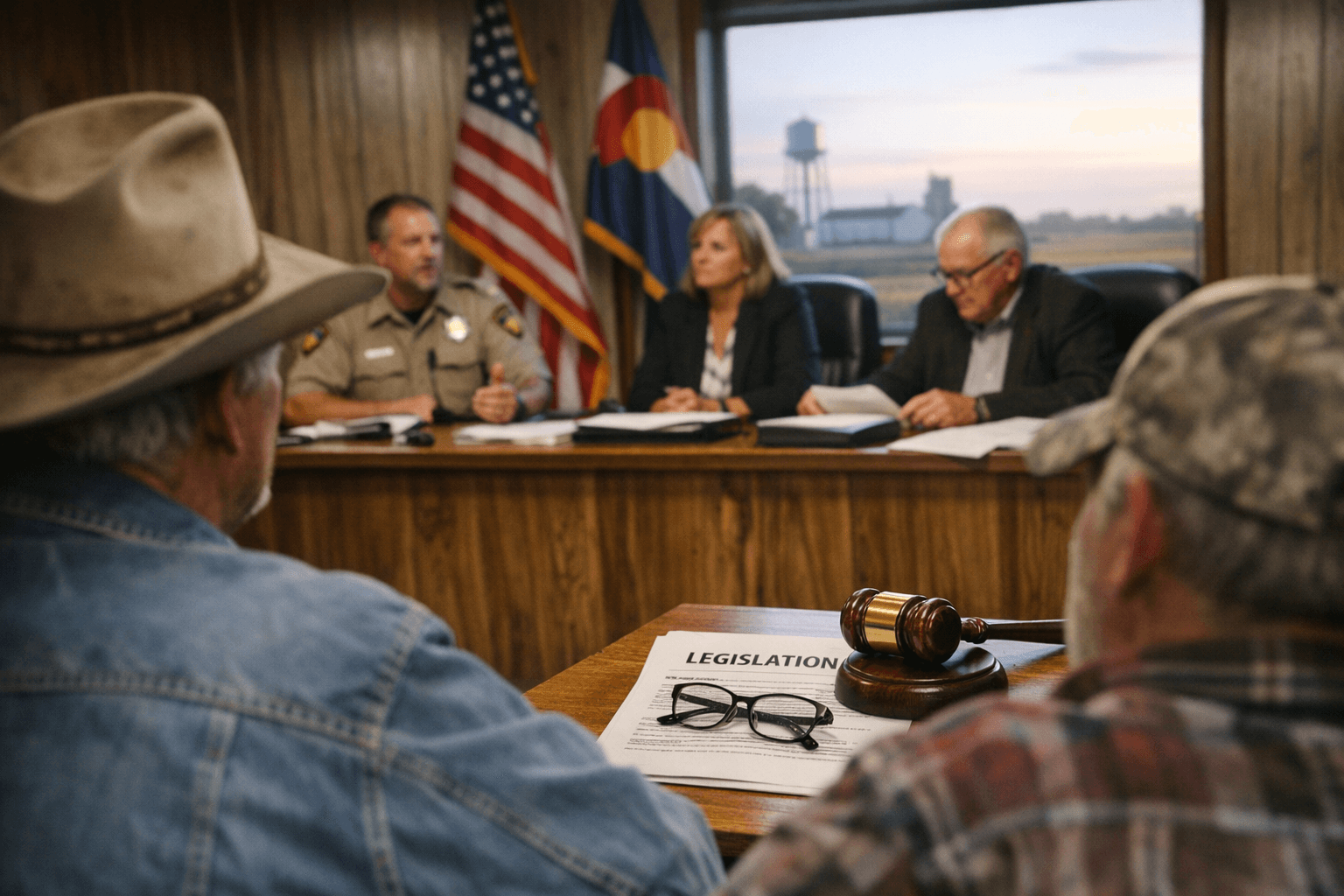
1. Senate Bill 3, new background checks and training for semi-automatic weapons
AspenTimes flagged SB 3 as “Among the most controversial legislative proposals this session,” and its text (as described in reporting) would require new state background checks and up to 12 hours of safety training before purchasing semi-automatic guns that accept detachable magazines, including AK‑ and AR‑style rifles and pistols. The AspenTimes passage states: “Beginning in August 2026, Coloradans will need to pass a background check and undergo up to 12 hours of safety training offered through a local sheriff’s office and administered by a qualified firearms instructor.” For Logan County, that language explicitly links implementation to local sheriff capacity; follow-up reporting should ask Logan County Sheriff’s Office how it would administer training, whether instructors are in place, and what costs or scheduling burdens the requirement would impose.
2. HB 1040, classifying nuclear as a clean energy source
AspenTimes reports HB 1040 “classifies nuclear as a ‘clean’ energy source,” while also noting the bill “doesn’t allocate funding or plans for any nuclear sites.” The bill is framed as a tool to help meet Colorado’s goal of phasing out carbon‑emitting electricity plants by 2050 and “could help coal‑dependent communities, including those in northwest Colorado, transition their economies.” For Logan County the concrete questions are whether local power plants or workforces could qualify for transition assistance and how reclassification would affect regional grid planning; those are matters Logan County economic development and workforce officials should monitor once the bill text and fiscal notes are released.

3. HB 1182, wildfire‑reduction measures aimed at lowering homeowners’ insurance
AspenTimes describes HB 1182 as seeking “to help homeowners lower their wildfire risk and, in turn, their insurance premiums,” noting Colorado has seen dramatic homeowners‑insurance increases as weather events intensified by climate change raise risk. The reporting does not list program mechanics or funding, so Logan County needs to know whether the bill creates grants, cost‑share programs, or standards that would apply locally; county emergency management, the extension service and insurers should be asked for briefings on eligibility, timelines and any application windows once the bill text is available.
4. HB 1247, expanding local revenue uses to include infrastructure and public safety
AspenTimes reports HB 1247 “further expands how those dollars can be used to include infrastructure and public safety,” and that local governments already may use the revenue for tourism, workforce housing and child care. The source does not name the revenue stream; fiscal notes and the statute language are needed to determine whether Logan County can redirect existing local revenue to sheriff budgets, road projects or other priorities. County commissioners and the county treasurer will want the bill language to understand whether it changes statutory revenue restrictions or requires local adoption actions.
5. HB 1272, construction‑defect reforms tied to Gov. Polis’ housing agenda
AspenTimes describes HB 1272 as aiming to “reduce the number of lawsuits filed against condo developers” and says it “was among the chief priorities of Gov. Jared Polis’ housing agenda.” Lawmakers argue construction‑defect liability has “stifled condominium development and, in turn, limited the amount of starter homes available to first‑time buyers.” Logan County planners and affordable housing developers should seek the bill’s definitions and liability limits: the local impact will depend on whether reforms apply statewide, include rural counties, or are limited to certain building types or timeframes.
6. Worker Protection Collective Bargaining (HB26‑1005), changing union vote rules
5280 describes HB26‑1005 (the Worker Protection Act) this way: “The Worker Protection Act is back this session with the same goal: to make it easier for unions to force all workers, regardless of whether they belong to the union, to pay representation fees.” 5280 also states the existing Colorado law requires a second vote with at least 75 percent support before negotiating over union security and that this bill “would eliminate that second vote.” For Logan County employers and public‑sector workers, that change could alter bargaining dynamics; county HR and any public employers in the county should track committee hearings and consult counsel to understand timing and required votes.
7. HOME Act, state authority to bypass local zoning for affordable housing
5280 summarizes the HOME Act as a proposal that “would give qualifying affordable housing developers, public schools and universities the ability to bypass local zoning laws and build homes on their land.” Rep. Andrew Boesenecker (Fort Collins Democrat) said: “We feel like, with those three entities in the bill, that we’re really going to capture a lot of folks who are already doing really good work in this space to bring about more supply and, further than that, affordable housing to our communities.” The Colorado Municipal League is explicitly noted as opposing this class of measures, arguing they “would undermine the rights of local communities to make decisions for themselves and could violate the constitutional self‑governance powers of home rule cities.” Logan County officials should ask whether the bill’s qualifying criteria would apply to school districts or public land in the county and whether a zoning bypass could be invoked without county approval.
8. Energy and utility bills, outage notifications, a domestic‑violence risk protocol, and low‑income electricity pricing
5280, the Colorado Sun and KUNC together flag several utility and safety measures. One notification bill “would require utilities to notify the public about planned power outages via phone calls or text messages, email and broadcasts on local radio and news stations”; the Colorado Sun and KUNC explicitly tie such proposals to a tragedy: “The bill is in part a response to the death of a Delta woman during a power outage in 2024. The woman’s medical equipment failed during the unplanned outage.” Another measure, sponsored by Majority Leader Duran, “would establish a statewide assessment protocol to help law enforcement identify domestic violence danger faster.” Separately, 5280 describes a proposal that would require major energy providers, including Xcel Energy and Black Hills Energy, to provide basic electricity for low‑income customers at the cost of production “without making a profit,” potentially tied to Public Utilities Commission law changes. For Logan County residents dependent on medical equipment, the notification bill could be material; county public health, hospitals, and local utilities (identify whether Xcel or Black Hills serve the county) should be asked whether current customer‑notification systems meet the proposed standards and what changes would be required.
9. Flock Safety warrant bill, privacy limits on license‑plate reader databases
5280 reports on a bill that “would require law enforcement to get a warrant before using the Flock Safety database in their investigations.” The reporting notes Flock Safety is a video surveillance network that includes license plate readers and that “data privacy experts are concerned about misuse, including by federal immigration enforcement,” adding the system “has been used incorrectly in at least one high‑profile case in Colorado.” Logan County law enforcement and county attorneys should be queried about any local deployment of Flock cameras, their data‑use policies, and whether department practice already requires warrants; the legal and civil‑liberties implications will depend on current local usage and any state standard the bill sets.
10. ADU / parcel‑sale / local zoning bills, expanding property‑sale and accessory dwelling options
5280 describes two related affordable‑housing proposals: one that would make it easier for homeowners to sell off a portion of their property and another that builds on 2024 legislation that eased accessory dwelling unit (ADU) construction. The reporting says these proposals would apply to higher‑density areas like the Denver metro and Grand Junction and that “local governments are already opposing both bills.” Because none of the source excerpts mention Logan County specifically, county assessors and planning staff must determine whether the measures would reach rural counties or remain targeted to higher‑density jurisdictions; the Colorado Municipal League’s stated opposition suggests municipalities will press for local control in committee hearings.
Conclusion, what Logan County should do now Statewide majorities (5280 reports Democrats hold a 23‑12 Senate edge and a 43‑21 House edge with one vacancy looming) mean many of these measures will advance to committee debate, so Logan County leaders should move promptly to get the missing documents flagged in reporting, bill texts, fiscal notes, sponsors’ statements and effective dates, and to brief local stakeholders listed above (sheriff, county commissioners, public health, utilities, assessors and housing authorities). Where the sources leave gaps, sponsors, bill numbers or fiscal impacts, those are the exact records to obtain before a local position is formed; tracking committee calendars and the Colorado General Assembly bill pages will be essential in the weeks ahead.
This article was produced by Prism’s automated news system from verified source data, official records, and press releases, then run through automated quality and moderation checks before publishing. The system is built and supervised by the people who set the standards it runs under. Read our full AI policy.
Did this article answer your question?