Los Alamos Lab unveils URSA, AI system aims to speed research
URSA gives Los Alamos scientists a coordinated set of AI agents that can plan, code and run simulations, with early tests speeding radiation hydrodynamics work.

Los Alamos National Laboratory is betting that the future of research is not a single chatbot, but an AI team. URSA, short for the Universal Research and Scientific Agent, is designed to help scientists brainstorm hypotheses, plan experiments, run simulations and analyze results, all while learning from each step.
The lab described URSA as an open-source software package built around modular, feedback-driven agents rather than a rigid one-pass workflow. That matters in a place like Los Alamos, where the hardest problems often involve high-stakes science, specialized physics and massive computing demands. The URSA paper says high-fidelity simulations in areas such as inertial confinement fusion and materials modeling can take hours or days on large supercomputers, and many runs do not pay off. URSA is meant to cut through that bottleneck by composing information flow between agents for planning, code writing and execution, and online research.
In early demonstrations, the system showed promise in radiation hydrodynamics, where it searched complicated design spaces faster than traditional methods. The lab has also built a benchmark framework to compare URSA against established approaches like Bayesian optimization, a sign that the project is being treated as a research tool rather than an AI demo. The paper calls URSA a scientific agent ecosystem developed at Los Alamos, and its authors include Michael Grosskopf, Nathan DeBardeleben, Russell Bent, Rahul Somasundaram, Isaac Michaud, Arthur Lui, Alexius Wadell, Warren D. Graham, Golo A. Wimmer, Sachin Shivakumar, Joan Vendrell Gallart, Harsha Nagarajan and Earl Lawrence, all tied to Los Alamos and ArtIMis.
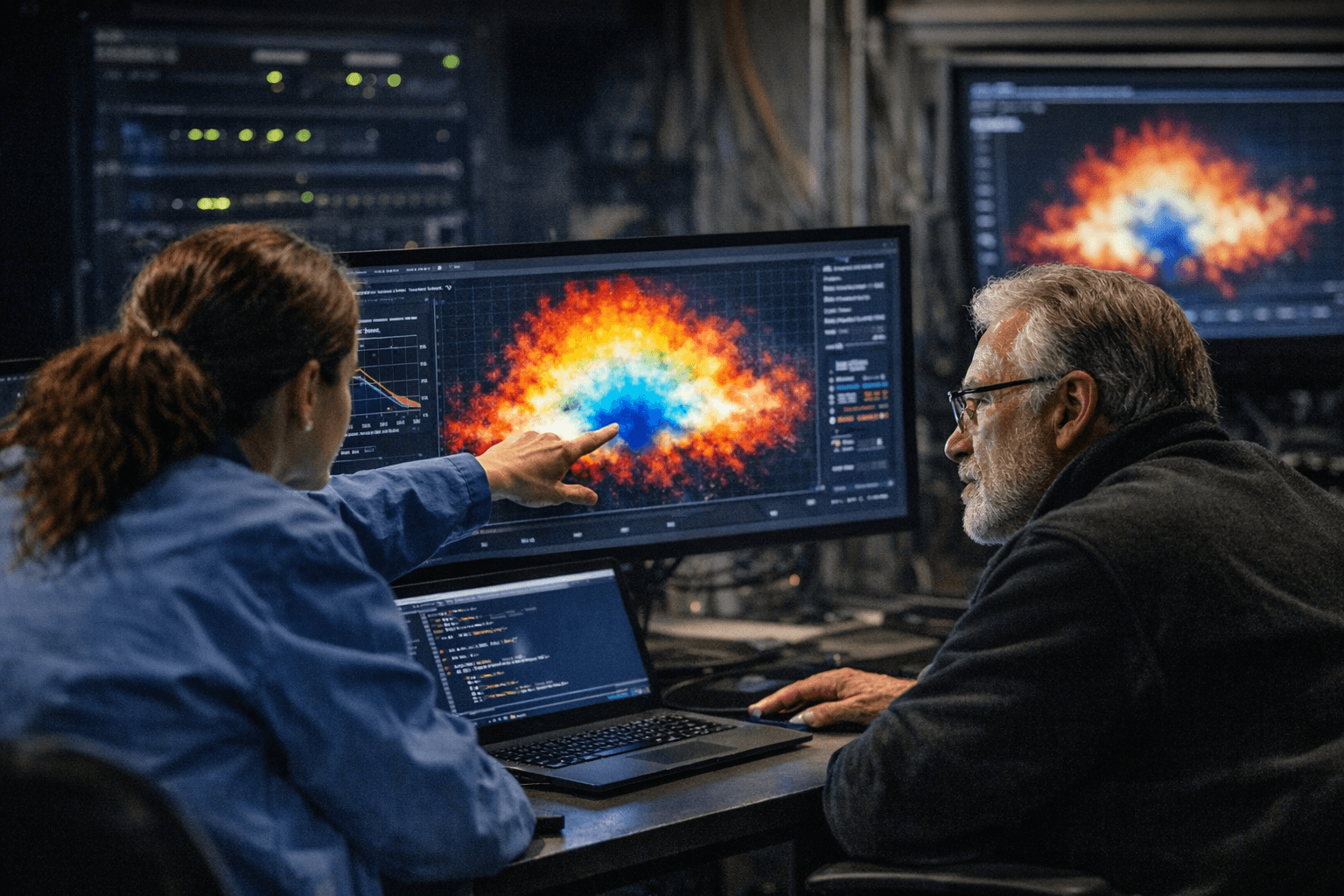
Earl Lawrence’s abstract for the project draws a sharp line between what machines should do and what people should keep doing. Humans, he said in effect, are best at thinking, asking questions, suggesting solutions, vetoing bad ideas and understanding results, while agents should handle the rest. In URSA’s design, that means agents for hypothesizing, planning, simulation management and general-purpose execution, while researchers stay in charge of judgment, interpretation and scientific direction.
For Los Alamos County, the local significance goes beyond AI buzz. A tool that helps scientists move faster through expensive simulation cycles could strengthen the lab’s competitive edge in national security work, attract more research talent and help keep funding flowing into New Mexico. That same logic is behind the lab’s broader push into AI, including the National Security AI Office led by Jason Pruet and the April 2025 1,000 Scientist AI Jam Session, where nearly 250 researchers and professionals from Los Alamos and Sandia took part. URSA now becomes part of a larger race in which Los Alamos is trying to shape not just what AI can do, but how science itself gets done.
This article was produced by Prism’s automated news system from verified source data, official records, and press releases, then run through automated quality and moderation checks before publishing. The system is built and supervised by the people who set the standards it runs under. Read our full AI policy.
Did this article answer your question?