UNM, Los Alamos Lab Team Up to Solve Century-Old Physics Problem with AI
Los Alamos scientist Duc Truong led a UNM-LANL team that built an AI framework running 400 times faster than supercomputer simulations to crack a century-old physics problem.

A computational framework built jointly by researchers at the University of New Mexico and Los Alamos National Laboratory reproduces the lab's best materials simulations more than 400 times faster, according to a study published in Physical Review Materials and reported by ScienceDaily on March 15.
The framework, called THOR, short for Tensors for High-dimensional Object Representation, attacks a problem that has resisted solution for roughly a century: computing configurational integrals, the high-dimensional mathematical quantities that describe how atoms interact inside materials and govern thermodynamic and mechanical properties. Traditional approaches, including simulations run on supercomputers, can take weeks to complete those calculations.
"This breakthrough replaces century-old simulations and approximations of configurational integral with a first-principles calculation," said Duc Truong, a Los Alamos scientist and the study's lead author. "THOR AI opens the door to faster discoveries and a deeper understanding of materials."
THOR uses tensor network algorithms to compress what researchers describe as an enormous high-dimensional mathematical structure into a chain of smaller, connected components, making calculations that were previously intractable direct and tractable. The framework also integrates with machine learning-based atomic models that encode interatomic interactions and dynamical behavior, letting it adapt across a wide range of physical conditions.
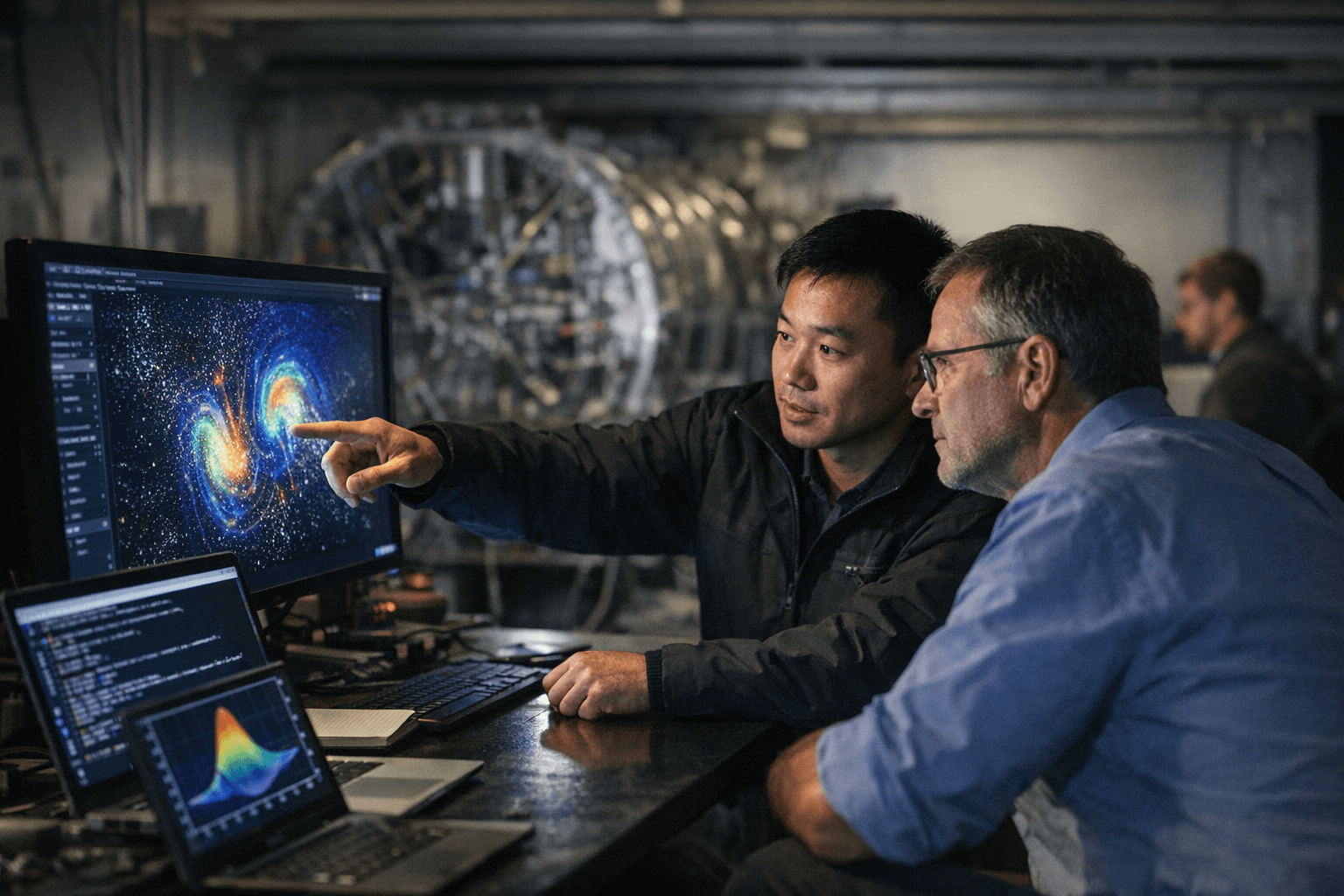
Boian Alexandrov, a Los Alamos senior AI scientist who led the project, described why the configurational integral has been so resistant to conventional methods. "The configurational integral — which captures particle interactions — is notoriously difficult and time-consuming to evaluate, particularly in materials science applications involving extreme pressures or phase transitions," Alexandrov said. "Accurately determining the thermodynamic behavior deepens our scientific understanding of statistical mechanics and informs key areas such as metallurgy."
The team validated THOR against three distinct materials: copper, argon in a crystalline state under high pressure, and tin undergoing a solid-solid phase transition. In each case, the new method reproduced results previously obtained from advanced Los Alamos simulations while running more than 400 times faster. Those three test cases were chosen to span a range of physical complexity, from a simple metal to a noble gas at extreme pressure to a material caught in the middle of changing its crystal structure entirely.
Researchers say the framework's compatibility with modern machine learning potentials makes it a versatile candidate for use across materials science, physics, and chemistry, with potential applications in metallurgy and energy storage. The THOR Project has been made publicly available on GitHub.
This article was produced by Prism’s automated news system from verified source data, official records, and press releases, then run through automated quality and moderation checks before publishing. The system is built and supervised by the people who set the standards it runs under. Read our full AI policy.
Did this article answer your question?