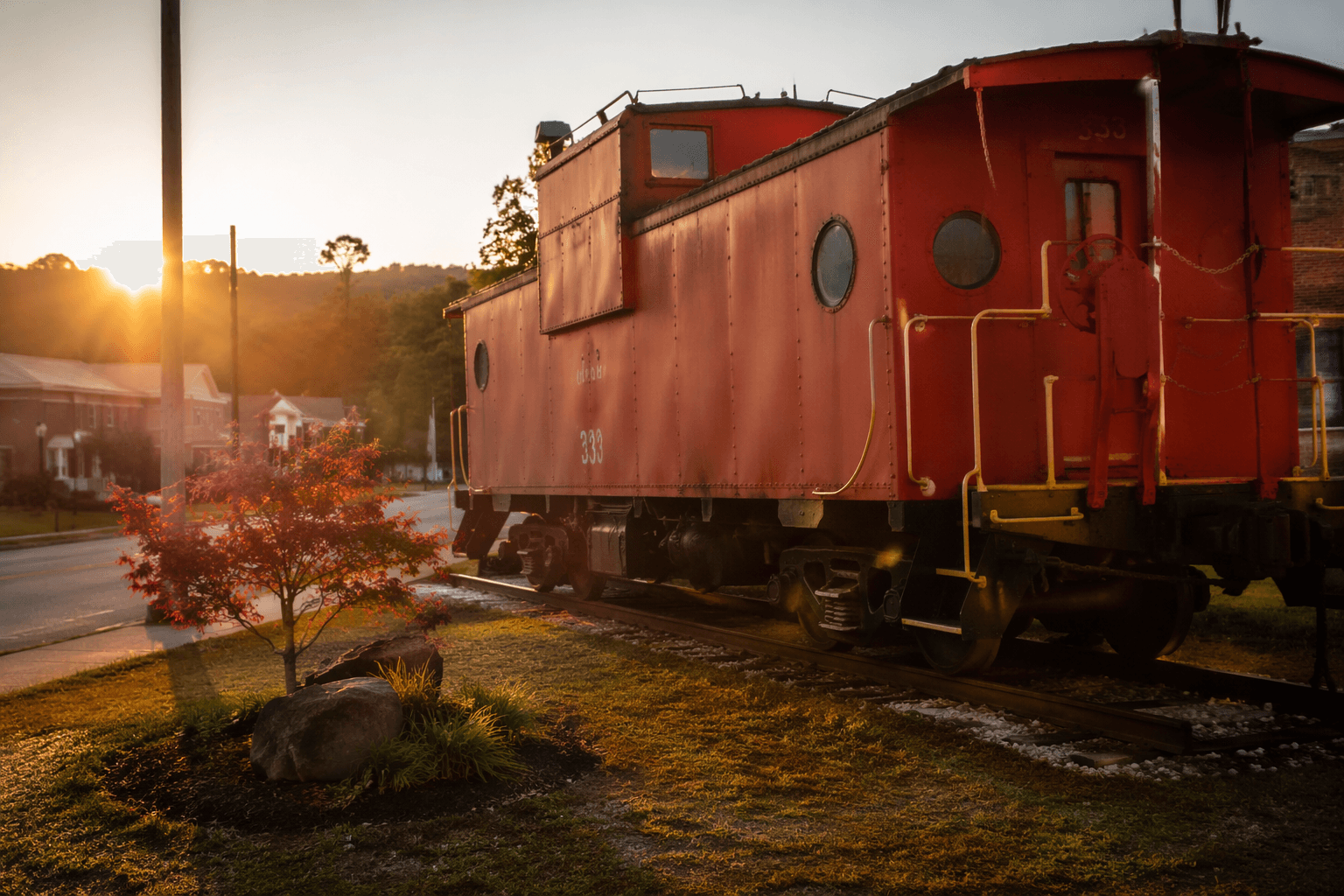
Welch, McDowell County Seat, Offers Museums, Landmarks and Visitor Services
Welch has been McDowell County's seat since 1892, anchoring a downtown where the courthouse steps witnessed a defining moment of the coal mine wars and a French WWII boxcar stands in Veterans Park.
A County Seat Shaped by Coal and Consequence
Welch was once a prosperous city during the coal mine boom of the early 20th century, and that history still defines what visitors encounter downtown today. Welch was selected as the county seat after a lengthy debate over its location. Prior to the 1892 election, the courthouse had been located in Perryville and Coalwood, but as the population around Welch increased, residents demanded that Welch be named the county seat, and the controversy was settled when McDowell County citizens voted for Welch as the court's location. The city that emerged from that vote has served as the civic and cultural center of the county ever since, and the Visit McDowell County tourism initiative describes it as holding "huge significance to the county."
In the 1940s, Welch had over 6,000 people and McDowell County over 100,000, with 55 mining operations in the area. Over the following decades, coal production diminished, and today the city of Welch has about 1,700 people and McDowell County roughly 17,600. That contraction is part of the story visitors encounter at every turn, and it is precisely what gives Welch's landmarks their weight.
The McDowell County Courthouse
The impressive Romanesque Revival courthouse rules over Welch's compact downtown from a grassy throne high above Wyoming Street. The core structure is a very early work of the important Southern architect Frank Pierce Milburn, who was just twenty-five years old when his design was selected in a competition that received input from twelve architects. Construction began in 1893, with contractors building the Romanesque Revival structure using Berea stones. The courthouse and jail were completed in 1894 and cost approximately $43,000. It was placed on the National Register of Historic Places on August 29, 1979.
The courthouse carries some of the most dramatic history in southern West Virginia. On August 1, 1921, detectives from the Baldwin-Felts agency assassinated Matewan Police Chief Sid Hatfield on the courthouse steps. At that time, Hatfield was a major labor leader within the coalfields, and his association with the United Mine Workers and Mary Harris "Mother" Jones were nationally known. In the courthouse yard, John Hardy, a Black railroad worker, was hanged for a murder in Eckman in 1894, and that execution became the subject of the folk, blues, and bluegrass standard "John Hardy."
There is an annual reenactment and an annual outdoor production of "Terror of the Tug," a play about the coal mining wars in West Virginia, held at the McArts Amphitheater at Mt. View High School. As you move through Welch, watch for the National Coal Heritage interpretive waysides beside the McDowell County Courthouse, which provide additional context for the building's turbulent history.
The Merci Boxcar at Veterans Park
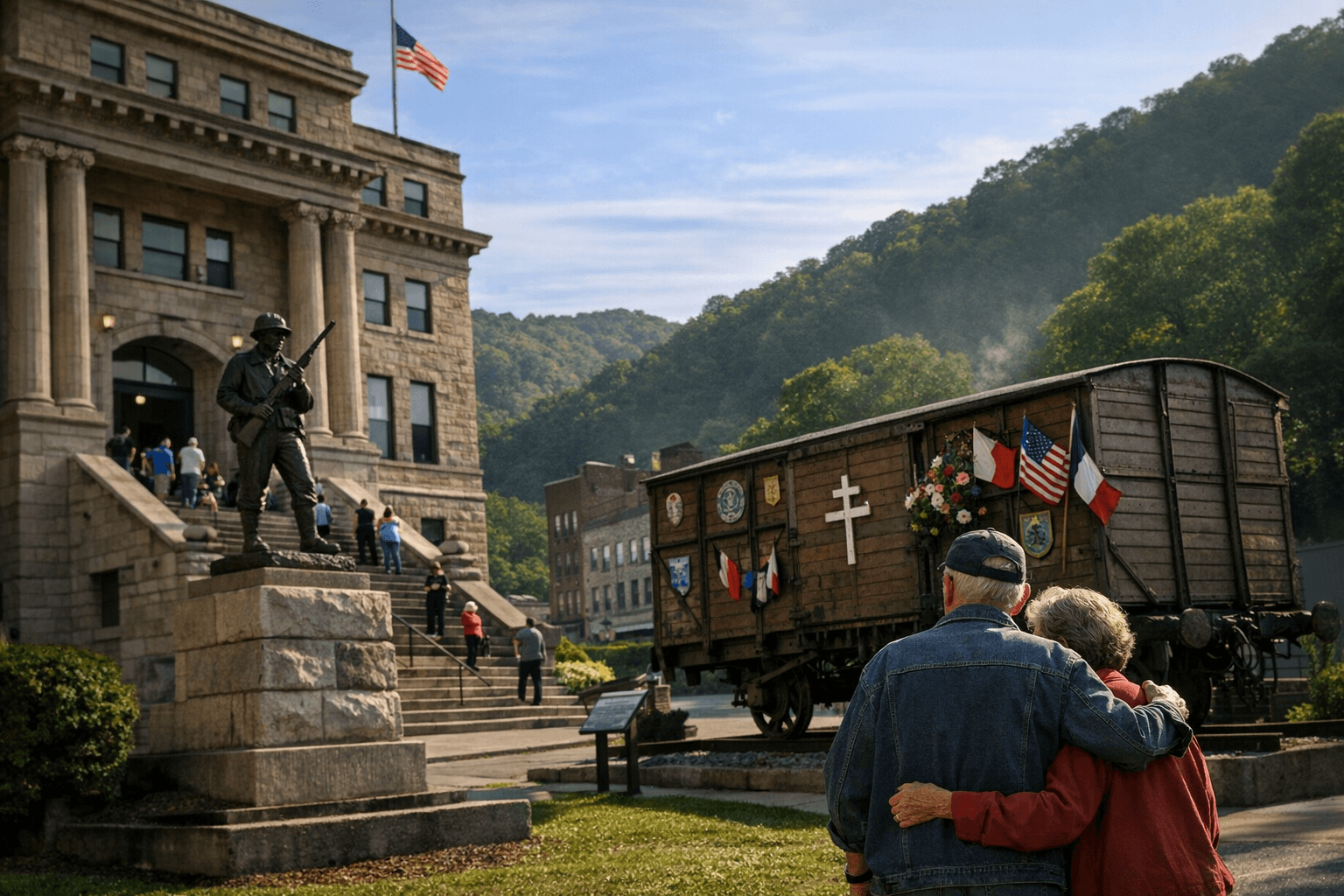
The Merci Boxcar is located in Veterans Park, close to the intersection of U.S. 52, WV 16, and WV 103. It is one of Welch's most unusual and quietly moving landmarks. In February of 1949, a train of 49 French boxcars arrived by ship in New York harbor. Each wooden boxcar contained hundreds of gifts from French citizens, symbols of gratitude for the United States military and humanitarian efforts during and after World War II. One car was delivered to each American state, and many still exist in state capitals and museums.
In 1994, West Virginia's boxcar was found in South Charleston in an open field, with very little wood left and the metal badly rusted. The car was brought to Welch on June 6th (D-Day) 1996 and taken to the McDowell County Vocational School, where it was renovated. The renovation was carried out by La Societe des Quarante Hommes et Huit Chevaux, and the marker was erected in 1997. The boxcar now sits in Veterans Park as a permanent outdoor exhibit, free to visit, representing both the French gesture of thanks and the deep veteran community that has long called McDowell County home.
The National Coal Heritage Trail
Welch sits squarely on the Coal Heritage Trail, one of America's designated National Scenic Byways. The Coal Heritage Trail winds through more than 187 rugged miles across 13 counties and commemorates the history of the southern West Virginia "smokeless" coalfields, a remarkable legacy of working-class culture, industrial might, racial and ethnic diversity, and the creation of a unique national culture. The trail begins on Route 52 in Bluefield, travels to Welch, then takes Route 16 north to Ansted.
Picking up Route 52 outside Bluefield and driving the southern portion of the Coal Heritage Trail means passing through a loopy chain of former coal towns connected by railroad tracks, with company houses lining the road and spreading up the steep mountainside before arriving in Welch. When presidential candidate John F. Kennedy visited Welch by train in 1960, he saw a city that was seriously decaying and had a very high poverty rate caused by the declining coal mining industry; it was his visit here that was believed to be the basis of the aid brought to the Appalachian region by the Kennedy and Johnson administrations.
Downtown Welch: Arts, Culture, and Street-Level History
The Jack Caffrey Arts and Cultural Center in Welch is home to Jay Chatman, president of the McDowell County Historical Society and board member of the National Coal Heritage Area. Chatman is the author of "McDowell County Coal and Rail," and many of the artifacts in the Center belong to him.
A trolley car operates in Welch, said to be the only one in southern West Virginia. Brick wall murals painted by renowned local artist Tom Acosta are visible throughout the city, alongside long stretches of beautiful rock retaining walls built by Italian stonemason-miners, the concrete smoothed with forks and spoons to ensure their strength. These details reflect the ethnic depth that once made Welch extraordinary: "Welch was the most ethnically diverse city in the country, with people coming here from dozens of countries," according to Jason Grubb, a business development specialist and local advocate.
Martha H. Moore Riverfront Park offers a view of the river and an amazing mural. The park provides a quieter counterpoint to the courthouse district, situated along the Tug Fork River that defines Welch's geography.
McDowell County Beyond the City Limits
Welch functions as the natural base for exploring a county that is far larger than its downtown suggests. According to the Visit McDowell County tourism initiative, McDowell County "is a beautiful and historical county full of Appalachian culture and hospitality." McDowell County covers 533 square miles, and the majority of that land is forested, encompassing several state parks, scenic vistas, wildlife, trails, ATV entertainment, and historical towns. Camps of lodging cabins have sprung up, a few historic houses have been renovated as bed-and-breakfasts, and it is not unlikely that you will see an ATV riding down Welch streets toward the next stretch of trail.
Visitor Services and Practical Information
Tourism in Welch and McDowell County is coordinated by the Council of the Southern Mountains, a nonprofit social service agency in southern West Virginia. The Council issues information on county-wide events, local activities, hotels, restaurants, and points of interest, with an explicit mission of using tourism to promote economic development in McDowell County.
To reach the Council or request visitor information:
- Address: 148 McDowell Street, Welch, WV 24801
- Phone: (304) 436-6800
- Online categories: Explore, Lodging, Food, and Contact options are all available through the Visit McDowell County website
The McDowell County Courthouse is located at 90 Wyoming Street, at the intersection of Wyoming Street and Bank Street in downtown Welch. Municipal offices serving county residents are concentrated in the same downtown corridor, making the core of the city navigable on foot.
For those arriving via the Coal Heritage Trail on Route 52 or Route 16, Veterans Park and the Merci Boxcar are visible near the main intersection entering town, and the courthouse district is a short walk up Wyoming Street. Welch's compact downtown means that its most significant landmarks, the courthouse, the arts center, the murals, and the riverfront park, are all within close reach of one another, which makes the city a practical and historically rich stopping point for anyone traveling through the coalfields of southern West Virginia.
This article was produced by Prism’s automated news system from verified source data, official records, and press releases, then run through automated quality and moderation checks before publishing. The system is built and supervised by the people who set the standards it runs under. Read our full AI policy.
Did this article answer your question?