Bluewater Lake levels plunge as Zuni Mountains snowpack melts early
Bluewater Lake sat just 1.87 feet above its conservation pool, even as Zuni Mountains snowpack nearly vanished before spring.
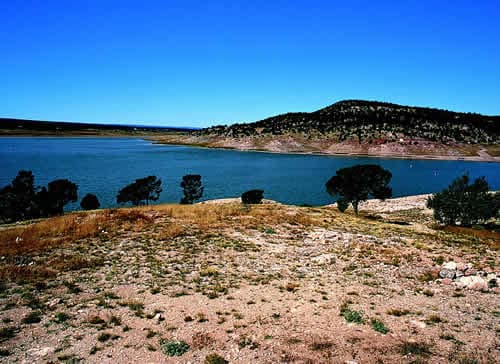
Bluewater Lake has slipped to a level that leaves little cushion for summer, sitting at 7,367.23 feet on April 27, just 1.87 feet above the conservation-pool line of 7,365.36 feet. For McKinley County households, ranchers and anyone headed to Bluewater Lake State Park, that thin margin matters because the reservoir depends mainly on runoff and snowmelt from the Zuni Mountains, and this year’s snowpack disappeared early.
USGS water-year records show the lake does not usually fall below the conservation-pool elevation. Once it does, water ownership shifts under the 1948 Bluewater Lake Minimum Pool Agreement: water below 7,365.36 feet belongs to the State Game and Fish Department, while water above that mark is owned and used by Bluewater-Toltec Irrigation Co. That split, set when the lake and dam were already central to local water use, is now once again at the center of a dry-water-year calculation.
The reservoir has also been shrinking in volume. Reporting tied to USGS data showed Bluewater Lake at 4,500 acre-feet on January 1, then 4,485 acre-feet by January 8, before continuing to edge down through winter and early spring. Snowpack in the Zuni Mountains improved briefly in late January, but by early March it was effectively gone from the gauge. On May 3, USDA Natural Resources Conservation Service reporting showed New Mexico snow-water equivalents at very low levels across many basins, a sign that spring runoff potential had already weakened statewide.
That trajectory raises the stakes in the Rio San Jose basin, where Bluewater is one of the key reservoirs and where lake levels influence both irrigation supply and recreation. The New Mexico Environment Department has said Bluewater Lake is especially vulnerable because it has relatively low storage volume compared with annual watershed precipitation and faces high evaporative demand, a combination that can pull the lake down quickly once inflows fade.
The warning extends beyond the shoreline. Drought.gov reported that 100% of people in McKinley County were affected by drought, underscoring how quickly a fast-melting snowpack and a declining reservoir can translate into tighter summer conditions. If the lake keeps falling, managers will be watching that conservation-pool threshold closely, because dropping below it would shift control of the water stored in the lake and could affect downstream irrigation, park use and the broader water balance in west-central New Mexico.
This article was produced by Prism’s automated news system from verified source data, official records, and press releases, then run through automated quality and moderation checks before publishing. The system is built and supervised by the people who set the standards it runs under. Read our full AI policy.
Did this article answer your question?


