Fort Wingate links Navajo history, railroad expansion and Route 66
Fort Wingate is a place where Navajo return, railroad expansion, Route 66 and a 2024 cleanup plan still shape McKinley County.

Fort Wingate sits about seven miles east of Gallup along Interstate 40, where the red rocks meet the edges of the Navajo Nation and the Zuni Tribe reservation. It is not open to the public, but it still carries a weight that reaches far beyond a fenced historic district: more than 400 sites and ruins traceable to Navajo and Zuni traditions make it a living landscape of memory, land stewardship and contested history.
A landscape built on layered homelands
The National Park Service treats Fort Wingate as more than a former military post because the place sits in an ancestral homeland for both Navajo and Zuni people. That matters in McKinley County, where questions about access, preservation and interpretation are not abstract museum debates but part of how residents talk about land and responsibility.
The Library of Congress has described the fort as one of the Southwest’s most important military landscapes, and that designation reflects the site’s scale as much as its symbolism. The district is not a single ruin or a lone barracks line. It is a broad historic area where military architecture, Indigenous sites and transportation corridors overlap in one place.
From Fort Fauntleroy to Fort Wingate
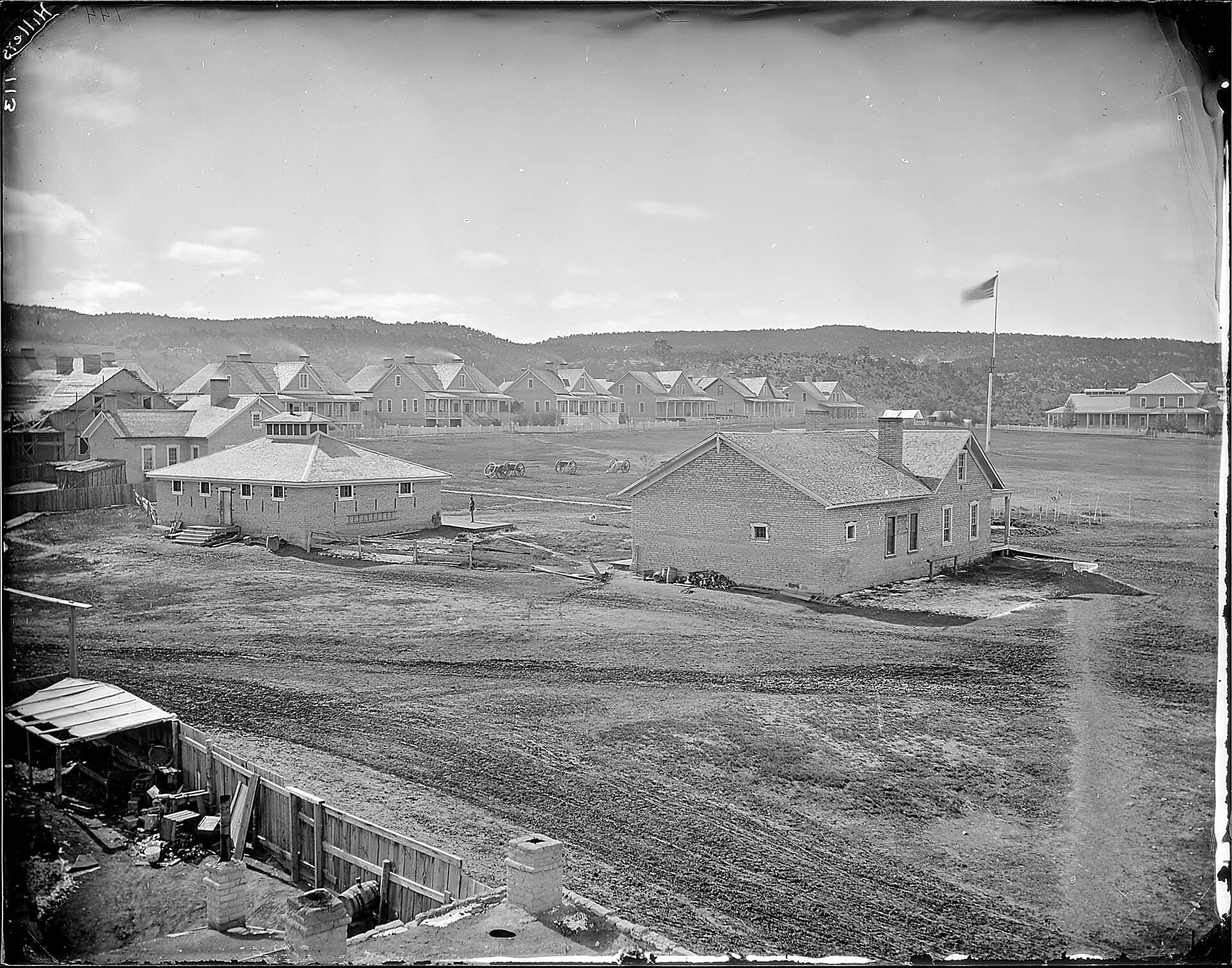
The story begins with Fort Fauntleroy in 1860, then moves through the upheaval of the Civil War and into the 1868 establishment of Fort Wingate. That shift followed the treaty period that allowed Navajo people to return home, which makes the site inseparable from the wider history of the Long Walk and the reshaping of Navajo homeland after forced removal.
Fort Wingate then became a large installation that helped police the surrounding reservation and protect construction on the Atchison, Topeka and Santa Fe Railroad. That connection matters because it places the fort inside the machinery of U.S. expansion, not outside it. The military post was not only watching a frontier border; it was helping secure the rail line that tied western New Mexico to national movement, settlement and commerce.
Railroad corridor, Route 66 and the road to Gallup
Fort Wingate later became a key military installation along Route 66 during World War II, which gives the site a second layer of meaning for modern travelers in McKinley County. The same landscape that once supported frontier control later sat within the era of automobile travel and wartime logistics, linking it to the broader corridor that made Gallup a crossroads town.
That history helps explain why Fort Wingate still belongs in conversations about tourism and heritage even though it is not a stop where visitors can wander freely. The site connects Gallup’s history to railroad expansion, to Route 66 and to the Indian Country geography that shaped the region long before either road existed. In practical terms, it is one of the places where McKinley County’s story becomes visible in a single view.
Military reservation, depot and wartime storage
Library of Congress records describe the Fort Wingate Military Reservation as established in 1870, and by 1918 the Army Ordnance Department had assumed control of the reservation. The ordnance mission turned the site toward explosive storage, with magazines built for TNT. During World War II, a new ammunition storage depot began replacing the earlier facility, extending the military role into the 20th century.
That later chapter mattered long after the frontier era ended. Fort Wingate was one of the best-preserved military establishments in the Southwest until the late 1950s, a detail that helps explain why historians and preservationists still look to the site as a benchmark for military landscape history. The active mission at the Fort Wingate Depot Activity did not cease until 1993, leaving behind not just structures but environmental obligations.
Cleanup is now part of the history
The most immediate chapter is a 2024 restoration plan completed by the Navajo Nation, the Zuni Tribe, the New Mexico Office of Natural Resources Trustee, the U.S. Army and the U.S. Forest Service. The plan follows a 2022 settlement and uses $1,137,150 awarded in settlement with the Army to address injuries tied to hazardous substances released at the site.
Those hazards include lead, arsenic, other metals, volatile organic compounds, PCBs and explosive compounds. The plan also includes restoration work for Cibola National Forest and habitat for the Zuni bluehead sucker, a fish culturally significant to Zuni Pueblo and listed as endangered in New Mexico. That makes the project more than a cleanup. It is a test of whether federal, state and tribal institutions can restore a landscape that has been damaged while also respecting the communities tied to it.
How to understand Fort Wingate now
Because the historic district is not open to the public, the real way to approach Fort Wingate is interpretive rather than recreational. The site asks visitors, educators and local institutions to read the land with care: as a Navajo and Zuni homeland, as a military reservation, as a railroad-era holding ground and as a Route 66 landmark shaped by war and movement.
For Gallup and the wider county, that mix is the point. Fort Wingate is where McKinley County’s history of Indigenous return, U.S. expansion and environmental repair meets the present tense, and the obligation now is not just to remember it but to steward what remains.
This article was produced by Prism’s automated news system from verified source data, official records, and press releases, then run through automated quality and moderation checks before publishing. The system is built and supervised by the people who set the standards it runs under. Read our full AI policy.
Did this article answer your question?


