Navajo Nation Shelter Nonprofit Faces Cash Crisis Amid Delayed Reimbursements
ADABI staff drive to crisis calls without fuel money, carrying a $500,000 contract that pays back only after the bills are already due.
When a mother and her children need to flee a violent home in the middle of the night near Forest Lake, the advocates at Amá Dóó Áłchíní Bíghan Inc., known as ADABI, don't check their bank balance. They load into the nonprofit's lone vehicle and drive.
"Our priority is their safety," said Lorena Halwood, ADABI's executive director. "If a client and six children need to be picked up in Forest Lake right now, my staff, they're on their way. They don't wait to say, we need to put in gas. There's no gas. They're already on their way. Because time is of the essence, and we have to get that family to safety."
That round-the-clock commitment has kept the Chinle-based shelter operating. It has also pushed the organization to a financial breaking point.
ADABI was awarded a $500,000 contract through the Navajo Nation Division for Children and Family Services to provide crisis shelter and services to survivors of domestic violence and sexual assault across the Chinle Agency and surrounding parts of Dinétah. But the contract is structured on a reimbursement basis: the nonprofit must cover all costs first and submit invoices afterward. Those invoices can take weeks or longer to be paid.
That lag hits every line of the budget. Bookkeeper Elouise Begay manages the invoicing cycle, but the reimbursement clock does not pause for payroll, utility bills, food, diapers or vehicle fuel. Staff absorb those costs in real time, then wait.
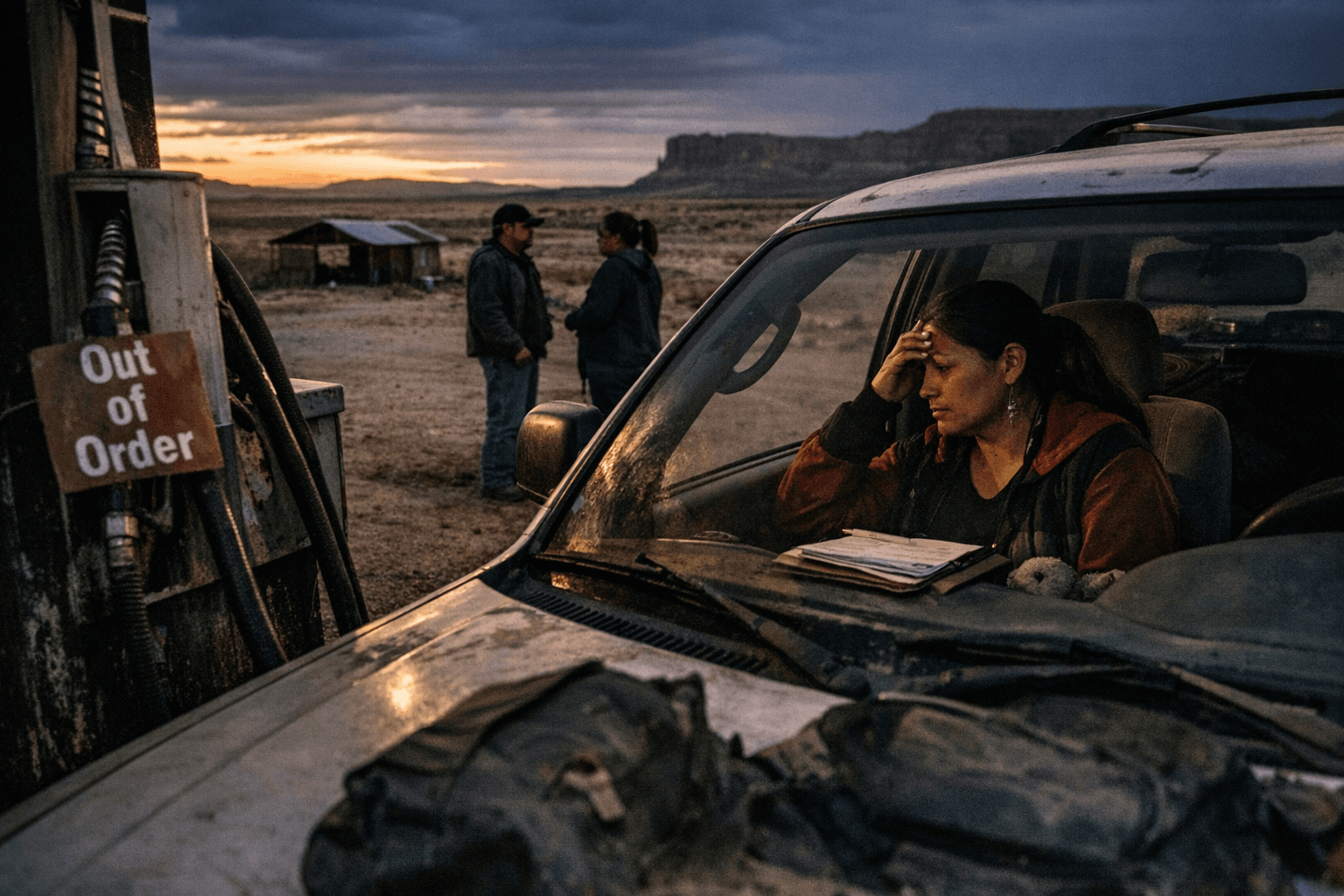
The structural problem is not unique to ADABI, but the consequences in rural Navajo communities are acute. Survivors fleeing violence in the Chinle Agency have limited fallback options. Gallup, the nearest regional center with hospital services, sits roughly 90 miles from Chinle and considerably farther from more remote communities on the reservation. When ADABI's financial strain slows its response capacity, that gap widens and families in crisis have nowhere to turn.
Fixing the problem requires an administrative change. Advance payments or faster interim reimbursements under the existing contract structure would allow ADABI to maintain staffing, keep its vehicle roadworthy and stock the shelter without carrying a perpetual operating deficit. The Navajo Nation Division for Children and Family Services controls that reimbursement timeline.
Survivors of domestic violence or sexual assault can reach ADABI's 24-hour hotline at (928) 674-8314. The organization's mailing address is P.O. Box 1279, Chinle, AZ 86503.
This article was produced by Prism’s automated news system from verified source data, official records, and press releases, then run through automated quality and moderation checks before publishing. The system is built and supervised by the people who set the standards it runs under. Read our full AI policy.
Did this article answer your question?


