New Mexico launches dashboard to track 50-year water plan progress
Gallup’s aquifers have fallen as much as 200 feet in 10 years, and a new state dashboard will show whether New Mexico’s water promises are keeping pace.
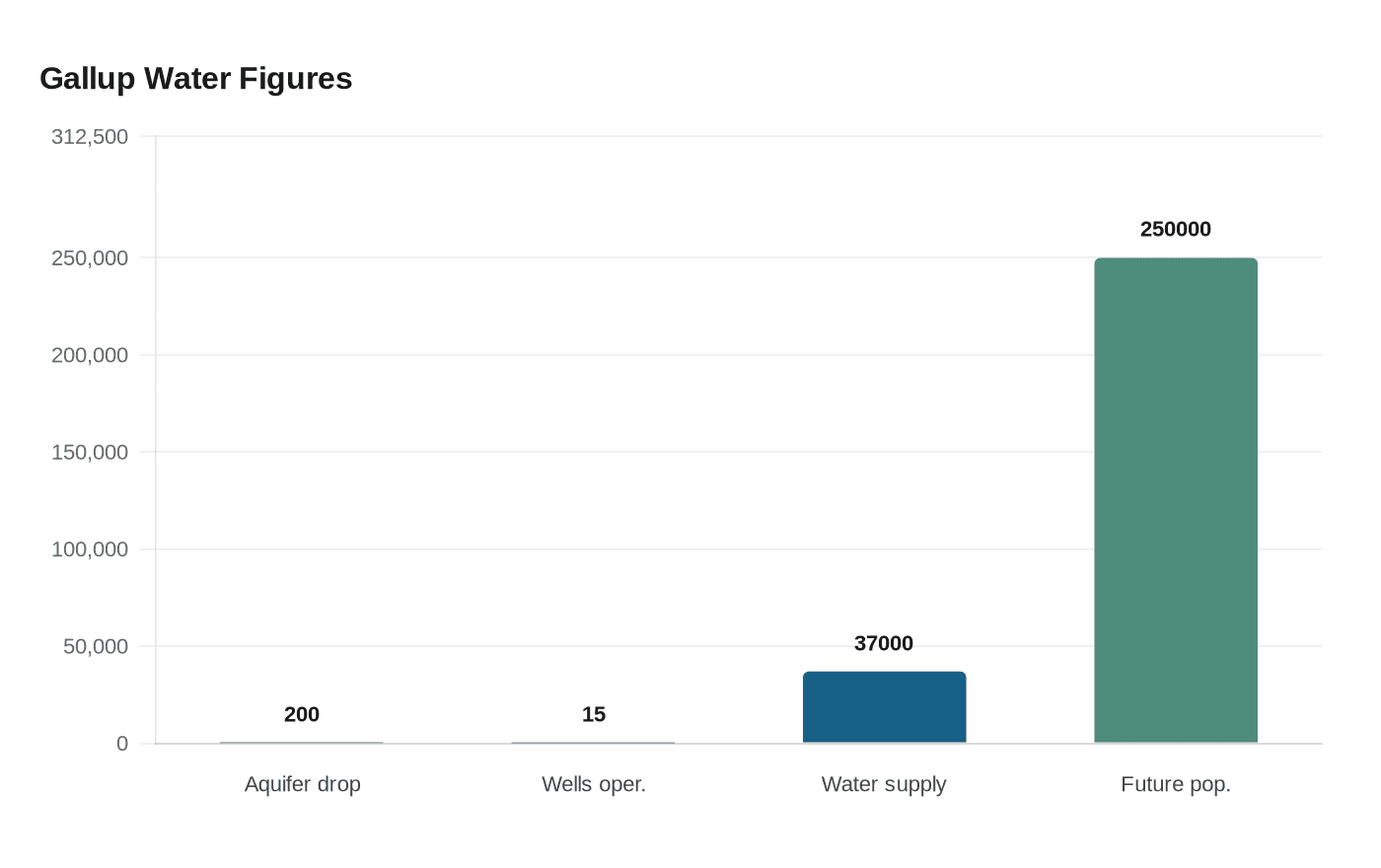
Gallup’s aquifers have dropped as much as 200 feet in the last decade, and only 15 of the city’s more than 45 wells are still in service or operational. That is the kind of local pressure the state’s new public dashboard is meant to make visible for McKinley County, giving residents a real-time look at whether New Mexico is moving beyond promises and into results.
The dashboard, launched April 28, tracks progress on the state’s 50-Year Water Action Plan, a long-range effort first announced in January 2024 to prepare New Mexico for a future that could be 25% drier within 50 years. State leaders framed the plan as a response to a water future already under strain, noting that almost three-fourths of New Mexico was then in severe to exceptional drought. The plan builds on the Produced Water Act, the Water Data Act, the Water Security Planning Act of 2023 and the Land of Enchantment Legacy Fund.
The plan is built around 11 priority actions in three areas: conservation, innovation and protection. State materials say each action includes a synopsis, immediate next steps and a measurable return-on-investment target. In February 2025, the governor’s office said it was seeking more than $270 million in nonrecurring funding to carry out the work, and legislative materials identify five lead agencies: the Office of the State Engineer and Interstate Stream Commission, the New Mexico Environment Department, the New Mexico Department of Agriculture, the Bureau of Geology and Mineral Resources and the Energy, Minerals and Natural Resources Department.
For Gallup and nearby communities, the plan is not abstract. The city’s water future still depends heavily on the Navajo-Gallup Water Supply Project, a federal project authorized by Public Law 111-11 in 2009. Gallup says the system is designed to divert more than 37,000 acre-feet of water each year through about 260 miles of pipelines and 24 pumping stations, serving a future population of about 250,000 by 2040. The Bureau of Reclamation says construction on the San Juan Lateral is expected to finish in 2028, with Congress mandating completion by the end of 2029.
That makes the new dashboard more than a state accounting tool. In McKinley County, where drought, aging wells and long-delayed infrastructure shape daily life, it could become a way to check whether Santa Fe’s water strategy is helping Gallup, the Navajo Nation and other western communities secure a more reliable supply before the next dry decade arrives.
This article was produced by Prism’s automated news system from verified source data, official records, and press releases, then run through automated quality and moderation checks before publishing. The system is built and supervised by the people who set the standards it runs under. Read our full AI policy.
Did this article answer your question?