Red tape blocks road repairs while chapter remains social hub
Nahodishgish leaders purchased culverts to fix a washout-prone BIA road on a school bus route, but federal jurisdictional rules prevented McKinley County crews from installing them, leaving the roadway unrepaired after the monsoon. The standoff underscores how overlapping tribal, county and federal authority can endanger safety and stall local projects even as the chapter house continues to anchor community life.
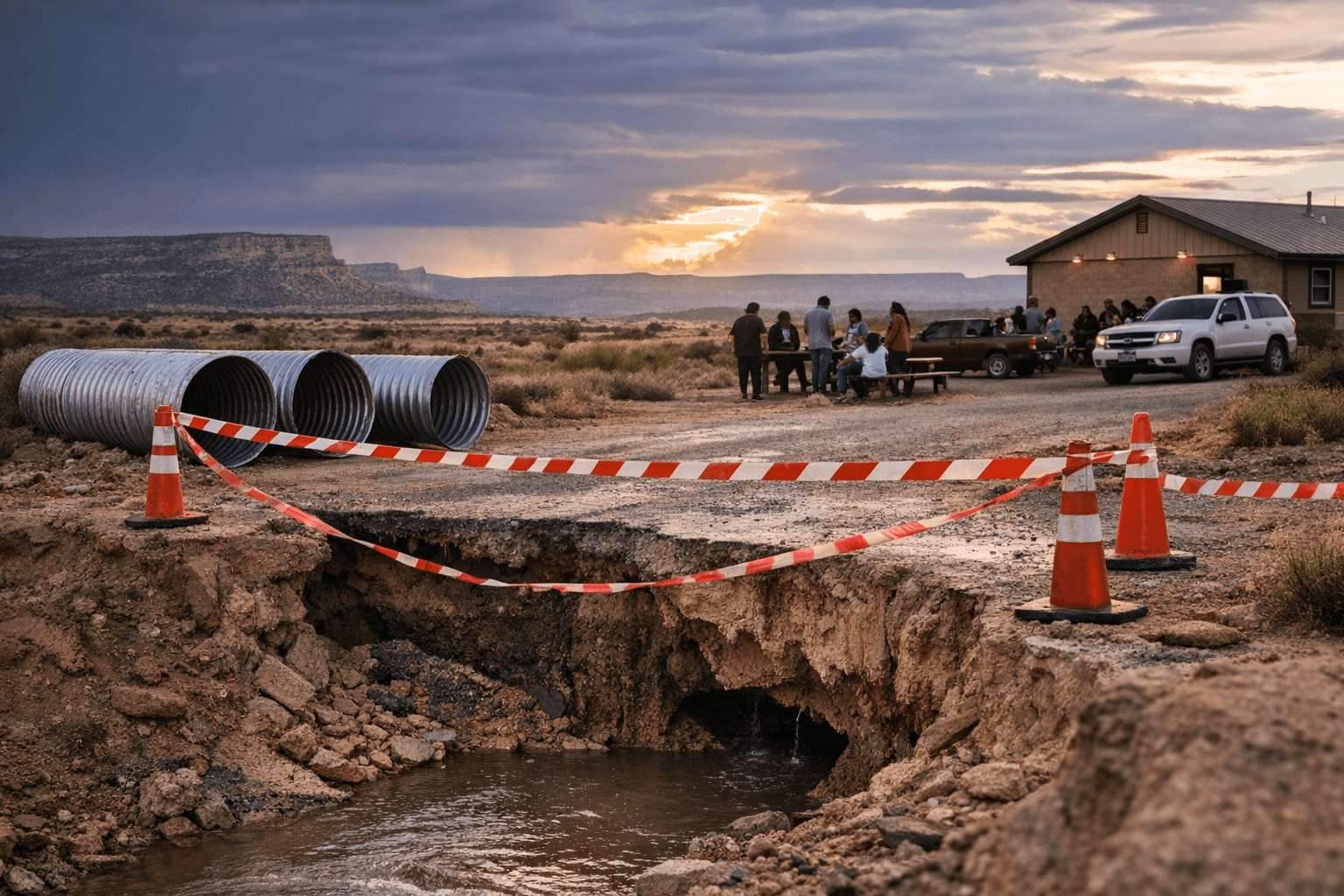
Nahodishgish, a small chapter of roughly 1,000 residents perched above a ridge near Gallup, illustrates a common challenge in McKinley County: strong civic life coexisting with persistent infrastructure and jurisdictional roadblocks. Chapter officials said they bought culverts to stabilize a washout-prone stretch that serves a school bus route, enlisted county help to install them, and were stopped because the road is under Bureau of Indian Affairs control. The culverts sat idle near the chapter house and the road washed out again during the monsoon.
As chapter president Vanessa Begay Lee described it, the chapter confronted layers of regulation and denial of local initiative: "Red tapes, everywhere!" Lee said she had expected county crews to install the culverts after the chapter purchased them, only to be told by federal authorities that neither the county nor the chapter could repair a BIA road. She said that after two decades as a police officer she had been used to people doing what she asked, but in the chapter leadership role she had heard "There's no way we can do that."
The jurisdictional stalemate has concrete consequences. The affected road is part of a school bus route, making repeated washouts a safety and access concern for families. The chapter also ran into limits when planning to place summer youth employment participants with elders for wood chopping and home repairs; child labor and transportation rules restricted how underage workers could be used, complicating local efforts to pair youth employment with elder services. A separate youth quilt project was barred from fair competition because contest rules require work by an individual, not a group.
Despite these constraints, Nahodishgish’s chapter house remains the community’s social and civic center. A portrait of former Navajo Tribal Chairman J.C. Morgan hangs inside the chapter house, and the calendar is full: seasonal shoe games, a black-tie banquet for student athletes with strict dress and academic standards, a widely attended Labor Day featuring traditional games and a tug of war, holiday dinners, a Veterans Day parade and other events. "It's really fun," Lee said of the Labor Day festivities. Accounts Maintenance Specialist Lucinda Begay summarized the chapter's role succinctly: "This place is a real community." Lee added with a laugh, "Everyone here is related to everyone else, whether they like it or not."
The chapter’s assets, tight social bonds and active civic programming, coexist with structural deficits: no paved roads, some homes without running water or electricity because of the cost to pump water up the ridge, and high local unemployment complicated by proximity to the larger Crownpoint community 12 miles away. The current combination of federal control over roads, county limitations and regulatory barriers to youth programs highlights a recurring policy problem for McKinley County policymakers and tribal leaders: how to align responsibilities and funding so small chapters can address urgent safety, utility and economic needs without sacrificing local initiative.
This article was produced by Prism’s automated news system from verified source data, official records, and press releases, then run through automated quality and moderation checks before publishing. The system is built and supervised by the people who set the standards it runs under. Read our full AI policy.
Did this article answer your question?


