Tribes seek full accounting of Native money used for boarding schools
Two tribes want a federal accounting of trust money, land proceeds and education funds they say helped pay for boarding schools. The case could reshape what descendants in McKinley County know about the loss.
The Wichita and Affiliated Tribes and the Washoe Tribe of Nevada and California are pressing a federal court to account for tribal trust funds, land proceeds and treaty-stipulated education money they say helped pay for the boarding school system that separated Native children from their families for more than 150 years.
Their case, filed in 2025 and amended on June 3, 2026, argues that the federal government’s own estimate of more than $23.3 billion in inflation-adjusted appropriations for the boarding school system and related assimilation policies does not capture the full financial damage. The case was transferred from the Middle District of Pennsylvania to the U.S. District Court for the District of Columbia on Sept. 15, 2025.
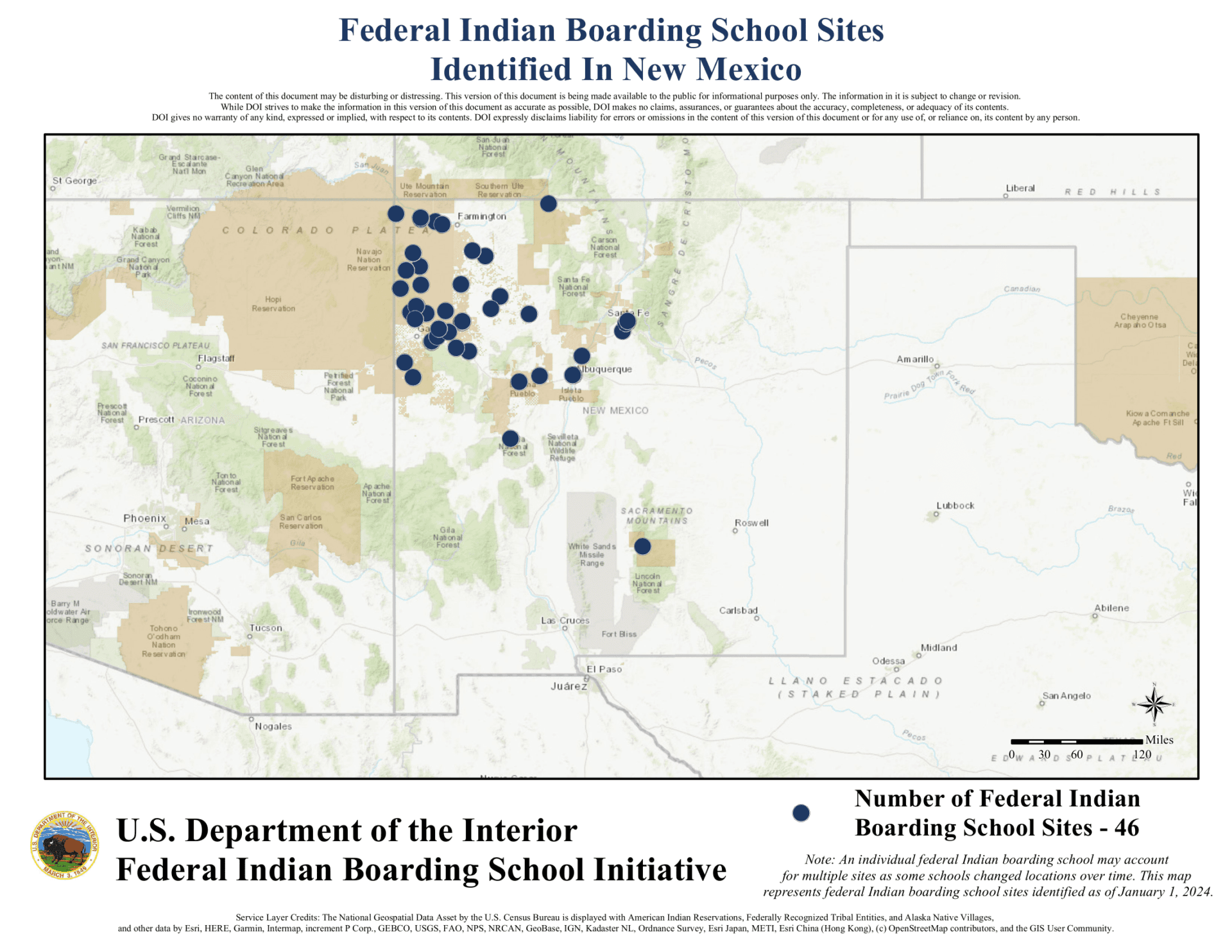
The request lands in the middle of a broader federal reckoning that began when the Interior Department launched the Federal Indian Boarding School Initiative in June 2021. The department released its first investigative report in May 2022 and a second volume on July 30, 2024. That final report identified 417 federal Indian boarding schools across 37 states or then-territories, at least 973 documented deaths of American Indian, Alaska Native and Native Hawaiian children, and at least 74 marked and unmarked burial sites at 65 school sites.
For families in McKinley County and across the Navajo Nation, the lawsuit reaches beyond the courthouse. It asks how much Native money was diverted to sustain a system that stripped children of language, kinship and home, then left communities to absorb the long aftermath. The boarding school era did not end with the closing of a campus; its effects still shape family histories, language recovery, and the records descendants must use to piece together what happened.

The tribes’ legal theory is straightforward: if Native trust funds, land-sale proceeds and education dollars were used to keep the boarding school system running, then the accounting should show exactly where that money went and how much of it came from Native nations themselves. Reporting on the case has said tribal advocates believe that at some points as much as 95% of boarding school funding came from Native nations’ trust funds.
That demand for a full ledger gives present-day force to the Interior Department’s findings. The government has already acknowledged the scale of the boarding school network, the death toll and the burial sites. The remaining question, now being tested in Washington, is whether federal records can also show how much Native wealth was taken from tribes to finance the system that harmed their own children.
This article was produced by Prism’s automated news system from verified source data, official records, and press releases, then run through automated quality and moderation checks before publishing. The system is built and supervised by the people who set the standards it runs under. Read our full AI policy.
Did this article answer your question?


