Zuni Pueblo Offers Travelers Cultural Sites, Festivals, and Desert Scenery
With roughly 80% of its workforce making art, Zuni Pueblo is less a tourist stop than a living "artist colony" set against New Mexico's high desert mesas.
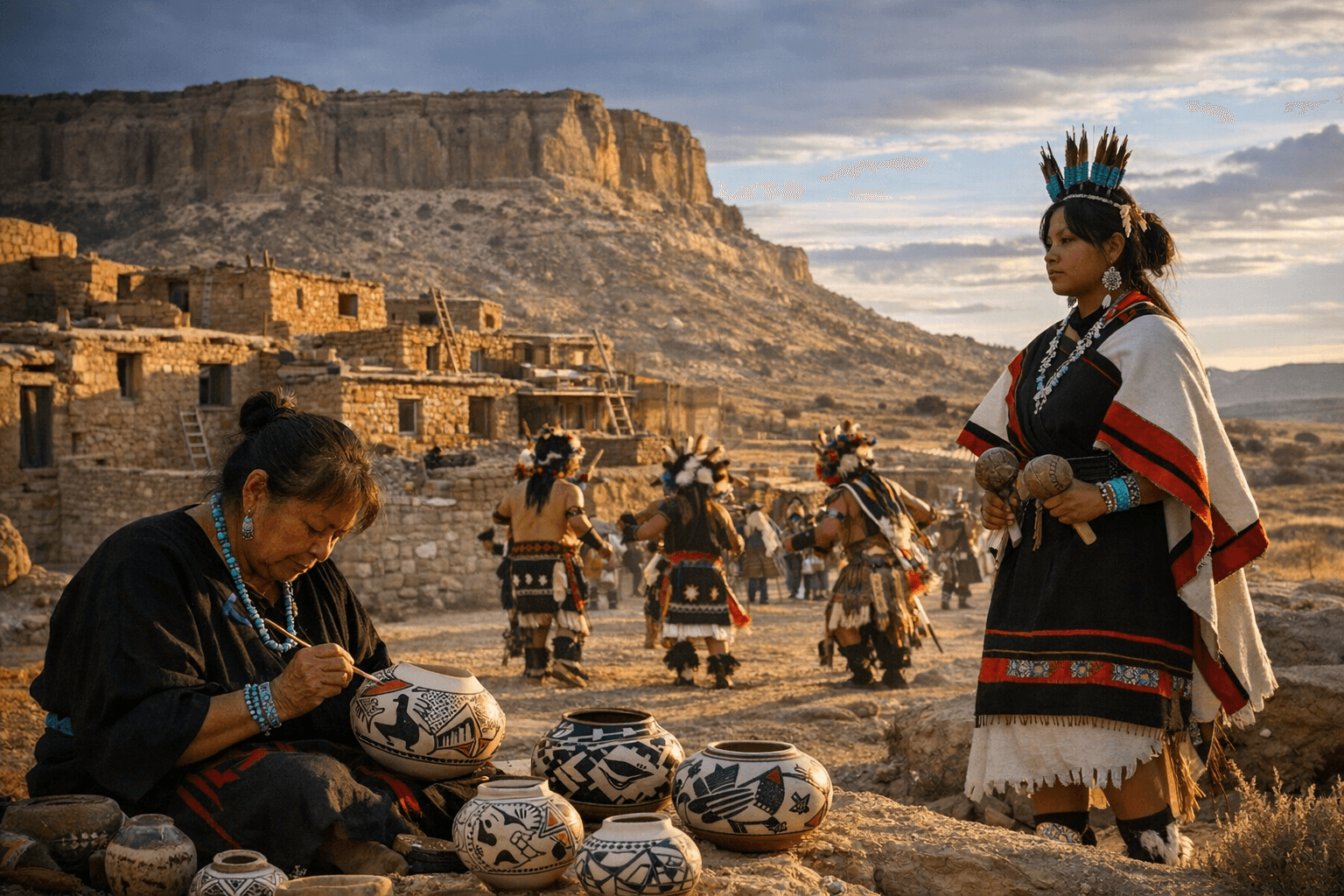
A short drive from Gallup, the Pueblo of Zuni sits beneath wide desert skies and distant mesas in McKinley County, and what awaits there is unlike anything else in New Mexico. The A:shiwi people, as the Zuni call themselves, have built a community where culture is not a performance staged for visitors but the foundation of daily life. With more than 400,000 combined acres of land, an enrolled population of over 20,000, and a self-described identity as the most traditional of all nineteen New Mexico Pueblos, Zuni offers a depth of experience that few destinations in the Southwest can match.
An "Artist Colony" in the High Desert
The Zuni economy runs on art, and the numbers behind that fact are striking. According to Zuni Pueblo MainStreet, perhaps 80% of the Zuni workforce is involved in making art, prompting the community to describe itself plainly as an "artist colony." The main industry is the production of arts, including inlay silverwork, stone "fetish" carving, pottery, and others "of which we are world famous," as Zuni Pueblo MainStreet puts it. Stone inlay jewelry, fetish carvings, and textiles are among the specific forms visitors encounter. These are not mass-produced souvenirs: the Zuni Visitor Center connects travelers to artisans whose families have lived in the region for generations, with the lineages and histories behind the work available to anyone willing to ask.
This artistic tradition developed in part from geographic isolation. The A:shiwi have maintained a unique language, culture, and history across centuries, and that distinctiveness is visible in every art form produced here. Zuni is the largest of the nineteen New Mexican Pueblos by land area, yet it has remained unusually insular in the best sense: deeply committed to its own traditions rather than absorbed into a broader regional identity.
Zuni Pueblo MainStreet
Anchoring the visitor experience is Zuni Pueblo MainStreet (ZPMS), a 501(c)(3) nonprofit organization located within the Pueblo of Zuni. Created in July 2012, ZPMS holds a distinction no other organization in the country shares: it is the first and only Native American Main Street community in the United States. Its mission is to "utilize new approaches and methods to encourage revitalization of our local economy while continuing to preserve our unique traditional and historic elements." That balance, between economic development and cultural integrity, shapes how ZPMS approaches tourism. Growth is welcomed, but not at the cost of what makes Zuni worth visiting in the first place.
The Zuni Visitor Center
The Zuni Visitor Center is the recommended first stop for anyone arriving at the Pueblo. Set against the backdrop of distant mesas and wide desert skies, it serves as "both a practical hub for travelers and a gateway to understanding the spiritual and cultural richness of Zuni Pueblo," according to Zuni Pueblo MainStreet. The center highlights local arts, including pottery, jewelry, and textiles, and provides direct connections to artisans. Staff are knowledgeable in A:shiwi traditions and can offer guidance on historic sites as well as hiking and sightseeing in the Zuni Mountains and surrounding high desert.
The Visitor Center's philosophy is deliberate: it "encourages exploration at a respectful pace, allowing visitors to engage deeply with both landscape and community." For travelers accustomed to rushing through destinations, that approach is worth taking seriously. Zuni is a living community, not a museum, and the pace set here reflects that reality.
Planning Your Visit: Tours and Practical Logistics
Weekend tours are available at Zuni Pueblo, and reservations must be made at least three days in advance. Through those tours, visitors can meet staff knowledgeable in A:shiwi traditions, learn about historic sites, and receive personalized guidance for hiking, sightseeing, and cultural experiences throughout the Zuni Mountains and the surrounding high desert.
A few practical notes for planning:
- Reserve tours at least three days ahead; they are available on weekends.
- Start at the Zuni Visitor Center for orientation, artisan connections, and trail or sightseeing guidance.
- Allow enough time to engage with the arts, not just browse them. Many artisans are available to discuss their work and family histories.
- Zuni is a sovereign pueblo, and visitors should approach the community with the same respect they would bring to any host culture. Before traveling, confirm current visitor protocols, photography policies, and any restrictions that may apply during cultural events or ceremonies. The Visitor Center is the right place to ask those questions directly.
Specific operating hours, tour pricing, and contact information for the Visitor Center and ZPMS were not available at the time of publication; travelers should verify current details directly with Zuni Pueblo MainStreet before finalizing plans.
What to Experience
Beyond the tour structure, Zuni offers a range of draws concentrated around its arts, history, and landscape:
- Stone inlay jewelry and inlay silverwork: Zuni's most internationally recognized art form, produced by multigenerational families with techniques passed down over centuries.
- Stone fetish carvings: Intricate small sculptures with deep spiritual and cultural significance in A:shiwi tradition.
- Pottery and textiles: Additional art forms available directly from artisans and highlighted at the Visitor Center.
- Museum exhibits: Cultural and historical exhibits providing context for the community's long presence in the region.
- Cultural events and festivals: Zuni hosts cultural events throughout the year. Specific festival names, dates, and public access details should be confirmed with the Visitor Center before travel, as some ceremonies are not open to outside visitors.
- Traditional food: Opportunities to experience A:shiwi culinary traditions alongside the broader cultural experience.
- Hiking and desert scenery: The Zuni Mountains and surrounding high desert provide striking landscape for guided hikes and sightseeing, with staff at the Visitor Center able to direct visitors to appropriate trails and viewpoints.
A Community Worth Visiting Carefully
Zuni is a short drive from Gallup, but the distance measured in cultural significance is far greater. The A:shiwi have sustained a living civilization across this stretch of high desert for generations, producing art that has found its way into collections worldwide while maintaining a language and ceremonial life unique among the pueblos. Zuni Pueblo MainStreet's work since 2012 reflects a community thinking carefully about how to share that heritage with the outside world without surrendering what makes it extraordinary. Visiting with that context in mind, and at the pace the Visitor Center recommends, is the most meaningful way to experience what Zuni has to offer.
This article was produced by Prism’s automated news system from verified source data, official records, and press releases, then run through automated quality and moderation checks before publishing. The system is built and supervised by the people who set the standards it runs under. Read our full AI policy.
Did this article answer your question?


