How Menominee Tribal Courts work, from family cases to appeals
Menominee Tribal Court reaches from child welfare to appeals, and the website shows how Keshena families can check dockets, forms, jury duty, and payments.
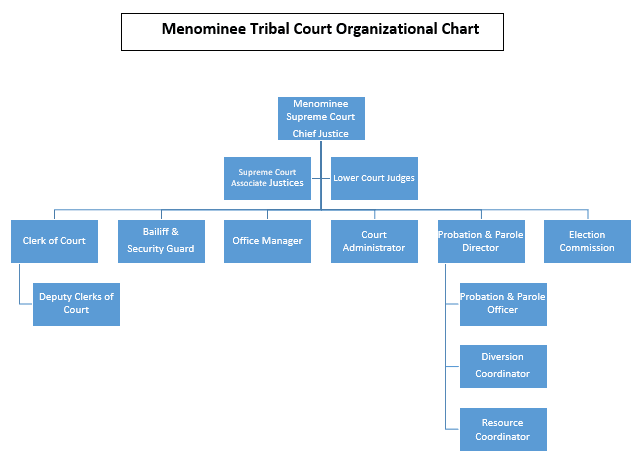
In Keshena, around Legend Lake, and across the Menominee Indian Reservation, Menominee Tribal Court handles family disputes, juvenile matters, probate, civil cases, and appeals under the Menominee Tribal Constitution and By-laws as a “separate and equal branch of the Tribal Government.” Its Supreme Court is the “final and supreme interpreter” of that constitution and tribal ordinances.
When Tribal Court enters daily life
Menominee County residents encounter Tribal Court when a problem becomes a legal one inside the reservation community. The court’s listed case types show how broad that reach is: adoption, child support, civil commitment, conservation, criminal, custody, divorce, guardianships, juvenile matters, motor vehicle issues, name changes, ordinance cases, paternity, probate, relinquishments, restraining orders, small claims, and appeals. That means a family breakup in Keshena, a dispute over a small debt, a juvenile citation, or a conservation-related issue can all lead into the same courthouse system.
The Menominee Tribal Courts provide judicial services to the Menominee Indian Reservation. For some residents, that means a divorce or custody filing. For others, it means a probate case after a death, a restraining order in a safety situation, or a small-claims filing over money owed.
Family cases often begin in Children’s Court
The clearest day-to-day path into the system runs through Children’s Court. Its forms cover temporary physical custody requests, CHIPS and JIPS matters, delinquency, adoption, guardianship, and termination of parental rights. In plain terms, if a child in the community needs immediate protection, or if the Tribe is working through a longer case about placement, supervision, or parental rights, this is where the paperwork starts.
The Children’s Court page also shows how specific those proceedings can be. It includes summonses and notices for CHIPS, JIPS, and guardianship cases, plus notices of hearing, notices of rights and obligations, and protection-and-services petitions. The delinquency side has its own referral forms, including law-enforcement and non-law-enforcement referrals. A case can begin with police contact or through another channel inside the community.
The general forms page includes a motion for transfer to Tribal Court and an order on that motion when a child-related case starts somewhere else and a family wants it brought into the tribal system. The related transfer order form addresses jurisdiction questions and, in some cases, whether keeping jurisdiction in Menominee Tribal Court is in the child’s best interest.
What the court is deciding in child welfare matters
In the CHIPS petition form, the Menominee Tribal Family Services Department alleges a child is in need of protection and services, and the form also refers to reasonable and active efforts to return the child home while protecting the child’s health and safety. In plain English, that means the court is not only deciding where a child should be today, but also whether a family can be safely reunited with the right support.
That same structure appears in the termination and adoption paperwork. The Children’s Court page lists forms for adoption, guardianship, and termination of parental rights, including voluntary and involuntary actions. For a local family, that can mean anything from formalizing a permanent placement to resolving whether a parent’s rights are being suspended or ended under tribal law.
Appeals and the court’s own rules
The Menominee Tribal Courts also include appellate review. The court site identifies appeals as one of its case types, and the tribe’s Supreme Court as the final interpreter of the constitution and ordinances. That gives the court system its own internal ladder for review, separate from Wisconsin’s state courts.
The court’s Cyber Library houses the Court Rules of Procedure for civil and criminal cases, a criminal procedure rule change, the Judicial Code of Ethics, appellate materials, and recognition of foreign judgment. It also links to legal resources including the Wisconsin State Law Library, Wisconsin Circuit Court Access, and the Wisconsin Tribal Judge Association.
What happens after a filing
Once a case is in motion, the court site gives residents several ways to follow along. The home page includes the Court Docket, Forms, Jury Duty, Staff Directory, Children’s Court, Cyber Library, Fines and Fees, and Announcements. The docket page is active and shows the current docket, while the staff directory provides contact information for court personnel. That makes the site useful not just for lawyers, but for anyone who needs to check dates, find paperwork, or figure out where a case stands.
Payments have also moved online. The court’s announcements page lists an “On-Line payment option” through the Menominee Tribal home page, where users can select the Pay On-Line tab and find the Courts link.
This article was produced by Prism’s automated news system from verified source data, official records, and press releases, then run through automated quality and moderation checks before publishing. The system is built and supervised by the people who set the standards it runs under. Read our full AI policy.
Did this article answer your question?