Rainbow Falls and Woodland Bowl Highlight Menominee County's Natural, Cultural Heritage
Rainbow Falls draws hikers to a quiet Wolf River cascade on tribal land, while the Woodland Bowl in Keshena hosts a powwow that pulls dancers and spectators from across North America every August.
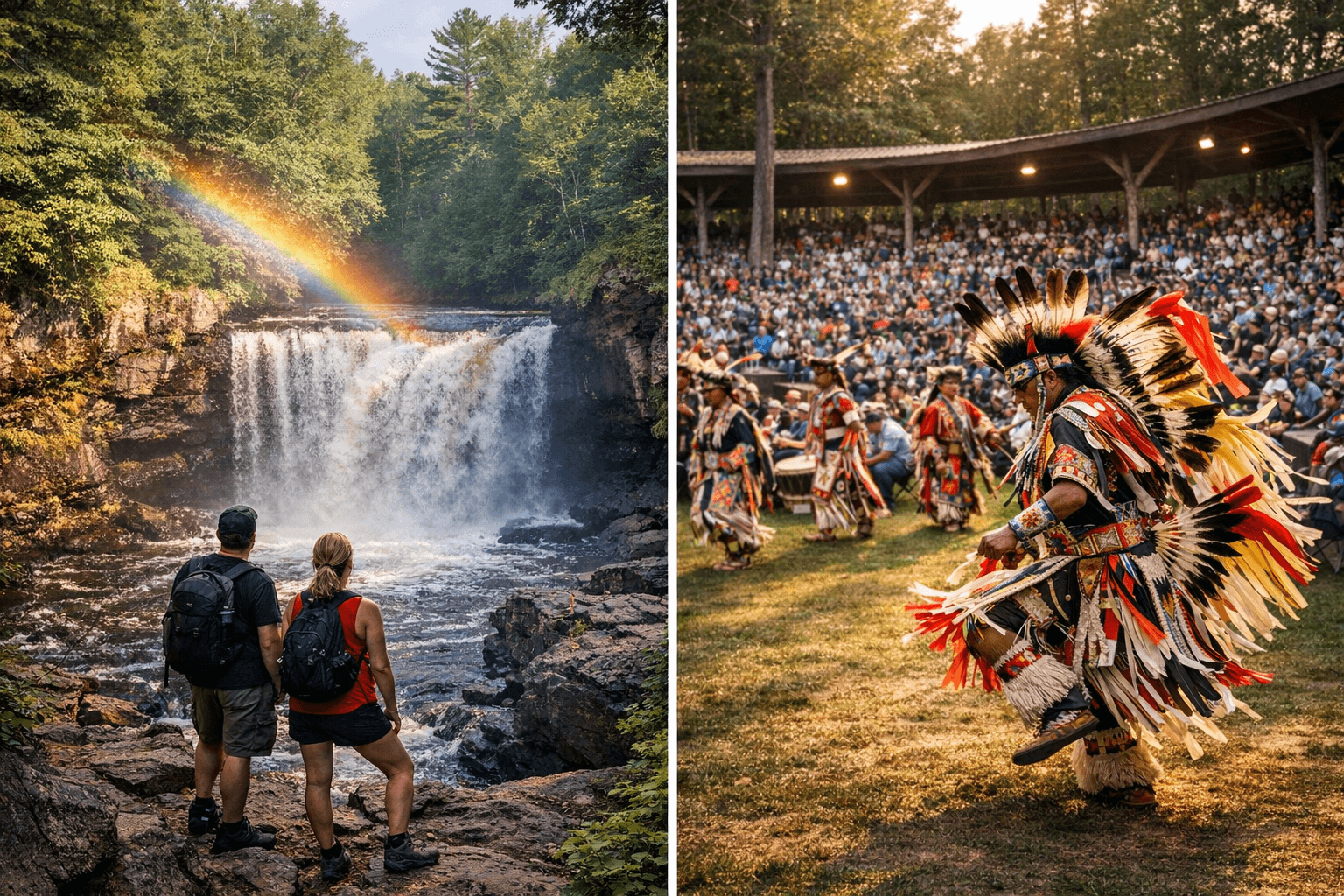
The Wolf River has carved its way through Menominee County for millennia, and at a bend just outside Neopit it produces one of northeastern Wisconsin's least-crowded and most rewarding waterfall hikes. About 20 miles southeast on Route 87 in Keshena, the Woodland Bowl opens an entirely different kind of landscape: a natural open-air amphitheater that for nearly six decades has hosted the Menominee Nation Contest Powwow, the Veterans' Gathering of Warriors, and the ceremonial life of one of Wisconsin's sovereign tribal nations. Both sites are shaped by the same governing principle — the Menominee Nation's commitment to stewardship over the land and culture it has managed continuously for generations. Understanding that context before you arrive makes for a richer visit at either location.
Rainbow Falls: The Hike, the River, and What to Bring
Rainbow Falls sits within the Menominee Reservation's stewardship zone at an elevation of roughly 1,053 feet, its GPS coordinates placing it at 44.97°N, 88.79°W — squarely on tribal land northeast of Neopit. The hike runs approximately 2.4 miles round-trip and rates as moderate, making it accessible to most fitness levels while still delivering a genuine forest walk rather than a paved stroll. Photographers and hikers who have documented the site consistently describe the payoff as a cascade framed by old-growth canopy with none of the crowds that follow Wisconsin's more publicized waterfalls.
Trail conditions shift dramatically by season. Spring snowmelt and autumn rains leave the path muddy and, at either edge of winter, potentially icy. Summer visitors face a separate challenge: mosquitoes and biting insects are common near the river from May through September. Standard preparation includes ankle-supporting footwear, insect repellent in warm months, and enough water for the full round-trip, since onsite facilities are minimal. Visit in daylight; the route is unmarked after dark.
Paddlers and anglers drawn to the Wolf River itself face one additional requirement: the tribe controls river access in this reach, runs shuttle services for permitted users, and requires a tribal permit for anyone launching their own watercraft. That requirement is not a barrier so much as a signal. This is a working, governed landscape with active tribal jurisdiction, and planning accordingly produces a smoother trip.
Respecting Tribal Land: Access, Boundaries, and Leave No Trace
Because Rainbow Falls lies on tribal land or within tribal stewardship zones, the rules governing a visit are set by the Menominee Nation rather than by Wisconsin state parks. Posted signage and any seasonal guidance from tribal offices define where visitors can go and what they can do along the route. Leave No Trace principles apply throughout: pack out everything you bring in, stay on marked paths, and respect private property boundaries. Seeking permission or guidance before venturing off established routes is not optional etiquette here — it is part of the access agreement. Checking the tribe's official website for current conditions or seasonal restrictions before your trip eliminates most potential problems.
Woodland Bowl: A Venue Shaped by the Land Itself
Located on Fairgrounds Road (Route 87) in Keshena, the Woodland Bowl is an open-air amphitheater formed by the natural contours of the terrain rather than engineered into flat ground. Its design handles large Grand Entries, multi-category dance competitions, vendor loops, and public ceremonies without losing the character of a community gathering. The Bowl functions as the reservation's primary ceremonial space and, for one weekend each August, as the largest single cultural tourism draw in Menominee County.
The annual Menominee Nation Contest Powwow, now in its sixth decade, pulls contestants and spectators from across the United States and Canada. The 57th Annual ran August 1–3, 2025; the 58th Annual will follow in 2026, with the tribe's official website serving as the authoritative source for confirmed dates. Based on the established pattern, plan for an early August weekend and build flexibility into your travel schedule until dates are published. Admission in recent years has been set at $15 for a weekend pass and $10 for a single day, with free entry for visitors 60 and older and children 5 and under.
Grand Entries — the ceremonial processions that open each powwow session — have been scheduled on Fridays at 7:00 p.m. and twice daily on Saturdays and Sundays, at noon and 7:00 p.m. Arriving before the procession begins is not a courtesy: Grand Entry protocols ask that spectators remain in place once it starts, and movement through the arena disrupts the ceremony for everyone. The Bowl also hosts the Veterans' Gathering of Warriors separately from the Contest Powwow, an event with its own ceremonial structure and community.
Economic Reach and Vendor Participation
The Contest Powwow weekend registers as one of the highest-revenue periods for food vendors, beadwork and craft sellers, and regional hospitality businesses in Keshena and surrounding communities. That economic reach extends beyond the Bowl itself into lodging, fuel stops, and restaurants throughout the county. Vendors seeking a booth must apply through the tribe's cultural offices ahead of each season; walk-in setup is not permitted, and application guidance is published on the tribe's official website annually.
Quick-Reference Planning Guide
- Confirm current tribal access rules and seasonal conditions before traveling
- Wear ankle-supporting footwear; pack water and insect repellent in warm months
- Carry out everything you bring in; no onsite facilities
- Paddlers need a tribal permit for the Wolf River before launching
- Hike in daylight only; the trail has no lighting
For Rainbow Falls:
- Check the tribe's official website for confirmed 2026 event dates before booking travel
- Arrive before Grand Entry; moving through the arena once the procession begins disrupts the ceremony
- Budget time for parking during the Contest Powwow; crowds are large and shuttle logistics vary by year
- Vendors must apply through tribal cultural offices in advance
- Follow published drumming and dance etiquette from event organizers
For the Woodland Bowl:
The Shared Thread
What connects a riverside cascade outside Neopit with an amphitheater in Keshena is not proximity on a map but a shared governance structure. The tribe sets access rules for the river, maintains the Bowl, publishes ceremony guidance for powwow visitors, and manages the surrounding land as part of a stewardship mission that predates Wisconsin statehood by centuries. Visitors who grasp that system before they arrive become better guests and, during powwow weekend, active contributors to an economic and cultural ecosystem that has defined Menominee County across generations. The falls will remain after Labor Day. The 58th Annual Contest Powwow will occupy a single August weekend. Both are worth the drive.
This article was produced by Prism’s automated news system from verified source data, official records, and press releases, then run through automated quality and moderation checks before publishing. The system is built and supervised by the people who set the standards it runs under. Read our full AI policy.
Did this article answer your question?