How the Florida Keys get drinking water from the mainland
A 130-mile mainland pipeline, two treatment plants, and emergency desalination keep the Keys supplied when storms or breaks threaten the line.
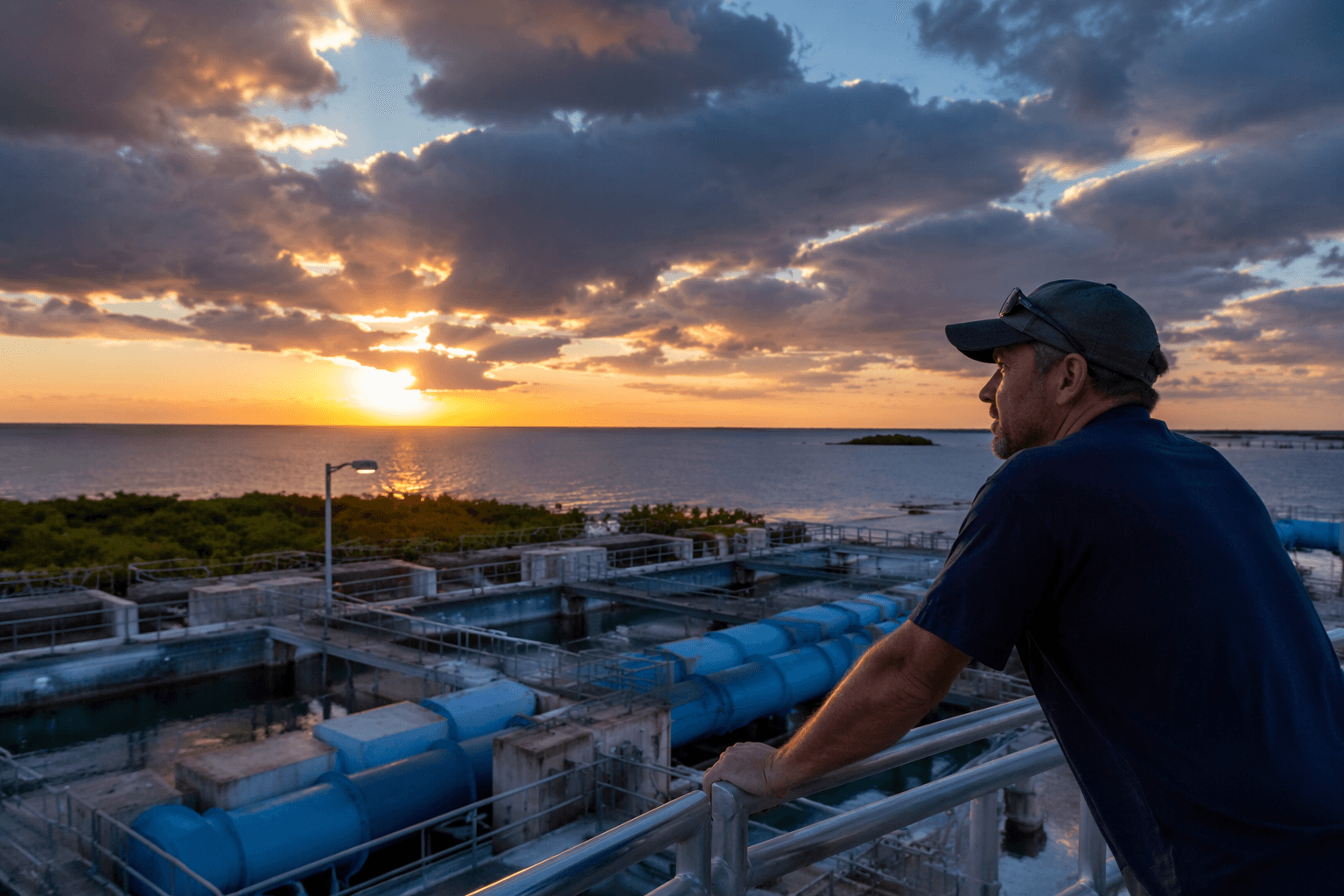
Every faucet in the Florida Keys depends on a water system that starts on the mainland west of Florida City and ends 130 miles later in Key West. The Florida Keys Aqueduct Authority says it sends about 22 million gallons a day into the island chain, so a line break or storm is not just a utility problem, it is a disruption that would reach homes, hotels, restaurants, hospitals and the businesses that run Monroe County.
The mainland source behind the island taps
FKAA says its primary drinking-water source is the Biscayne Aquifer, with the Floridan Aquifer added as a supplement through low-pressure reverse osmosis. The utility’s wellfield sits in protected pine rockland west of Florida City, near Everglades National Park, where FKAA says the source water is exceptionally high quality before treatment and subject to regulatory protections.
That matters because the Keys do not have a natural freshwater buffer of their own. FKAA’s annual water quality report says the system uses two treatment plants, and the utility says water is continuously monitored and tested to meet federal and state drinking-water standards. In practice, that means the supply is not just pumped south, it is actively managed from the point it comes out of the ground.
Joshua Peele, FKAA’s Water Quality and Environmental Manager, is the named contact in the utility’s water quality reporting for drinking-water questions. For residents who want accountability around a system this large, that kind of on-the-record contact is part of the infrastructure too.
How 130 miles of pipe reaches the Keys
FKAA says the treated water is pumped 130 miles from Florida City to Key West, supplying the entire Florida Keys. The transmission main begins at 36 inches in diameter and narrows as it moves south, with booster stations in Key Largo, Long Key, Marathon, Ramrod Key and Stock Island helping keep pressure moving through the island chain.
The authority says the line can operate at pressures up to 250 psi, which shows how much engineering is built into getting water across bridges, channels and low-lying islands. This is not a short local loop. It is a long-distance system that has to keep enough force in the line to reach the Lower Keys while still protecting water quality along the way.
FKAA also says it provides potable water to all residents in the Keys and supplies reclaimed water in select areas for non-drinking uses such as irrigation and vehicle washing. That mix of drinking water and reuse matters in a county where every gallon has to be stretched further than it would in a mainland city.
Why the Keys built a mainland supply in the first place
The modern system grew out of scarcity. A historical account says the Florida Keys Aqueduct Commission was formed in 1937, and before the buried pipeline was completed in the early 1940s, fresh water reached the Keys by boat, train, truck and rain cisterns. The same account puts average rainfall at about 36 inches a year, a reminder that local rainfall alone was never enough to support the population now spread from Key Largo to Key West.
That history explains why the pipeline is still a core civic issue, not an old engineering footnote. The Keys moved from rain barrels and deliveries over water or rail to a mainland-fed utility that now serves the whole island chain, and the island economy has grown around that assumption of dependable supply.
FKAA’s 2024 annual financial report, for the fiscal year ended September 30, 2024, describes the utility’s mission as providing safe, reliable and efficient water and wastewater services with environmental sustainability and fiscal responsibility. In a place that still lives with limited land, a fragile coastline and heavy seasonal use, that mission is operational, not rhetorical.
The weak points that matter during storms or breaks
The system’s greatest vulnerability is also obvious: the water has to travel a long way through a narrow corridor of pumps, mains and bridge-linked communities before it reaches the far end of the Keys. If a main line fails, or if a storm damages key infrastructure, the utility has to lean on redundancy fast. FKAA says it can draw on seawater plants in Marathon and Stock Island in emergencies.
That backup logic is becoming more important as the utility spends heavily to harden the system. In February 2025, the U.S. Environmental Protection Agency announced a $147 million WIFIA loan to FKAA as part of a broader $300 million project effort that EPA said is expected to serve 150,000 people. EPA said the project includes nine components and is designed to improve reliability, longevity and resilience against hurricanes and other extreme weather.
One of the clearest examples is the Kermit H. Lewin Stock Island Reverse Osmosis Facility. FKAA says construction began in October 2021 and was expected to be completed by June 2025, with a price tag of about $47 million and $30,678,750 in Community Development Block Grant-Disaster Recovery funding. The new facility is designed to replace the existing Stock Island RO plant, which FKAA says was damaged during Hurricane Irma, and it has a capacity of 4 million gallons per day.
What backup water means for Monroe County
FKAA says the new Stock Island facility is meant to provide a reliable alternative source if water from Florida City is disrupted. That is the real civic point of the whole system: the Keys depend on a mainland supply, but they also need enough local resilience to keep water moving after a storm, a mechanical failure or a long interruption in the transmission main.
The scale of the system makes that urgency plain. FKAA says it supplies roughly 22 million gallons a day, and EPA’s 2025 project announcement ties the broader upgrade program to 150,000 people. In Monroe County, where water supports not just households but the hotels, marinas, restaurants and public facilities that define daily life, the line between drinking water and economic stability is thin.
The result is a utility that has to do several jobs at once: pull clean groundwater from a protected mainland wellfield, treat it through lime softening and reverse osmosis, disinfect it with chloramines, push it 130 miles south, and keep backups ready when storms or breaks hit. That is how the Keys get drinking water from the mainland, and it is why the system remains one of the county’s most important pieces of unseen public infrastructure.
This article was produced by Prism’s automated news system from verified source data, official records, and press releases, then run through automated quality and moderation checks before publishing. The system is built and supervised by the people who set the standards it runs under. Read our full AI policy.
Did this article answer your question?