Meredosia's river trade and rail roots shaped early Illinois history
Meredosia turned an Illinois River landing into a rail first and a factory town. Its trade past still explains Morgan County pride and loss.

Meredosia sits at one of the earliest crossroads in Illinois history, where river traffic, railroad ambition and small-town industry met on the banks of the Illinois River. The village was surveyed in 1832, but its commercial life was already moving by then: the first general store dates to 1831, and steamboats had begun reaching Meredosia in 1826. That early start made the place more than a landing. It made Meredosia one of the towns that helped teach Illinois how to trade.
River commerce built the town
The Illinois State Historical Society describes early travel on this stretch of river as canoe and keel boat work before steam changed the pace. In Meredosia, that shift mattered fast. The village history says the settlement was established in 1832 as an important commercial center on the Illinois River, and it was named for Antoine D’Osia, a French priest, with the French word for lake folded into the place-name. Those details still define the village’s identity, because Meredosia was never just a dot on a map. It was a place where goods, people and money moved through one narrow channel and stayed long enough to build a community.
Before banks arrived in 1837, residents used coonskins, beeswax and honey as currency, a reminder that this was a frontier economy with real cash scarcity and practical substitutes. Between 1838 and 1858, several sawmills started, white pine was shipped in for homes, and a grist mill and lumber yard joined the local mix. Those are not random old-business facts. They show how river access turned Meredosia into a working center, where construction, milling and trade all depended on the same water route that first brought steamboats into town.

The first Illinois railroad began here
Meredosia’s biggest claim on state history came when the first railroad built in Illinois was authorized in 1837. The line ran 12 miles between Meredosia and Morgan City, and state museum material places the surveyed and contracted work on the Northern Cross Railroad between autumn 1837 and April 1838. The line later became part of the Northern Cross Railroad, then entered the larger rail story that would eventually connect with the Wabash Railroad network.
That same year, Illinois passed its Internal Improvements Act of 1837, a huge state construction package that called for rail lines and included $100,000 for the Illinois River. Meredosia sat right where the state’s transportation bets came together. The village did not just benefit from that investment. It helped justify it. In a county-sized place, the river and the railroad were not competing systems. They were twin engines, each pushing commerce a little farther from the riverbank.
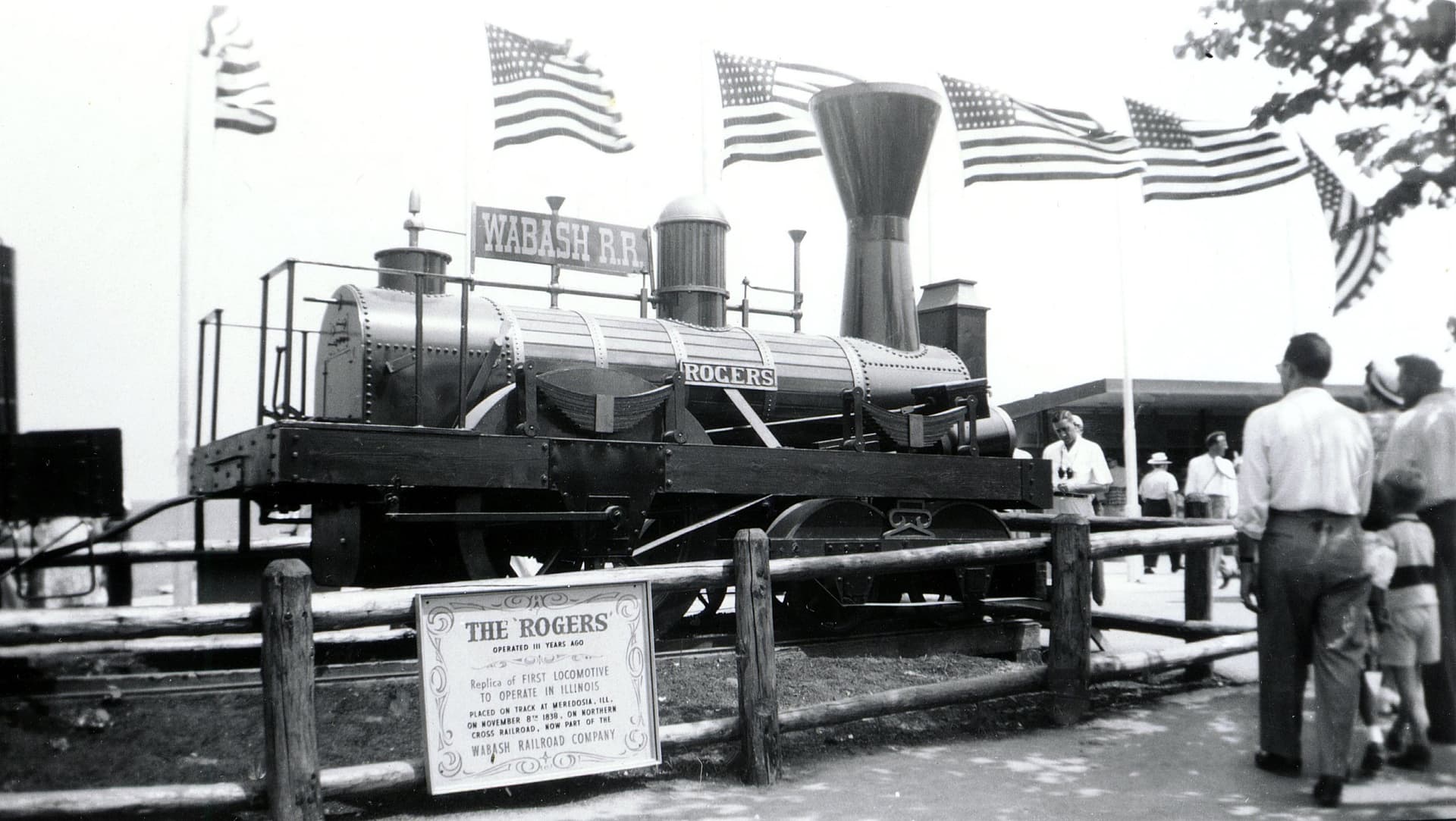
The proof arrived on November 8, 1838, when the Rogers, the first train ever to run in Illinois, steamed out of Meredosia. The village marker and railroad history tie that moment to a broader transformation: a small Morgan County river town became one of the places where the state learned to move faster than flatboat and keel boat schedules allowed. A line to Springfield followed in 1841, and the Northern Cross was sold in 1848, but the footprint it left was much larger than 12 miles of track.
Buttons, fish and the work of the river
Meredosia’s next industrial chapter came from the river itself. Shellers worked the water daily, and the town’s mussel beds fed a pearl-button business that became one of Meredosia’s signature industries. The process was labor-intensive, with 27 different jobs involved in making a pearl button, but it was also local and memorable enough to shape whole careers. Meredosia had three button plants, and the Wilbur E. Boyd Button Factory closed in 1948. The Mayes and Mullen plant was operating before 1912 and closed around 1930, while Casey Jones of Meredosia cut buttons there from 1912 until 1948.
That industry belonged to a wider river economy. The village history says four fish markets, Meredosia Fish Company, Main Street Fish Company, Bridge Fisheries and Hall’s Fish Market, thrived from 1900 into the 1930s before polluted waters hurt the fishery. RiverWeb’s account of commercial fishing between Havana and Meredosia stretches that trade even farther, from the 1890s to the 1950s, with catch shipped to Midwestern and Eastern cities. Together, the button plants and fish markets show a place where the river was not scenery. It was payroll, freight and daily work.

A smaller town carrying a larger legacy
Meredosia’s present-day numbers help explain why those older industries still loom so large. The village had 826 residents in the 2020 census, down from 1,044 in 2010, a drop that reflects the broader pressure on small industrial towns across central Illinois. That decline is part of the backdrop to the 2011 shutdown of the Meredosia energy center, when Ameren said the Meredosia and Hutsonville closures would eliminate 90 positions. A later update said a few employees would remain in Meredosia through March 31 to complete the plant closure safely.
Those losses matter because Meredosia’s identity has long rested on being useful to places beyond its own limits. It was useful to river shipping, useful to the state’s first rail experiment, useful to button makers, fish markets and power generation. Even now, the village’s history page, the Northern Cross Railroad marker and places like Boyd Park and IL Route 104 keep that layered story close to view. In Morgan County, Meredosia still stands as one of the clearest examples of how a river town helped shape Illinois before the state had fully found its modern form.
This article was produced by Prism’s automated news system from verified source data, official records, and press releases, then run through automated quality and moderation checks before publishing. The system is built and supervised by the people who set the standards it runs under. Read our full AI policy.
Did this article answer your question?