Alaska North Slope crude falls as global oil prices ease
North Slope crude slipped to $86.99 a barrel as Hormuz shipping eased, a small drop that still ripples through borough revenue and project planning.

Alaska North Slope crude slipped 84 cents to $86.99 a barrel on June 23 as tankers kept moving through the Strait of Hormuz under an interim U.S.-Iran agreement to reopen the waterway. The decline came alongside a broad market pullback, with West Texas Intermediate down $1.61 to $73.21 and Brent off 82 cents to $77.08, a sign that Alaska’s benchmark was moving with global oil rather than standing apart from it.
For North Slope Borough, even a modest one-day drop carries outsized weight. Roughly 95% of borough revenue comes from oil-and-gas property taxes, and the tax base supports services across a region of 10,582 residents spread over nearly 95,000 square miles. When ANS weakens, the pressure runs through revenue forecasts, project schedules and the confidence of companies weighing where to spend next on the Slope.
The latest price still sits well above the long view. In April, Alaska Department of Revenue figures put ANS at an average of $111.17 a barrel, $8.70 above Brent and $13.11 above WTI. The department described the Brent-to-ANS gap as the largest monthly value since 2000 and possibly the highest in history, underscoring how tightly Alaska grades can trade in the Pacific Basin when supply is scarce.

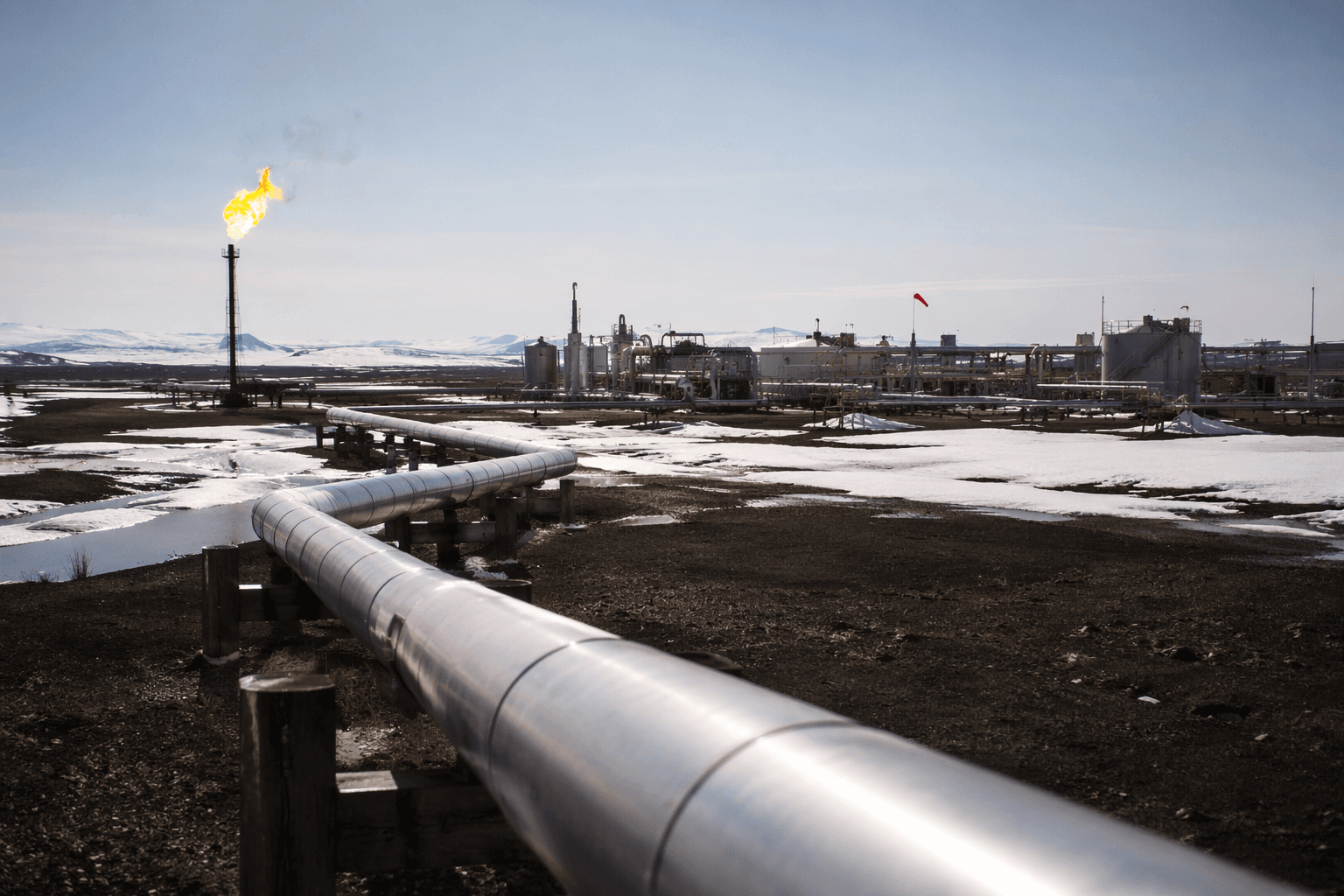
That premium has mattered because North Slope oil does not move on paper alone. It flows through the 800-mile Trans-Alaska Pipeline System, which has 11 pump stations and ends at the Valdez Marine Terminal. Alyeska Pipeline Service Company said TAPS averaged 452,542 barrels a day in May, a reminder that the line is still carrying enough crude for price swings to affect cash flow, field economics and contracting decisions across the basin.
The June pullback also came against a volatile geopolitical backdrop. The International Energy Agency said an interim U.S.-Iran agreement could reopen the Strait of Hormuz and lift a U.S. blockade on Iranian oil traffic, helping push prices to their lowest levels since early March. Later in the same week, oil prices turned higher again after an attack on a vessel in the strait, showing how quickly the market can swing when Persian Gulf shipping is at risk.

ANS has traded far higher in recent years, reaching an all-time record of $144.59 in July 2008 and topping $127 during the 2022 energy shock. Against that backdrop, $86.99 is not a collapse, but it is the kind of dip that Alaska oil officials, borough finance planners and producers on the Slope will watch for signs of a longer turn.
This article was produced by Prism’s automated news system from verified source data, official records, and press releases, then run through automated quality and moderation checks before publishing. The system is built and supervised by the people who set the standards it runs under. Read our full AI policy.
Did this article answer your question?