Alaska North Slope crude surges above $106 on global risk rally
ANS crude closed at $106.66, a rare spike that could improve North Slope project economics and bolster borough tax receipts if it lasts.

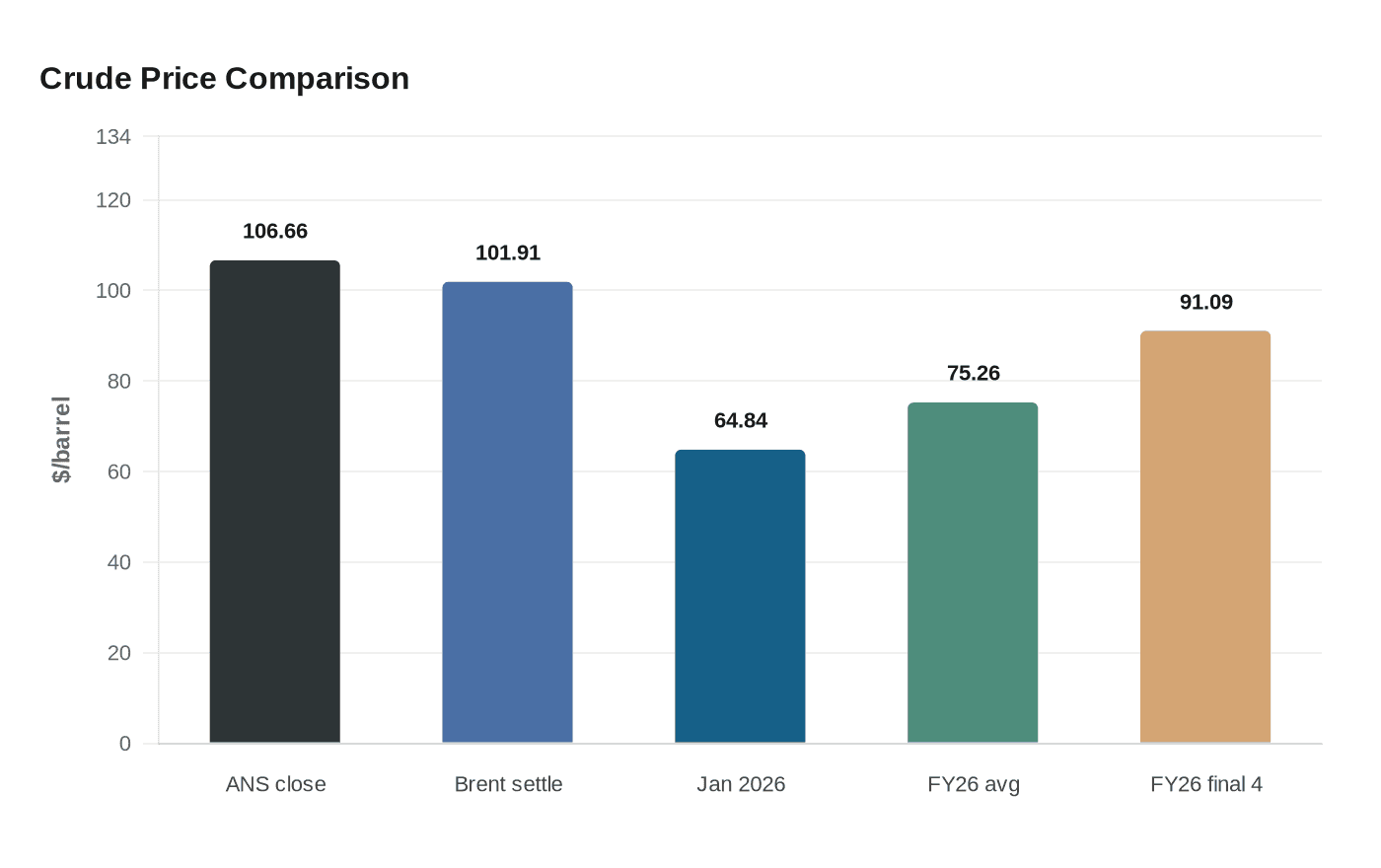
Alaska North Slope crude closed at $106.66 a barrel after a $2.22 jump, a level that can quickly change the math for producers, the state treasury and the North Slope Borough. The spike came as global crude markets rallied on renewed tension in the Strait of Hormuz, where reported attacks on vessels sent Brent briefly above $100 before it settled at $101.91, up $3.43 on the day.
The size of the move stood out because Alaska’s own price backdrop has been far softer for months. The Alaska Department of Commerce said January 2026 ANS averaged $64.84 a barrel, and monthly prices had hovered between about $62 and $75 since September 2024. That makes the April price far above the range state planners had been living with, even after the Alaska Department of Revenue’s spring forecast assumed FY 2026 ANS would average $75.26 and rise to $91.09 in the final four months of the fiscal year.
For the North Slope Borough, the price surge matters in a very direct way. The borough had an estimated 10,582 residents as of July 1, 2025, spread across nearly 95,000 square miles, and oil and gas-related property taxes provide 95% of local tax revenue. Higher benchmark prices do not automatically translate into instant cash, because transportation costs, taxes and production volumes all shape the take, but a stronger ANS price improves the earnings picture for barrels already moving through the system and can support a firmer near-term revenue outlook.
The real test is whether elevated prices hold long enough to affect spending. Alaska’s fall 2025 revenue forecast projected ANS production at 457,000 barrels a day in FY 2026 and 517,800 barrels a day in FY 2027, helped by new North Slope output, including Pikka. If prices stay above the assumptions built into those budgets, projects that looked marginal at $64 to $75 oil become easier to justify, and operators have more room to defend drilling programs, contract work and hiring tied to active field development.
That is why a one-day swing in a global benchmark can matter so much in Utqiagvik and across the Slope. Oil was first discovered at Prudhoe Bay on March 13, 1968, the field came on stream June 20, 1977, and production peaked at about 1.5 million barrels a day in 1979. More than four decades later, a jump above $106 showed that Alaska’s local economy still rises and falls with shocks far beyond the Beaufort Sea.
This article was produced by Prism’s automated news system from verified source data, official records, and press releases, then run through automated quality and moderation checks before publishing. The system is built and supervised by the people who set the standards it runs under. Read our full AI policy.
Did this article answer your question?