Alaska Revenue Forecast Revises Oil Price, Production Outlook for North Slope
North Slope oil production is set to jump 60,800 barrels per day in FY2027, but falling prices mean state oil revenue rises just $10 million.

The Department of Revenue projected a significant jump in North Slope oil production starting in fiscal year 2027, driven by the startup of the Pikka oil field, but lower assumed prices will trim Unrestricted General Fund revenue by $181 million for FY2026 and $119 million for FY2027, according to the Spring 2026 revenue forecast presented to the Senate Finance Committee on March 16.
The forecast assumes Alaska North Slope crude will average $65.48 per barrel in FY2026, falling to $62.00 in FY2027 and not recovering to $75.00 until FY2036. Those price assumptions are $2.52 per barrel lower for FY2026 and $5.00 per barrel lower for FY2027 than what the Department of Revenue projected in its Spring 2025 forecast.
Production tells a more optimistic story for the North Slope, at least in volume terms. After averaging 468,000 barrels per day in FY2025, output is expected to dip to 457,000 barrels per day in FY2026 before climbing sharply to 517,800 barrels per day in FY2027, a gain of 28,400 barrels per day over the prior forecast. The Alaska Department of Natural Resources attributed that projected increase to the startup of production at the Pikka oil field and other new North Slope production. By FY2036, the long-term forecast projects 621,200 barrels per day.
Despite that production growth, the revenue benefit is modest. State oil revenue is expected to rise only marginally, from $1.43 billion to $1.44 billion, because lower per-barrel prices largely offset the volume gains. Petroleum royalties, property taxes, and production taxes are projected to account for just 23% of the state's general-purpose revenue in the next fiscal year, while the Permanent Fund transfer, rising by nearly $200 million from $3.8 billion in FY2026 to $4.0 billion in FY2027, would account for almost 66% of that same pool, according to Alaska Public Media.
The numbers leave Juneau with difficult arithmetic. Acting Commissioner Janelle Earls released the Fall 2025 Revenue Forecast summary tables on December 11, noting that Unrestricted General Fund revenue before the Permanent Fund transfer is forecast at $2.1 billion for FY2026 and $2.2 billion for FY2027. Those figures are well short of covering the state's $12 billion budget, which breaks even at $64 per barrel, two dollars above the forecast price for the coming fiscal year.
Governor Mike Dunleavy's proposed spending plan carries a projected deficit of more than $1.8 billion, driven in large part by a proposed Permanent Fund Dividend of $3,650 per resident. Legislators in the bipartisan House and Senate majorities have indicated a dividend closer to last year's $1,000 payout is more realistic given the revenue picture.
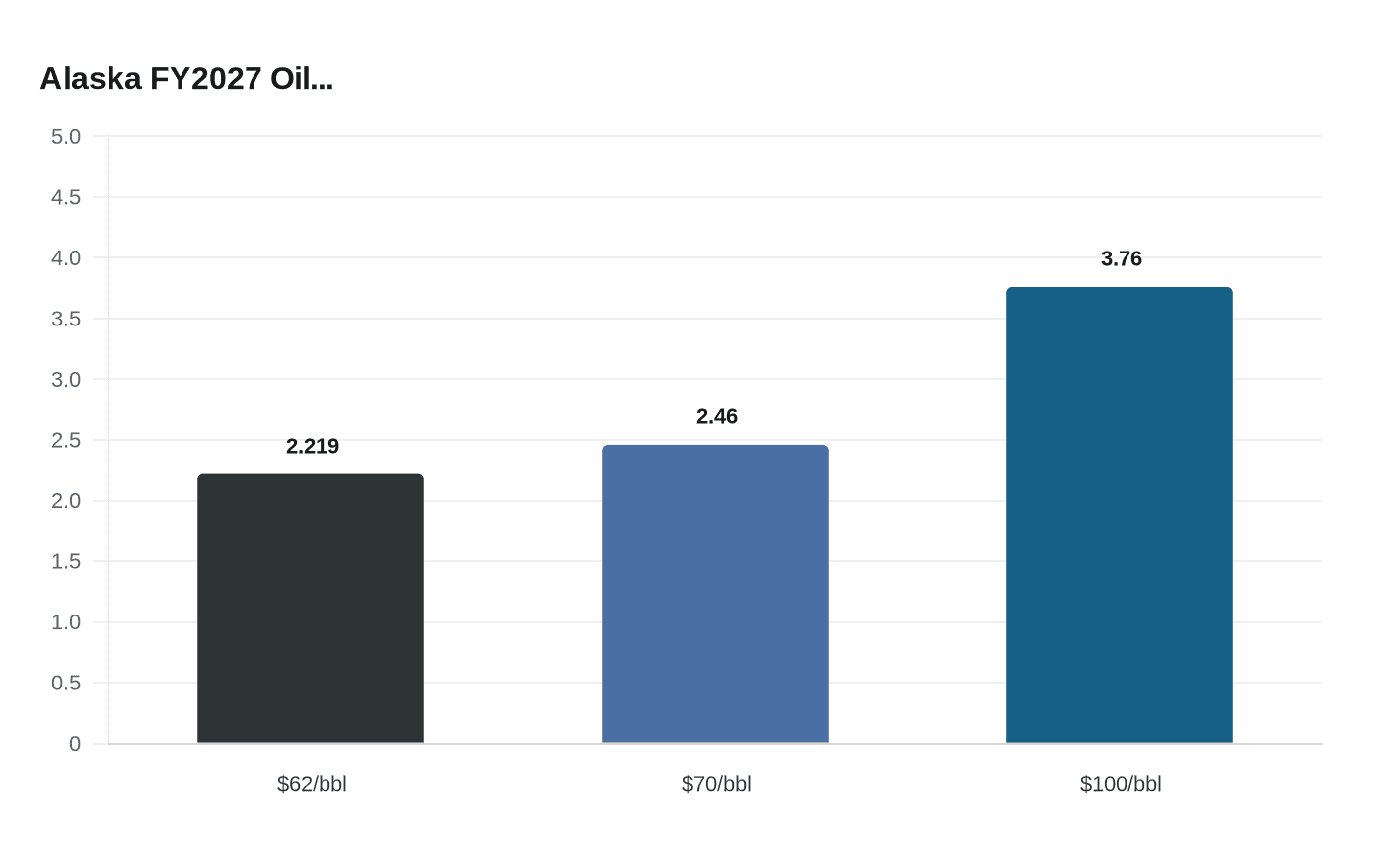
Sen. Bert Stedman, the Sitka Republican who co-chairs the Senate Finance Committee, noted that recent spot prices offered some relief. Alaska North Slope crude was trading near $71 a barrel when Stedman spoke, above the forecast assumption but still below the budget's break-even point for a full fiscal year. "If we have a $70 barrel oil going in for fiscal year '27 — from July on — that makes getting the ends to meet reasonably easy," he said. A DOR sensitivity table shows the stakes clearly: the state would receive $2.219 billion in FY2027 if oil averages $62 a barrel, $2.46 billion at $70, and $3.76 billion at $100. That $1.54 billion range between low and high scenarios roughly equals the deficit in Dunleavy's proposed budget.
Filling that gap through oil production alone is not a realistic option. The state would need North Slope prices near $100 per barrel or production exceeding 1.2 million barrels per day, an output level Alaska has not reached since the early 2000s.
Meanwhile, lawmakers are working to pass a supplemental budget of nearly $500 million to cover unbudgeted costs including disaster relief following Typhoon Halong, wildfire firefighting, transportation projects, and corrections officer overtime. Stedman acknowledged that a price spike late in the fiscal year has limited value for those immediate needs. "With the current spike — and we only have four months left in the year — we might pick up $100-$150 million or something," he said.
The full Fall 2025 Revenue Sources Book and updated forecast materials are available at the Department of Revenue's website, tax.alaska.gov.
Know something we missed? Have a correction or additional information?
Submit a Tip