Federal Register Sets 93-Whale Bowhead Quota for Alaska Eskimo Whaling Commission
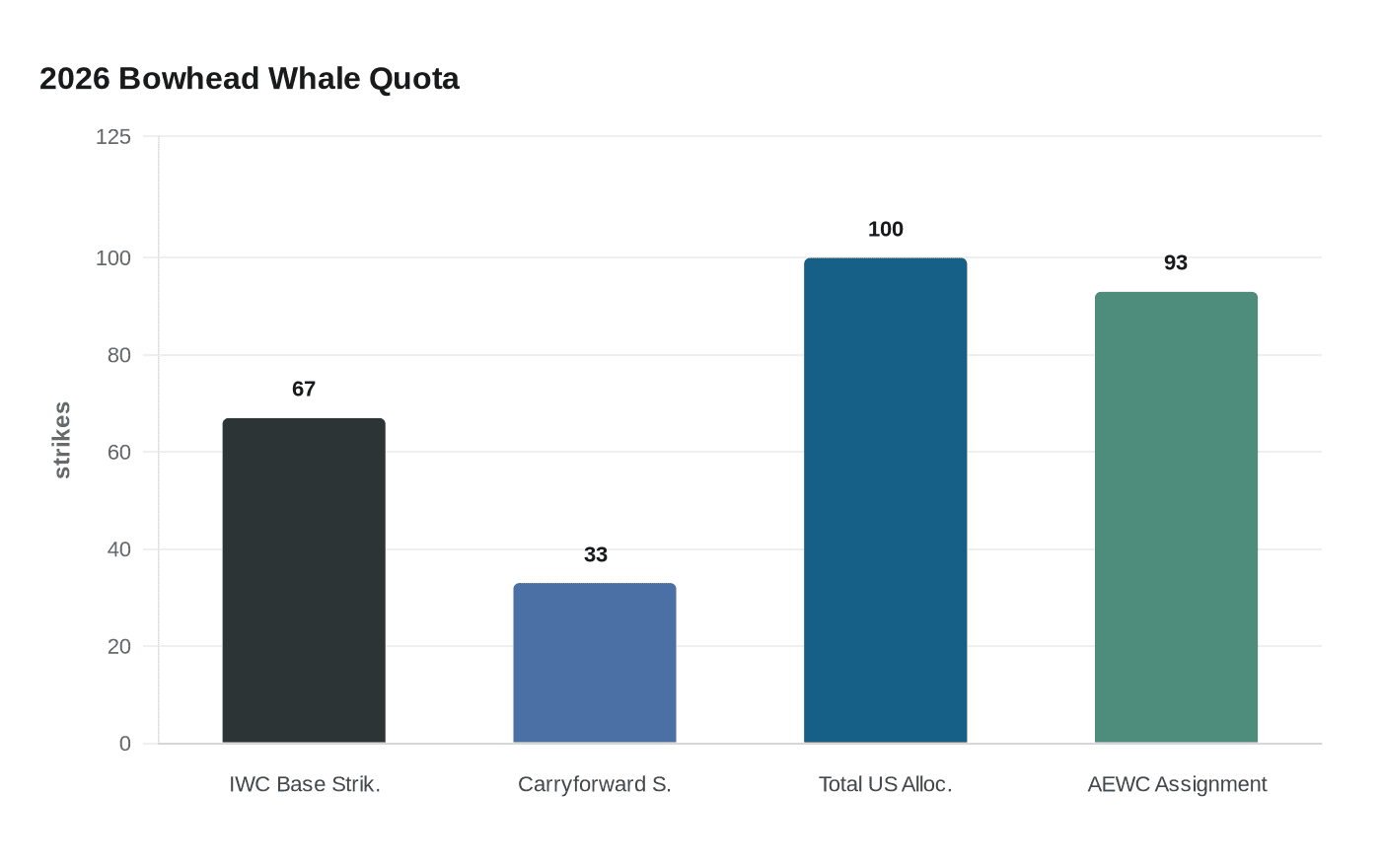
NMFS set the AEWC's 2026 bowhead quota at 93 strikes, boosted from a 67-whale base by 33 carryforward strikes banked from prior years.
The National Marine Fisheries Service published a formal notice last week setting 93 bowhead whale strikes as the 2026 quota for the Alaska Eskimo Whaling Commission, arriving just as crews across the North Slope are readying for spring hunts on the Beaufort Sea leads.
The April 2 Federal Register notice assigns the AEWC the United States' share of the bowhead harvest authorized under International Whaling Commission rules and the Whaling Convention Act. The headline number, 93, is higher than the IWC's annual base strike limit of 67 because 33 unused strikes carried forward from prior quota blocks were available for 2026, bringing the total IWC-authorized U.S. allocation to 100. NMFS assigned 93 of those strikes to the AEWC, which administers community-level allocations across 11 whaling villages on Alaska's north and northwest coasts.
The quota governs whaling captains holding AEWC licenses, and it applies to the Bering-Chukchi-Beaufort Seas stock of bowhead whales, the same population hunted by Russian Native communities whose share accounts for the remainder of the IWC's combined annual authorization. Under the carryforward rules, no more than 50 percent of the annual strike limit can be added to any single year's quota from prior blocks.
The regulatory framework behind the 2026 figure traces to the IWC's 69th meeting in 2024, where the Commission extended aboriginal subsistence whaling strike limits for a full six-year block covering 2026 through 2031. The IWC approved the extension by consensus after its Scientific Committee confirmed the harvest levels posed no harm to the bowhead stock and the United States and Russia met criteria for a status quo continuation of their hunts. That six-year certainty gives AEWC communities a stable planning horizon through the end of the decade.
The AEWC, established in the late 1970s, serves as the co-management body that translates federal quota numbers into practice across the North Slope Borough and affiliated villages. Whaling captains coordinate hunt logistics, and the commission negotiates conflict avoidance agreements when vessel traffic or offshore development could intersect migration corridors in Beaufort and Chukchi waters. As federal agencies assess industrial proposals in those same waters, the published quota serves as a concrete reference point for evaluating potential disruptions to subsistence rights.
The quota number itself does not guarantee a successful season. Crew safety, sea-ice conditions on the landfast ice and leads, weather, and whale distribution all shape whether communities land bowheads for the meat, maktak, and ceremonial provisions that carry the Iñupiat harvest tradition forward. The spring season is already underway in several North Slope communities; the Federal Register notice formalizes the legal ceiling under which every strike this year will be counted.
Sources:
Know something we missed? Have a correction or additional information?
Submit a Tip