Heavy Rains Trigger Raw Sewage Overflow Into Lake Odessa Waterway
A Michigan sewage overflow sends 13,000 gallons into a public beach waterway, mirroring the infrastructure stress fractures beneath North Slope Borough's permafrost-compromised sewer system.
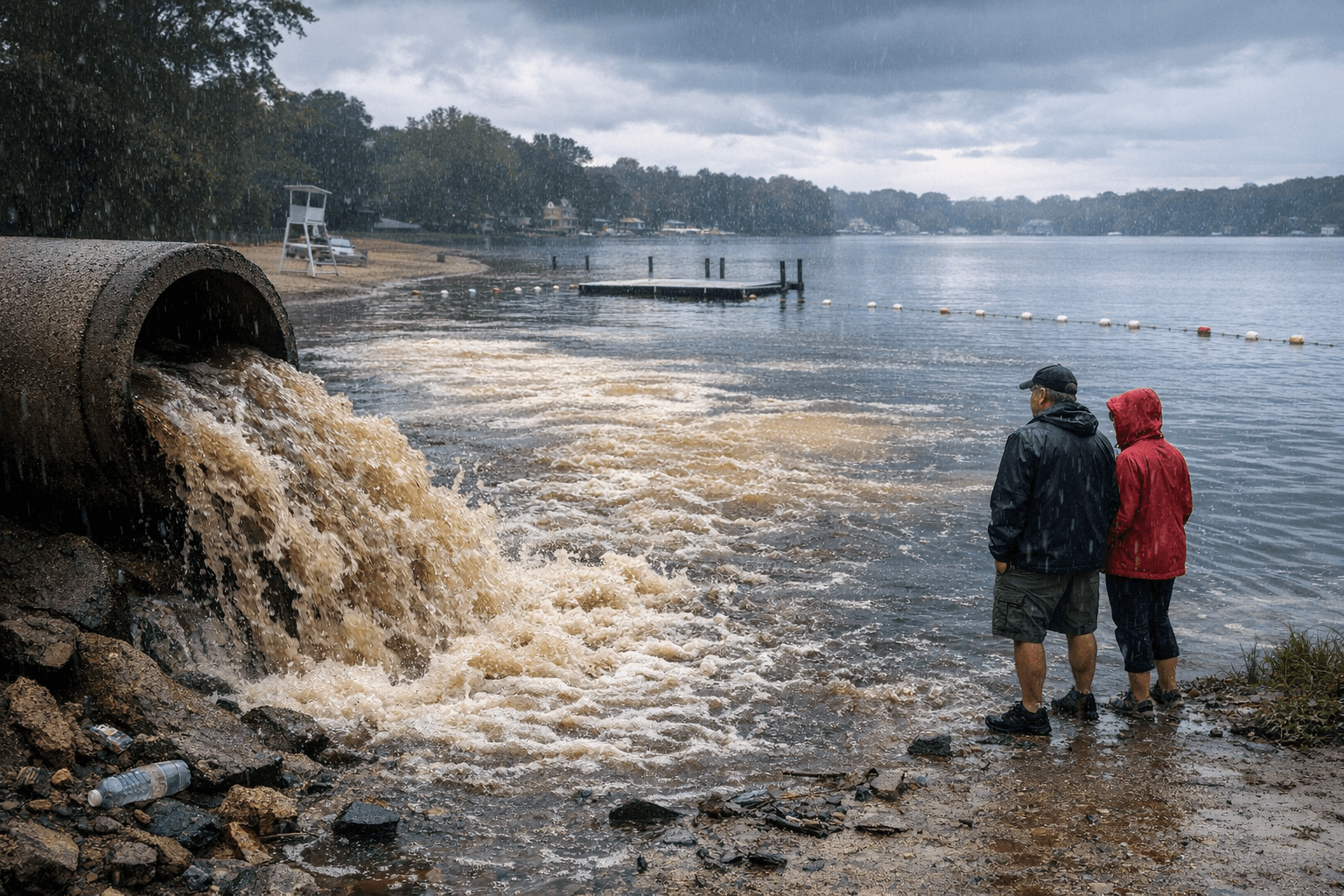
Thirteen thousand gallons of raw sewage discharged into Woodland Creek in Lake Odessa, Michigan after heavy rains overwhelmed the Lakewood Wastewater Authority's collection system, a failure that utilities operator Daniel Telman reported to state regulators. From Woodland Creek, the effluent moved downstream toward Jordan Lake, where Lake Odessa's municipal beach draws between 300 and 500 visitors on weekdays and over 500 on peak summer weekends. The mechanics of how that failure unfolded carry a direct lesson for the North Slope Borough.
The North Slope's underground water and sewer network was engineered for a frozen world. As permafrost thaws beneath Utqiagvik and the borough's other villages, pipes shift and fracture, and each new leak accelerates ground degradation around it. The compounding cycle is well-documented within the borough's own Public Works department: when Public Works Director Scott Danner announced a pilot above-ground connection project for Utqiagvik, he described the situation plainly. "The permafrost is not going to heal itself," Danner said. "It's not getting better, it's getting worse." That structural deterioration means storm water intrusion through cracked pipes during heavy rain events can rapidly overwhelm a system with no margin for surge capacity, producing exactly the kind of overflow that fouled Woodland Creek.
The Lake Odessa event is not an anomaly. An October 2018 discharge from the same Michigan authority elevated E. coli levels in a feeder creek to Jordan Lake, forcing the Ionia County Health Department to issue a no-body-contact advisory for the shoreline, lifted within two days after test results cleared. In June 2021, heavy storms across Michigan alone triggered nearly 10 billion gallons of sewage overflow statewide. On the North Slope, a heavy rain event combined with rapid spring thaw flooded the Sagavanirktok River in 2015, closing the Dalton Highway for weeks; a 2019 Sag flood threatened the Trans-Alaska Pipeline System and required costly emergency mitigation.
The price of hardening North Slope sewer infrastructure against that threat is not abstract. A pilot project to connect just 27 homes in Utqiagvik to a new above-ground water and sewer system, a design partly intended to outpace permafrost-driven pipe failure, carries a preliminary capital estimate of approximately $5 million, or roughly $185,000 per household. That figure covers a single test corridor. Retrofitting lift stations borough-wide with backup power, surge storage capacity, and above-ground pipe runs to withstand the kind of extreme precipitation events now striking Arctic communities with greater frequency would demand federal investment well beyond the borough's capital budget.
L. Eben Brower manages daily Water and Sewer operations for the North Slope Borough Department of Public Works, overseeing water and wastewater treatment and piped distribution systems across all seven villages. The borough has historically leveraged Indian Health Service sanitation construction programs, USDA Rural Development infrastructure grants, and EPA Clean Water State Revolving Fund allocations to finance major sewer upgrades. The 2021 federal Infrastructure Investment and Jobs Act added dedicated funding streams for rural water and wastewater, though competition for those dollars is intense among more than 200 Alaska communities with identified sanitation deficiencies.
In Michigan, EGLE requires utilities to report sewage discharges within four hours and holds statutory authority to mandate corrective action from systems with chronic overflow histories. Alaska's Department of Environmental Conservation holds parallel authority over borough wastewater systems. What neither state agency can supply is the infrastructure itself. That requires capital, political will, and a recognition that events playing out in Michigan waterways today are not distant cautionary tales for the North Slope Borough. They are previews.
Sources:
Know something we missed? Have a correction or additional information?
Submit a Tip