North Slope Iñupiat Leaders Urge Congress to Respect ANWR Development Support
North Slope Iñupiat leaders cite a rise in life expectancy from 34 years in 1969 to 77 today as evidence that ANWR development has transformed their communities.
A unified coalition of North Slope Iñupiat leadership, spanning elected borough officials, Alaska Native corporations, tribal governments, and regional nonprofits, is pressing Congress to pass resolutions that would nullify a 2024 federal decision blocking oil and gas leasing in the Arctic National Wildlife Refuge Coastal Plain, the ancestral homeland Kaktovik residents have occupied for thousands of years.
The push centers on two Congressional Review Act resolutions, S.J. Res. 91 and H.J. Res. 131, which would disapprove the Bureau of Land Management's 2024 Coastal Plain Oil and Gas Leasing Program Record of Decision. In a formal letter addressed to Senators Lisa Murkowski and Dan Sullivan and Representative Nicholas Begich III, the Inupiat Community of the Arctic Slope, the North Slope Borough, and Arctic Slope Regional Corporation signed on jointly, urging swift passage.
"We are encouraged by the Department of the Interior's actions to advance policies that reflect the perspectives of Kaktovik, the sole community located within the Coastal Plain," said Rex A. Rock, Sr., President and CEO of Arctic Slope Regional Corporation. "We remain committed to supporting Kaktovik's ongoing efforts to strengthen their community and build a brighter future."
North Slope Borough Mayor Josiah Patkotak credited the Trump-Vance administration directly. "We thank the Trump-Vance administration for recognizing that unleashing American energy dominance begins on the North Slope," Patkotak said. "Reinstating the 2020 Record of Decision in ANWR reflects the overwhelming support for responsible development in our region. When Uncle Doug calls, I answer. And when I call, he answers."
That relationship with Secretary of the Interior Doug Burgum, who also chairs the National Energy Dominance Council, took a concrete form when Burgum flew to Utqiaġvik and held a townhall with regional leaders. At that meeting, he heard testimony from Charles Lampe, a Kaktovik resident and President of Kaktovik Inupiat Corporation, a village corporation established under the 1971 Alaska Native Claims Settlement Act that owns approximately 92,000 acres of surface lands within the Coastal Plain. Lampe's letter to Alaska's congressional delegation closed with a direct plea: "We urge swift passage of S.J. Res. 91 and H.J. Res. 131."
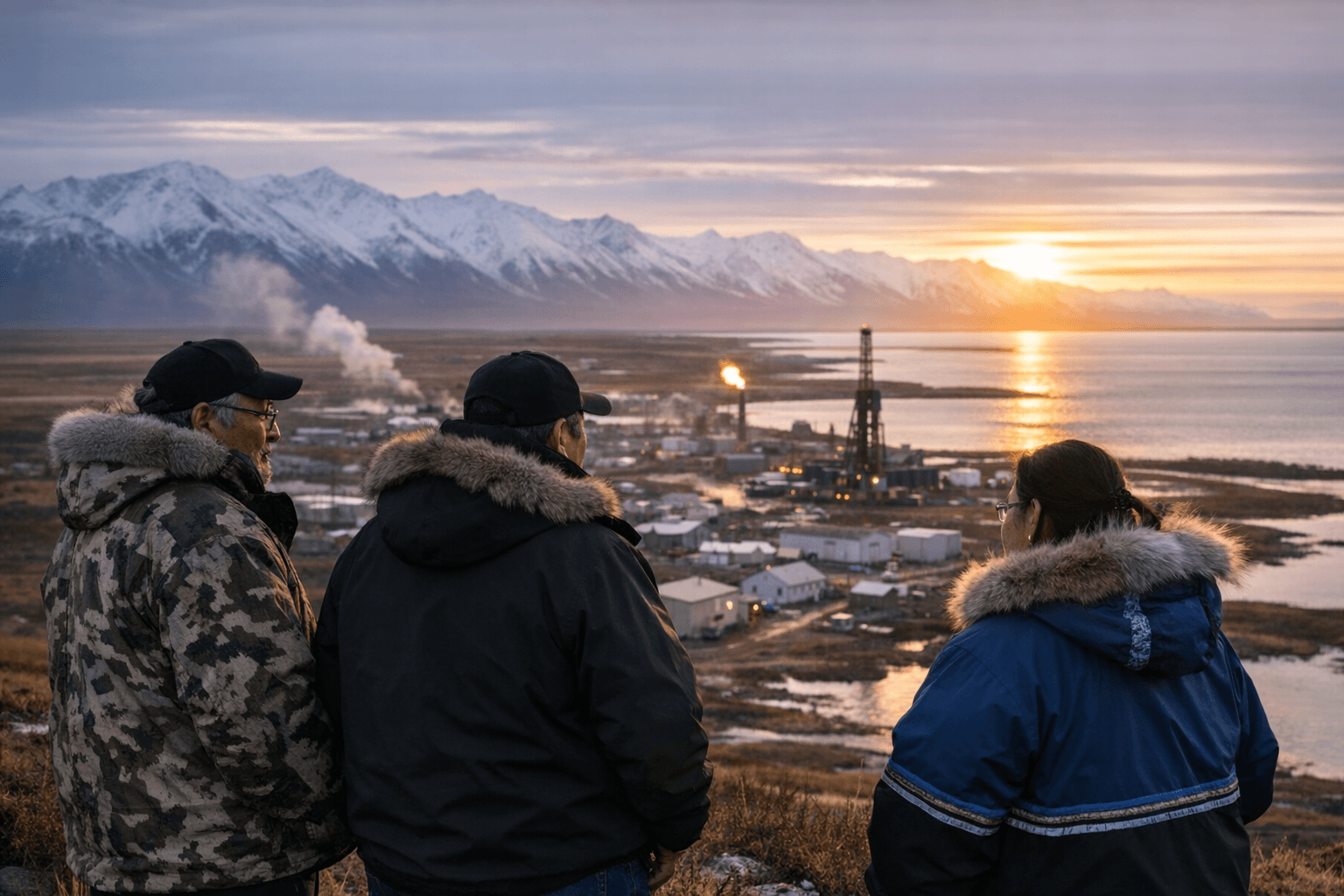
The broader effort is coordinated through Voice of the Arctic Iñupiat, a nonprofit founded in 2015 by the region's collective elected Iñupiat leadership. VOICE's board passed a resolution in 2017 supporting the opening of the 1002 Area to oil and gas exploration and development. More recently, VOICE became the first organization to file a lawsuit challenging the 2024 National Petroleum Reserve in Alaska rule, arguing it was crafted without meaningful engagement with North Slope residents and posed serious risks to Indigenous survival and services.
Doreen Leavitt, Tribal Secretary and Director of Natural Resources for the Inupiat Community of the Arctic Slope, pointed to movement in Congress as a sign the message is landing. "Congress hears the North Slope Iñupiat and is taking steps to reflect our communities' wishes in the budget reconciliation," Leavitt said. The House Committee on Natural Resources' budget reconciliation language mandates at least six lease sales within ANWR and resumes the leasing program within NPR-A.
The stakes, leaders argue, are existential and historical. The U.S. Geological Survey estimates the Coastal Plain may hold between 4.25 and 11.8 billion barrels of technically recoverable oil. The North Slope Borough, formed in 1972 specifically so Iñupiat communities could benefit from development on their ancestral lands, represents roughly 10,000 residents above the Arctic Circle. Its jurisdiction covers the entire NPR-A and the eight villages within it, and it funds public infrastructure, utilities, education, police, fire, emergency, and health services through taxes levied on oil and gas infrastructure.
Leaders point to a transformation in quality of life as the concrete argument for continued development access. Average life expectancy for North Slope Iñupiat has climbed from 34 years in 1969 to 77 years today, an increase attributed directly to the proliferation of services made possible through resource development projects. The Alaska National Interest Lands Conservation Act of 1980, which imposed restrictions on the Coastal Plain, was crafted and signed without consulting North Slope Iñupiat, a grievance that VOICE and the Kaktovikmiut have pressed through litigation, resolutions, and congressional testimony ever since.
Know something we missed? Have a correction or additional information?
Submit a Tip