Manhattan, Nye County’s living ghost town, grew from 1905 gold strike
Manhattan still survives on one bar-motel, about 125 residents, and the 1905 gold strike that built its streets. Heritage tourism helps, but the town’s future still hinges on one closure.
Manhattan is not just a scatter of mining ruins in Big Smoky Valley. It is a small, functioning place with about 125 residents, a single operating business, and a historic main street that still carries the shape of its boom years. The town’s survival now depends on the same kind of practical decisions that keep any rural settlement alive: someone staying, someone spending money, and one anchor business remaining open.
A town that still works
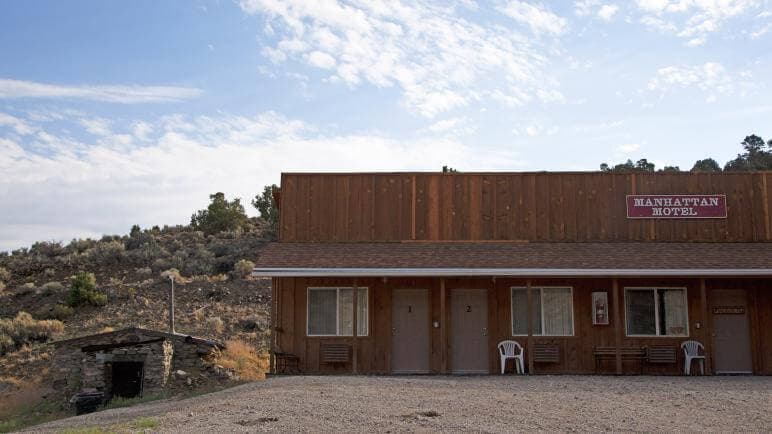
The clearest sign that Manhattan is still alive is the Manhattan Bar & Motel, which has occupied the same grounds since 1906 and remains the only functioning business in the living ghost town. That matters because it gives the town an everyday purpose beyond sightseeing: people can stop for a drink, a meal, or a night’s stay, instead of just passing through to photograph ruins. Travel Nevada notes that the motel has had a facelift in recent years, a reminder that even in a place built on abandonment, maintenance still decides whether a business keeps going.
The rest of Manhattan’s economy is thin by design and by geography. Nye County covers 18,181.9 square miles, the largest county in Nevada by land area, but its 2020 Census population was 51,591, so small places can feel isolated without being irrelevant. Manhattan’s tiny resident base gives the town a lived-in presence, but it also means one closure would be felt immediately.
How the 1905 strike reset the town
Manhattan’s modern identity began with gold, not nostalgia. Prospectors first came in the mid-1860s for silver, and the place was originally referred to as Manhattan Gulch, but the decisive turning point came in 1905 when John Humphrey found gold at the foot of April Fool Hill. The Nevada State Historic Preservation Office says the Manhattan Mining District northeast of town had already been organized in 1867, which helps explain why the camp could react so quickly when the new strike arrived.

The boom that followed was fast and visible. A post office opened in late 1905, and the camp soon had telegraph service, telephones, utilities, and businesses. Within a year, Manhattan’s population had climbed to about 4,000, a business district formed downtown, and modern services such as telephones and electric lights were installed. This was not a temporary tent camp clinging to a single shaft. It was a mining town that had enough momentum to build institutions, connect itself, and function as a regional center.
The U.S. Geological Survey describes Manhattan as becoming one of Nevada’s boom camps immediately after the gold strike. Its greatest production came in 1911, and mining declined after that. The district’s output was not limited to the main strike, either. The USGS says placer gold from deep gravel in the gulch added to the total yield, a detail that helps explain why the district mattered even after the easy excitement of the first strike faded.
What is still visible on the ground
Manhattan’s surviving streetscape still tells the story of that rise. One of the most recognizable remnants is the Nye and Ormsby County Bank ruins, where the original safe is still visible from the street. Travel Nevada says it is dangerous to go inside the ruins, which makes the bank a place to view, not explore. That caution is part of the town’s present-day reality: preservation here is as much about safe access and restraint as it is about romantic decay.
The physical remains matter because they are among the few pieces of the old town that still connect the mining boom to the present settlement. Visitors can stand in front of structures that once served a working financial district and then step a short distance to a business that has outlasted every boom-and-bust cycle since 1906. That contrast gives Manhattan a continuity rare in Nevada ghost towns, where many sites are empty enough to feel severed from any current use.
Why Manhattan still draws people
The town’s draw is not just its age. It is the combination of ruins, survival, and a functioning roadside stop in the middle of a historic mining landscape. Manhattan offers the kind of compact visit that shows how mining communities actually lived: where they banked, where they drank, where they slept, and what happened after the ore ran out. The visible safe, the bar-motel, and the handful of homes together turn Manhattan into a place where the past is not sealed behind museum glass.
Travel Nevada says the area produced more than $10 million in gold before mining ceased in 1947. That figure helps explain why the town remains culturally important even though the industrial base vanished generations ago. Manhattan’s history is not merely about loss. It is about how much material wealth a small camp once generated, and how little of the town still needs to remain for that story to keep drawing attention.
Can heritage tourism keep it alive?
Heritage tourism can help Manhattan, but only within narrow limits. A historic bank ruin, a preserved mining district, and a bar-motel with more than a century of continuity are real assets, especially in a county where long drives are part of the experience and small historic places can become regional landmarks. But tourism does not replace the need for a functioning business, and Manhattan’s own numbers show how fragile that balance is: about 125 residents, one active business, and a commercial footprint tied to a single property.
That makes Manhattan less a polished destination than a living test case for rural preservation. The town can stay visible as long as the Manhattan Bar & Motel keeps drawing people, the ruins remain accessible from the street, and the resident base does not disappear. If the bar-motel were to close, Manhattan would not instantly vanish from the map, but it would lose the one institution that still gives the place daily economic life. In a town this small, that would not be symbolic loss. It would be structural.
This article was produced by Prism’s automated news system from verified source data, official records, and press releases, then run through automated quality and moderation checks before publishing. The system is built and supervised by the people who set the standards it runs under. Read our full AI policy.
Did this article answer your question?