Mercury’s atomic-age rise shaped Nye County’s hidden desert town
Mercury was built to serve the bomb test site, and its sealed-off footprint still shapes Nye County’s land use, jobs and identity. Its Cold War past is now being preserved and rebuilt at the same time.
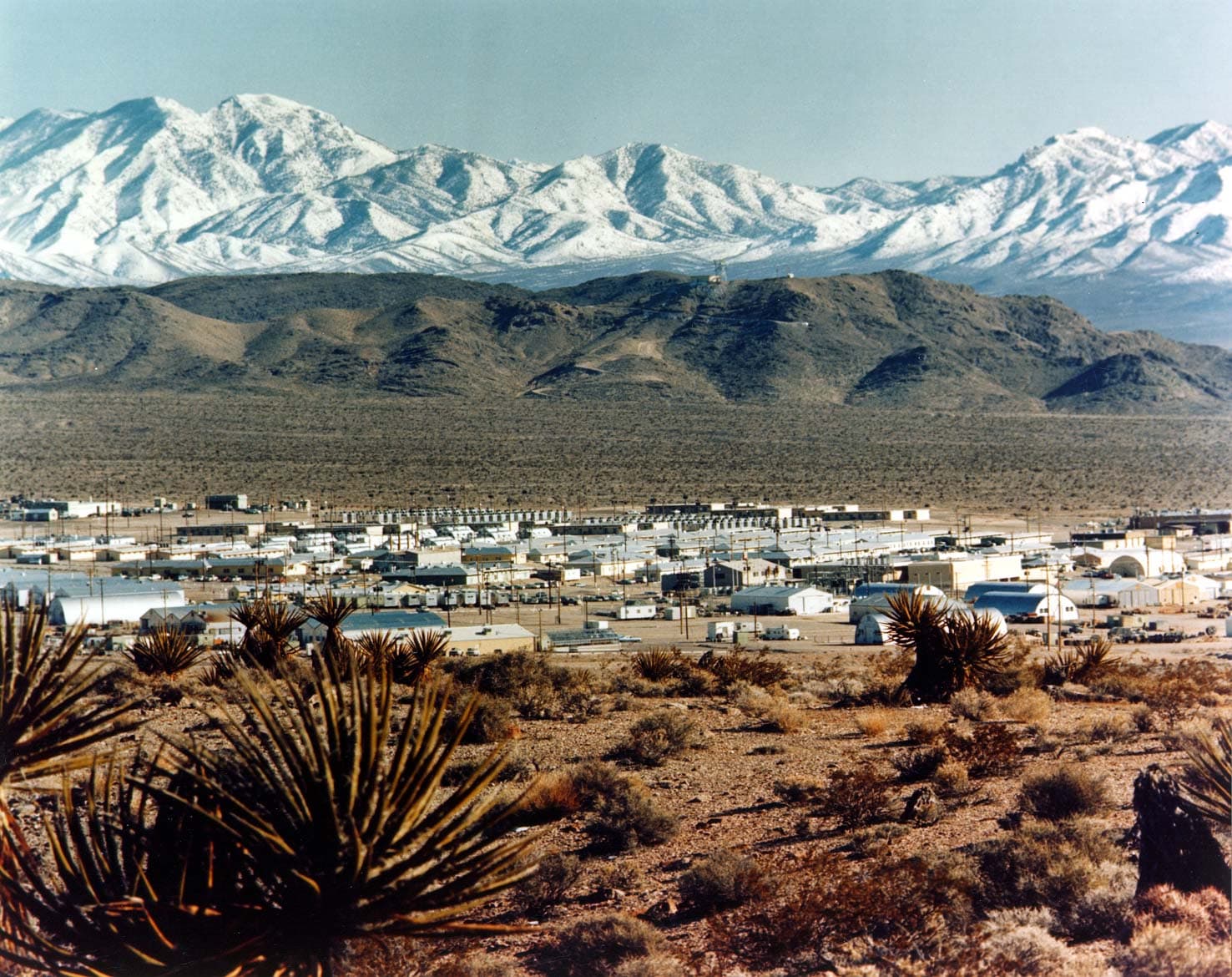
Mercury sits about 65 miles northwest of Las Vegas as the gate town to the Nevada National Security Site. The desert settlement was built to keep a national-security machine moving, with housing, mess halls, warehouses, utilities and offices placed where the public was never meant to wander.
From base camp to guarded town
Mercury began as Base Camp Mercury in 1951, after the first round of nuclear test operations made it clear the federal government needed a permanent support base for hundreds of workers on site. The town’s name is tied to a mining legend involving mercury-bearing ore in the Calico Hills and a route known as Mercury Road, which gives the place a local Nevada origin even though its purpose was federal.
The early camp was practical rather than picturesque. Temporary quarters and administrative buildings were arranged around the needs of a remote work force, and a $6.7 million construction project was approved that same year to ease overcrowding and expand the camp’s capacity. By the mid-1950s, Mercury had a U.S. Postal Service location and the official designation of Mercury, Nye County, Nevada, a sign that the government had turned a base camp into a real town, even if public access never came with it.
The Atomic Energy Commission later transformed Mercury into a bustling town with the facilities and amenities of a small U.S. town, but without open entry for ordinary visitors. Mercury was a controlled federal settlement, not a private boomtown or a county subdivision. Its streets, buildings and utilities were designed to serve a test range first and a community second.
What the test site built, and who it served
Mercury’s growth accelerated in the 1960s as the Nevada Test Site took on new missions, including the Plowshare Program and the Nuclear Rocket Development Station. Those programs helped push the site from a temporary test camp into a year-round operation, and in 1962 a supplemental AEC appropriations bill included a $15 million request for permanent construction to support more than 10,000 employees.
That expansion changed the built environment. Communications, health, medicine and safety buildings joined engineering and administrative offices, while maintenance shops, a motor pool, warehouses and two dormitories replaced much of the temporary infrastructure that had defined the early camp. The workers whose jobs depended on the site, along with the contractors and support staff who kept it running, benefited from a more stable federal foothold in the desert.
President Harry Truman authorized the Nevada Proving Grounds on Dec. 18, 1950, and the first atmospheric nuclear test at the Nevada Test Site took place on Jan. 27, 1951. The site went on to host 100 atmospheric tests through July 1962 and 828 underground tests overall, with the last underground test on Sept. 23, 1992.
What remains off-limits now
Mercury remains part of a restricted federal landscape, with many of the features of a small town but no public access.
The Desert Rock Air Strip, completed to support President John F. Kennedy’s 1963 tour of the Nuclear Rocket Development Station, remains active today. Much of Mercury’s infrastructure was designed for federal operations that outlasted the era that created them. Even now, the site’s most important roads, buildings and support systems still answer to the mission of the NNSS rather than to a conventional town government.
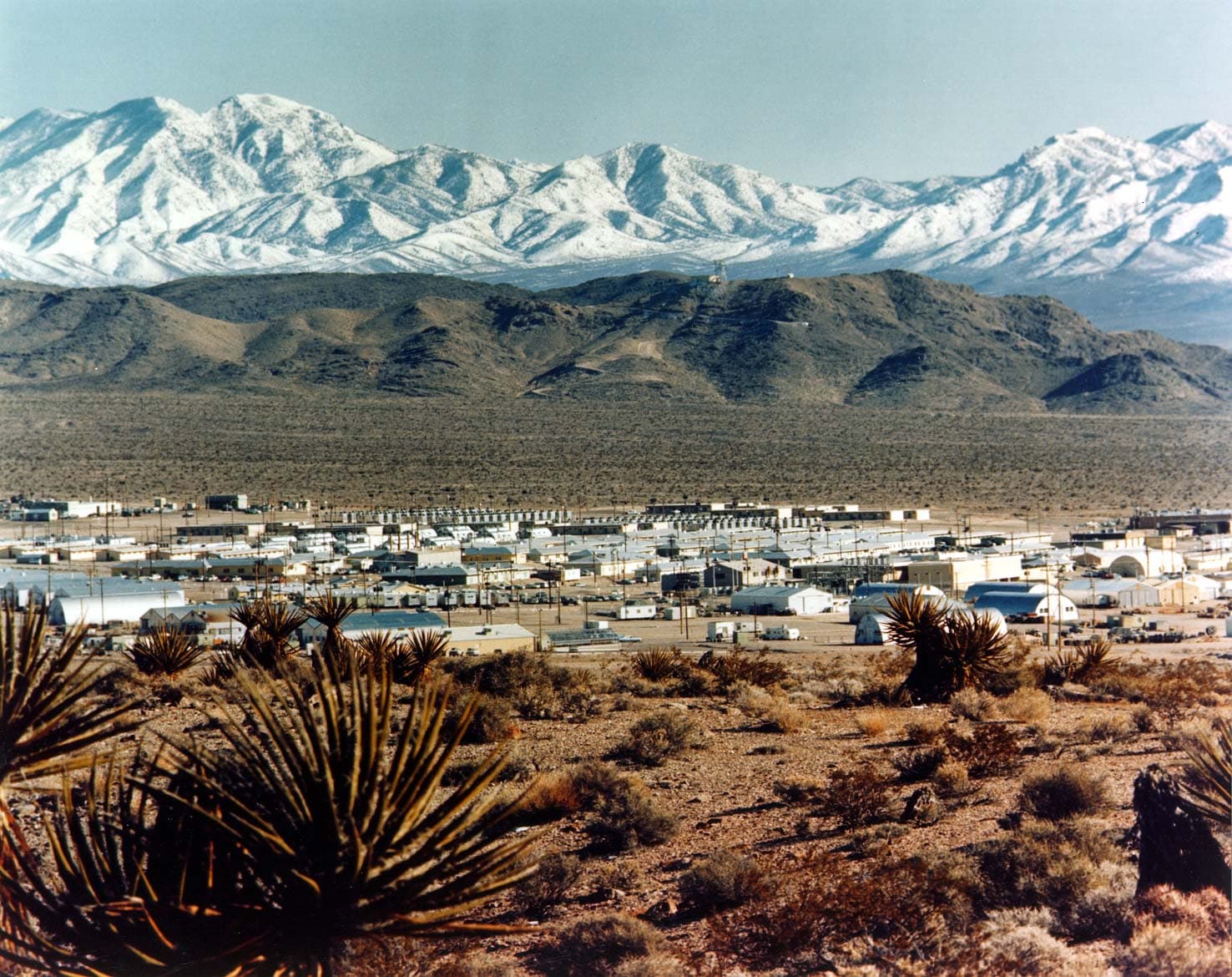
The State Historic Preservation Officer’s agreement on water and sewer upgrades identifies the Mercury Historic District as eligible for the National Register of Historic Places under Criteria A and C. The agreement identifies the district as nationally important for supporting nuclear testing and scientific research from 1951 to 1992, and it includes 153 individual landscapes, buildings and structures. Historic water and sewer systems are contributing elements.
Why Mercury still matters to Nye County now
Mercury’s residential population declined sharply in the 1970s and 1980s as testing was reduced and workers began commuting from Las Vegas. After testing was suspended in 1992, community utilities were shut down and the resident population was limited to a small remnant workforce. The town stopped functioning as a full residential center, but it remained a federal workplace.
Mercury’s existing infrastructure systems were installed in the 1950s and 1960s and have remained in continual use for more than 50 years with minimal modernization. The Mercury Modernization Plan calls for demolition of aging infrastructure, construction of ten new buildings, a walking campus, a new cafeteria and expanded solar production, with completion expected in 2030.
A 14,000-square-foot Building 1 was delivered on schedule and under budget in 2020, the first of nine new modern facilities planned to transform Mercury into a technologically enhanced campus. Mercury is one of the areas most concentrated for current expansion efforts, alongside PULSE and the Device Assembly Facility.
This article was produced by Prism’s automated news system from verified source data, official records, and press releases, then run through automated quality and moderation checks before publishing. The system is built and supervised by the people who set the standards it runs under. Read our full AI policy.
Did this article answer your question?