Nye County explains where property-tax dollars go after collection
Your property-tax bill starts with assessed value and is then split across county services, schools and districts, with rates that vary sharply from Pahrump to Tonopah.
A Nye County property-tax bill starts with assessed value, then the money is distributed across local public functions and districts, including the county, the school system and other obligations that shape day-to-day services in Pahrump, Tonopah and the rest of the county.
What ad valorem means on a Nye County bill
Nye County defines an ad valorem tax levy as a tax imposed as a percentage of assessed value, not market value. Taxable property includes land, buildings such as residences and garages, improvements such as porches, patios and fences, and other personal property located on the real estate as shown on the county tax bill. The term “ad valorem” comes from Latin and was first found in use in 1698.
Assessed value is the number that drives the bill. If a property has a house, garage or other improvement, those features are part of the taxable base the county uses to calculate what is owed, which is why the tax line on a bill can rise or fall even when a homeowner is focused on one piece of property only.
Why the split matters in Pahrump and beyond
Nye County also produced a Pahrump version of the guide. A 2005 land-use fiscal impact report for the Pahrump Regional Planning District listed the relevant jurisdictions as Nye County, the Town of Pahrump and the Nye County School District. Growth and public finance in Pahrump are tied to more than one public entity.
Property-tax questions quickly turn into questions about schools, county services and district-level responsibilities. A home, business or parcel in Pahrump may sit inside a different mix of jurisdictions than a parcel in Tonopah, Beatty, Amargosa Valley, Round Mountain or Outside South, and those differences show up in the rates residents pay and the services their dollars help support.
Local tax rates change by district
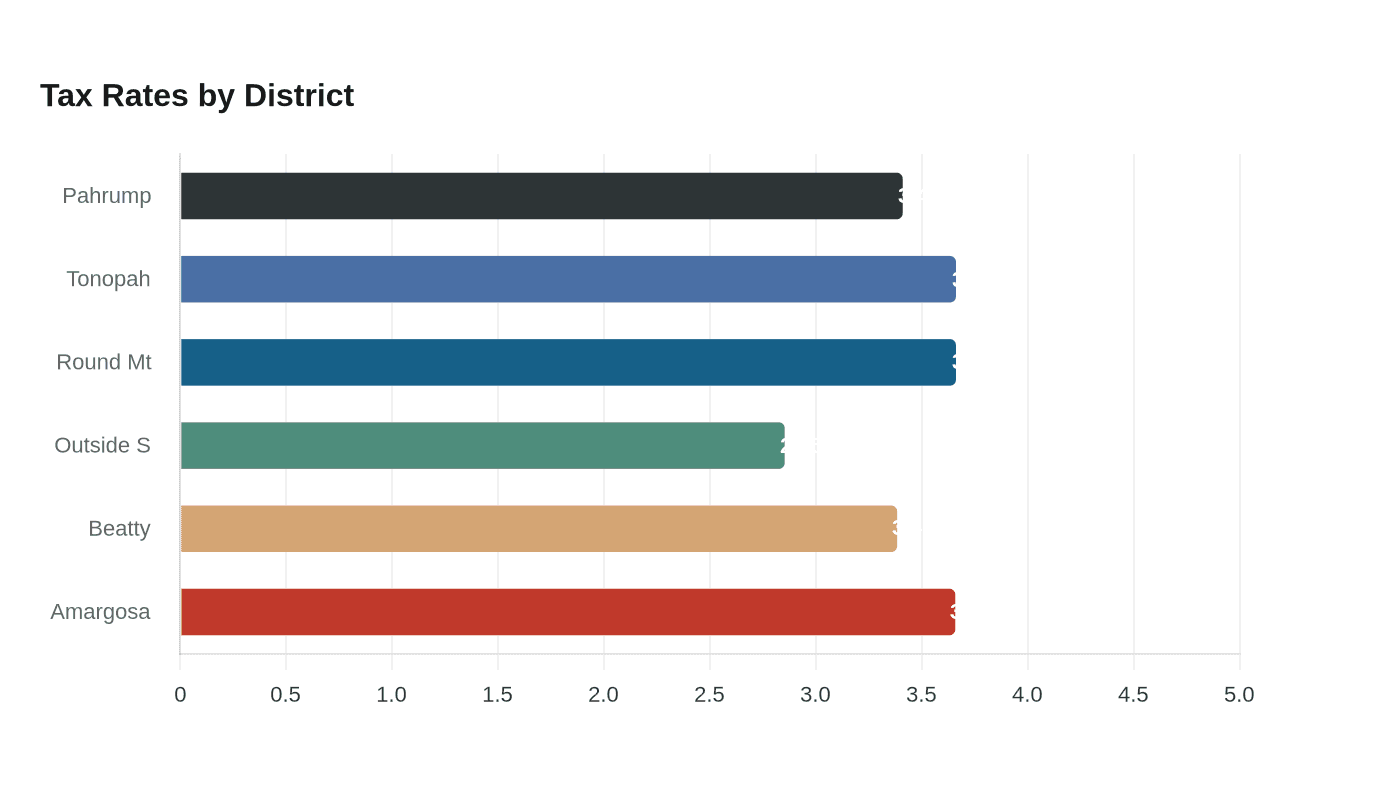
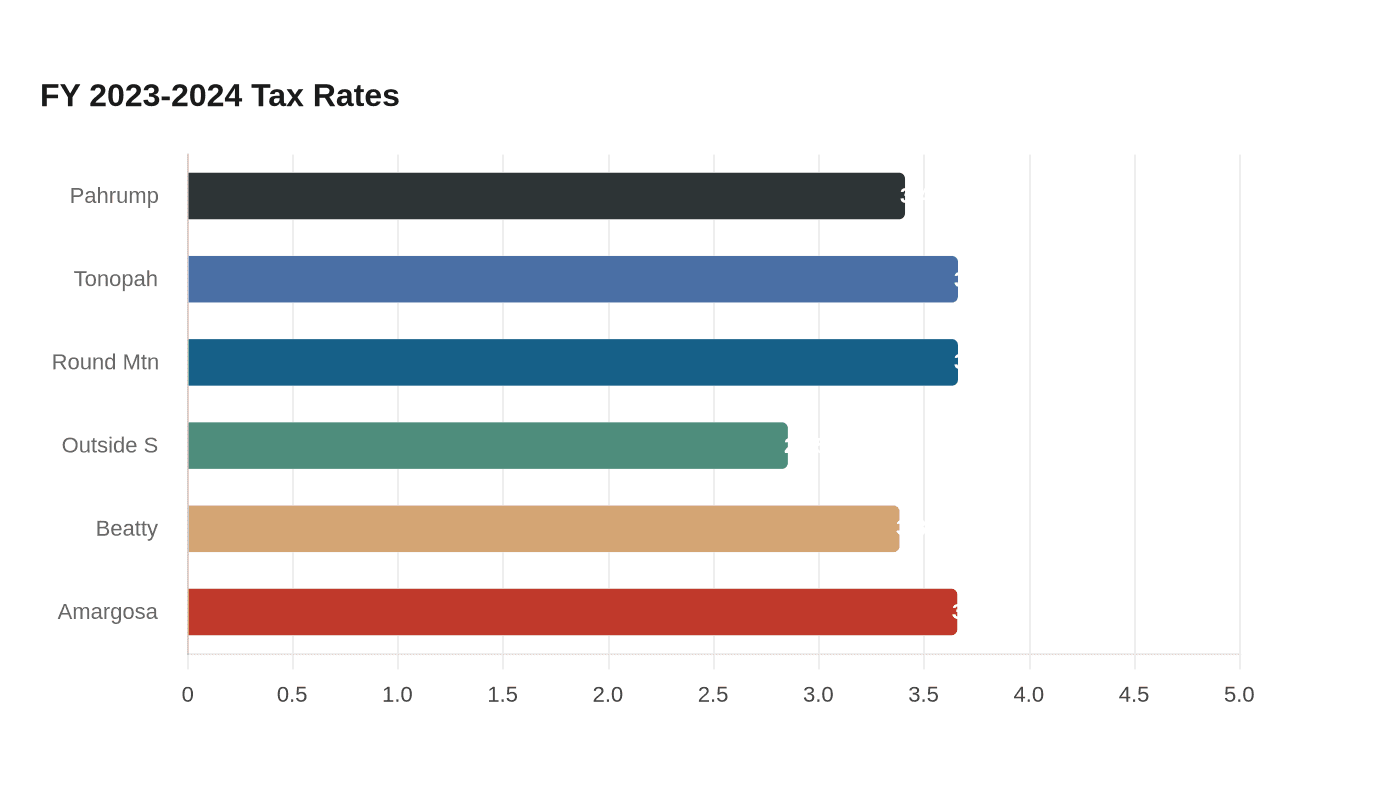
Nye County’s FY 2023-2024 property-tax-rate file listed Pahrump at 3.4085, while Tonopah and Round Mountain were both 3.6600 and Outside South was 2.8518. The same file also listed Beatty at 3.3823 and Amargosa at 3.6567. Tax rates are not flat across Nye County.
A 2024-2025 agenda item shows the Nevada Tax Commission certified the combined tax rates for that fiscal year. The final tax structure is set through a formal state-county process rather than an informal local estimate. For residents, the practical effect is simple: the amount collected on a property-tax bill is tied not only to assessed value, but also to which district a parcel falls in and which local obligations are built into that rate.
Where the money goes after collection
Property-tax revenue supports more than the county’s general operations. A 2017-2018 Nye County budget file included 11 funds, including debt service, requiring property-tax revenues totaling $18,952,934. A separate 2026 budget file shows one fund, including debt service, required property-tax revenues of $836,704. Property-tax dollars continue to be assigned to specific budget lines rather than pooled without distinction.
Debt service is part of the local tax structure that helps pay obligations already approved by public entities, and it competes with other county and district needs for the same taxpayer dollars.
How the county collects, accepts and tracks payments
Cash is accepted only at office locations. For taxpayers who do not pay in person, other payment methods are available, and credit or debit card payments carry a 2.95% fee with a minimum charge of $2.00. An archived county notice states that the property-tax payment system was back online.
A 2012 report of monies submitted to the Nye County treasurer recorded end-of-month personal property collections in Tonopah and Pahrump. The county tracks revenue by place as well as by fund. That kind of recordkeeping is what lets the treasurer, assessor and budget offices match payments to the right taxpayer and the right district.
What to do if the bill looks wrong or too high
Tax-benefit programs are available through the assessor’s office, which gives property owners a place to ask whether they qualify for relief or other adjustments. Board of Equalization hearings are held twice each assessment year and continue until taxpayer appeals are heard or otherwise resolved, giving residents a formal path to challenge an assessment they believe is incorrect.
This article was produced by Prism’s automated news system from verified source data, official records, and press releases, then run through automated quality and moderation checks before publishing. The system is built and supervised by the people who set the standards it runs under. Read our full AI policy.
Did this article answer your question?